
Selecting Speed Gate Turnstiles for European Offices: CE, Throughput and Access Control
Specify the passage first, then choose the cabinet and glass. A speed gate that looks appropriate in a reception rendering can become a bottleneck, nuisance-alarm source, or emergency-egress issue once real arrival patterns, visitor handling, lift-bank geometry, and access-control logic are applied. For European office entrances, the selection should begin with a written operational brief covering peak arrivals, credential types, wheelchair and delivery access, expected security posture, and the route people take after passing through the lane.
CE marking belongs in that brief, but it should not be treated as a single performance badge. It indicates that the product has been assessed against applicable European requirements and that the responsible economic operator has issued the required conformity documentation. The installed system still needs to suit the project: electrical supply, emergency release arrangement, accessible passage, building fire strategy, door interfaces, and local construction requirements are separate design questions. Request the declaration of conformity, installation instructions, technical file references where appropriate, and clear identification of the supplied configuration. A declaration for a basic cabinet does not automatically prove that every added reader, visitor intercom, sensor option, or custom barrier height has been evaluated in the same arrangement.
Start with the flow pattern, not a nominal lane rate
Published throughput is useful only when its test conditions resemble the entrance. A lane may process a high number of credentialed people when every person presents a valid card promptly, walks at a steady pace, and uses a single direction. Morning arrivals in a multi-tenant office behave differently. People pause to find mobile credentials, walk in pairs, carry coffee, push luggage, or turn toward reception after a failed read. Visitors may need a remote unlock, while staff move in the opposite direction for short intervals.
Measure or estimate the busiest sustained arrival window, rather than dividing the building population by an hour. The practical requirement is the number of people expected at the gate bank during the concentrated access period, with an allowance for imperfect presentation and recovery from denied transactions. Then assess the entire route. A gate bank cannot deliver its rated flow if queues are constrained by a revolving door, a narrow lobby, a turn at the lift lobby, or a reception desk positioned beside the exit path.
Lane width changes both capacity and control quality. A standard lane can encourage a predictable walking line and provide tighter sensor coverage. A wider accessible lane accommodates wheelchairs, mobility aids, large bags, and occasional equipment, but the wider opening creates more space for a second person to enter. Treating one wide lane as the normal high-volume lane often produces false alarms or forces overly permissive detection settings. A more resilient arrangement usually separates routine staff traffic from accessible, visitor, and managed exception traffic.
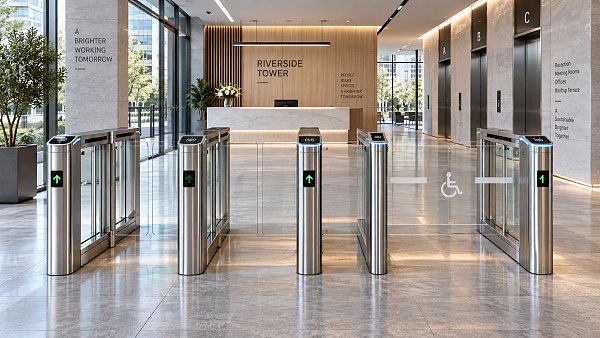
Bidirectional operation also needs careful interpretation. Two directions can be enabled electronically, yet the bank has a physical width and shared approach area. During a morning inbound peak, a person walking out through an adjacent lane may interrupt the cadence of inbound traffic and complicate tailgating logic. A system that can switch lane direction according to time schedules or live occupancy can be useful, provided that the direction indication is unambiguous and the access platform receives the current lane state.
CE documentation and installed-system responsibility
Ask for documents early enough to resolve deviations before equipment is released for production. The review should identify the exact model, barrier type, controller, power supply, reader mounting method, sensor configuration, and any integrated display or intercom. Product literature is not a substitute for a declaration tied to the supplied equipment. Where several parties contribute components, establish who owns the final integration boundary and who confirms that wiring, earthing, protective devices, and interfaces follow the documented installation conditions.
Electrical safety is only one part of the review. Moving barriers create pinch, impact, and entrapment considerations, especially where low glass wings close quickly or a cabinet has protruding reader pedestals. Sensor fields, motor force limits, obstacle response, and reversal behavior should be examined as a combined system. A gate that detects an obstruction reliably at the center of the lane may behave differently near the closing edge, close to the cabinet, or when a child-sized profile is partly obscured by an adult. Demonstrations should include these boundary areas rather than only a single person walking cleanly through the middle.
Emergency operation requires an agreed cause-and-effect sequence. The relevant question is not simply whether barriers “open on fire alarm.” Clarify what signal is received, whether it is normally energized or de-energized, how a cable fault is treated, what happens on loss of mains power, whether backup power is provided, and whether the resulting clear width supports the building’s escape strategy. In some layouts, barriers retract or swing free; in others, a controlled release is required. The gate supplier, electrical contractor, fire-system integrator, and building designer need one shared description of the final behavior. Late changes here frequently affect floor channels, cable routes, gate spacing, and reception furniture.
Anti-tailgating performance needs scenario-based testing
Infrared arrays and passage algorithms can distinguish a valid single passage from close following, reverse movement, crawl-under attempts, or movement against the authorized direction. Their effectiveness is shaped by lane geometry, barrier height, glass profile, walking speed, clothing, carried items, and the security policy assigned to an alarm. A claim of “anti-tailgating” without a defined test sequence has limited value.
Set the expected response for each event. A close follower after a valid credential may trigger an audible local indication, send an alarm to security software, preserve video evidence, or lock the lane after the person has cleared it. These are materially different outcomes. Immediate barrier closure can create a safety concern if the detection zone is poorly configured; a purely retrospective alarm may be unsuitable where the gate protects a restricted floor. The desired response should reflect what staff can actually investigate and how quickly they can act.
False alarms are not merely an inconvenience. If they occur during ordinary close-following at peak times, staff may lower sensitivity, mute alarms, or stop reviewing events. Conversely, aggressive settings that repeatedly interrupt legitimate movement can reduce throughput and encourage people to bypass the intended route. Acceptance testing should therefore include realistic groups, backpacks, umbrellas, rolling luggage, mobile-phone credentials, and people entering at varied distances. The aim is a defensible balance between detection and usable flow, documented for the chosen location rather than inferred from a showroom demonstration.
Access control integration is an operational contract
Decide which system owns the authorization decision. In most office deployments, the access-control platform evaluates the credential and sends an unlock command to the gate controller. The gate controller then manages barrier movement, sensor safety, passage counting, and alarm states. That division should be visible in the interface specification. Define the signals and messages for authorized entry, denied access, lane available, lane fault, tailgating alarm, forced passage, barrier open, emergency release, and communication loss.
Reader selection affects both user experience and the physical build. Card readers may be mounted in cabinet tops, separate pedestals, or glazed side posts. Mobile credentials require a clear presentation zone and enough time for phone wake-up behavior without keeping the barrier open unnecessarily. Biometric verification can increase transaction time and needs a deliberate placement decision: a reader positioned too close to the barrier causes people to stop within the safety area, while one positioned too far away allows a gap in which following behavior becomes harder to interpret.
Ensure that reader mounting, cable paths, controller cabinets, and network connections are resolved before the floor finish is complete. Stainless steel cabinets commonly conceal service compartments, but concealed does not mean easily accessible. A controller that requires removal of a glass wing, dismantling of adjacent cabinets, or access through a reception counter turns a small fault into disruptive work. Confirm front, rear, or side service clearance, the route for replacing a motor or power module, and how staff can isolate one lane without shutting down the entire bank.
Integration testing should use the production access rules, not only a dry contact release. Verify valid, invalid, expired, anti-passback, and visitor credentials; confirm that alarms are time-stamped consistently; and test behavior when the network connection is interrupted. Some architectures continue local operation from cached permissions, while others depend on a central decision. Neither approach is automatically correct, but the chosen failure mode must match the site’s security and business-continuity requirements.
Physical layout changes the gate’s real performance
Cabinet finish and glass height are visible choices, yet floor condition and approach geometry often determine long-term reliability. Survey the slab for level, strength, joints, underfloor heating, and existing services before fixing positions are approved. Speed gates need stable anchoring and accurate alignment between cabinets. An uneven substrate can affect glass clearance, sensor alignment, and barrier travel. Decorative floor finishes may also conceal joints that later allow small movement under repeated use.
Leave enough approach distance for credentials to be presented before a person reaches the barrier. A queue that forms directly against the gates increases close-following and forces abrupt stopping. Equally, provide a clear exit zone so a released person does not stop immediately to consult a phone or choose a direction. Reception desks, security posts, display screens, and parcel collection points should sit outside the sensor and pedestrian recovery area.
Materials should be evaluated for the actual lobby environment. Brushed stainless steel hides minor handling marks better than highly reflective finishes, while glass edges and top rails need protection during transport, fit-out work, and final cleaning. Specify the handover condition, spare components, cleaning restrictions, and responsibility for repairing damage caused after installation. Temporary protective film left in place too long can create its own finish problems, particularly in warm, sunlit entrances.
Commissioning should prove behavior under normal pressure
A completed installation is ready for handover only after mechanical alignment, safety devices, emergency release, credential operation, alarm reporting, and recovery procedures have been tested together. Test each lane independently and then test the bank under realistic directional changes. Record configuration settings, controller firmware, network addressing, access-control mappings, emergency interfaces, and the final sensor calibration. These records matter when a later software update, reader replacement, or lobby alteration changes the system’s behavior.
Maintenance planning should focus on components that influence passage quality: barrier pivots, drive assemblies, sensor windows, glass alignment, cabinet fixings, power supplies, and communication connections. Repeated nuisance alarms often point to a physical or environmental condition rather than a software defect. Loose cabinets, scratched sensor covers, shifted glass, bright reflections, nearby signage, or a changed pedestrian path can all alter detection performance. Reviewing the event pattern alongside a site inspection is more productive than repeatedly changing sensitivity values.
The strongest specification ties compliance evidence, lane geometry, access-control logic, emergency behavior, and acceptance tests to one defined entrance scenario. That creates a gate installation whose stated throughput and security functions remain meaningful after the office is occupied.
Have questions about this sector analysis, or seeking best practices specific to your niche? Drop us a line below and let the senior consultants at MHLS assist you.
We respect your privacy. Your information is strictly confidential.
Recommended News
 Physical Security System Engineering: From Risk Assessment to System DesignUnmanned Terminal FellowExplore physical security system engineering, from risk assessment to integrated design, procurement and testing. Build a safer, more resilient facility.
 Apple Home Collection Smart Lock and Other Accessories Open for Preorder November 13Biometric Auth ScientistApple Home Collection preorders open November 13, 2026. Explore the LG smart lock’s Matter and Aliro support and what buyers should verify before ordering.
 Choosing Servo-Driven Flap Barriers: Throughput, Safety and Access ControlAccess Control StrategistServo-driven flap barriers can balance throughput, safety and access control. Discover how to compare lanes, test performance and choose with confidence.
 Parcel Locker Network Pricing: Setup Costs, Fees and Contract TermsUnmanned Terminal FellowCompare parcel locker networks pricing, from setup costs and recurring fees to contract terms. Discover hidden charges and choose the right model.
 JR East Plans UWB Walk-Through Gates at 40 Stations in Spring 2028Access Control StrategistJR East plans UWB walk-through gates at 40 stations in spring 2028. Explore the rollout timeline and what suppliers should watch.
 Bank Vault Security Standards: UL and EN Ratings ExplainedVault Structural ArchitectExplore bank vault security standards and learn how UL 608 classes and EN 1143-1 grades differ, what they test, and how to verify certification before you buy.
 Mechanical Lock Hardware Prices: What Buyers Should Budget for Bulk OrdersMr. Gideon CrossMechanical lock hardware price is just the starting point. Discover what drives bulk-order costs and how to compare supplier quotes with confidence.
 IndexBox Forecasts Steady Global Security Keypad Market Growth Through 2035Dr. Valerius ThorneGlobal security keypad market growth is forecast at 3.3% annually through 2035. Explore the smart home and replacement trends shaping demand.
 Choosing an Infrared Safety Sensors Manufacturer: What Buyers Should CheckUnmanned Terminal FellowChoosing an infrared safety sensors manufacturer? Compare safety evidence, integration, environmental performance and lifecycle costs before you buy.
 Choosing a Security Material Testing Service: What to Check for Lock and Safe MaterialsProf. Elara SterlingChoose a security material testing service with confidence. Learn what to check for lock and safe materials, from attack methods and accreditation to reliable reports.
 How Precision Anti-Pick Lock Cylinders Resist ManipulationSecurity Metallurgy ExpertDiscover how precision anti-pick lock technology resists manipulation, and learn what to check when comparing security features, test evidence, and everyday reliability.
 Dermalog Joins NIST FastCAP Program for Contactless Fingerprint TestingProf. Elara SterlingDermalog joins the NIST FastCAP program for contactless fingerprint testing. Discover what this means for biometric identification and digital identity.











