
Specifying Servo-Driven Swing Gates for High-Traffic Building Entrances
High-traffic entrances expose weak specifications quickly. A gate that looks refined in a showroom can become a source of queues, nuisance alarms, unsafe interactions, and maintenance calls once it is placed between a busy lobby and a bank of elevators. When specifying servo-driven swing gates, opening speed matters, but it is only one part of a working entrance system.
The better starting point is to define the operating condition: who uses the entrance, how arrivals cluster during peak periods, what level of access control is required, and what must happen when a person, credential, sensor, or network connection does not behave as expected. The selected gate should support people flow without creating an uncontrolled route into the building.
Start with the flow pattern, not the nominal gate speed
A published opening or closing time does not tell the full story of throughput. Each passage cycle includes credential presentation, access decision, wing movement, the person moving through the lane, tailgating detection, and recovery if the passage is interrupted. In a real entrance, people also carry bags, pull luggage, walk in groups, hesitate at readers, or reverse direction after a failed credential.
Map the entrance before selecting lane widths or gate quantities. Separate regular badge holders from visitors, delivery personnel, people using mobility aids, and staff who may enter during shift changes. The busiest period is usually more important than the daily average. A lobby that is calm for most of the day may still require a robust configuration if arrivals compress into a short period before work begins.
Consider whether people arrive in a steady stream or in bursts. A steady stream can often be handled with several standard lanes. Burst traffic may need additional lanes, a clearer approach zone, and an access-control workflow that avoids users stopping in front of the barrier. Where visitors must be checked in, the visitor process should be placed before the gates rather than allowed to spill back into the access lanes.
Do not use a wide accessible lane as an informal overflow lane unless the design and operational rules support that use. A wider opening is useful for wheelchairs, large bags, carts, and assisted access, but it can also create a greater security exposure if it is routinely left open or used without suitable monitoring.
What servo control changes in a swing-gate entrance
Servo-driven swing gates use controlled motor operation to move the barrier wings with more precise acceleration, deceleration, and position control than a basic on-off drive arrangement. This can improve the feel of passage and help the wings respond consistently during frequent cycles. It can also support controlled closing behavior after an authorized person has cleared the lane.
That does not mean every site needs the fastest possible movement. A gate tuned aggressively may improve passage time for confident users, yet create discomfort or false safety activations when users hesitate, walk closely together, or approach from an awkward angle. In a mixed-use lobby, smooth motion and predictable behavior usually matter more than the most impressive cycle time.
Ask suppliers to describe the gate behavior across the full passage sequence, not simply its maximum opening speed. Useful questions include:
- How does the wing accelerate and slow as a person enters and exits the lane?
- What happens if someone stops inside the passage area?
- How does the equipment react to a person turning back, pushing a stroller, or carrying a wide object?
- Can movement profiles be adjusted for different traffic periods without compromising safety logic?
- How does the gate recover after a safety sensor is blocked or an unauthorized entry attempt is detected?
The answers reveal whether the product is designed for a demanding entrance or merely configured to appear quick during a short demonstration.
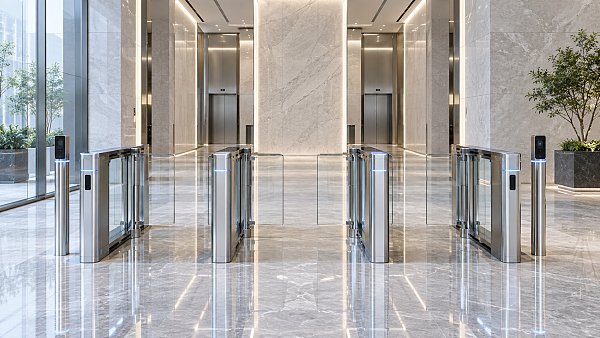
Security performance depends on the lane, sensors, and operating logic
A swing gate is not a standalone security decision. Its effectiveness comes from the interaction of physical barrier geometry, infrared sensing, credential validation, lane layout, staff response, and the surrounding architecture. A tall, heavy-looking barrier does not automatically deliver stronger control if users can pass around the installation, follow closely behind another person, or exploit an adjacent wide lane.
For high-traffic building entrances, anti-tailgating logic deserves close attention. The system should distinguish between a valid single passage, two people attempting to use one authorization, and normal movement that briefly appears irregular. Overly sensitive settings can create repeated alarms and interruptions; settings that are too forgiving can leave a practical security gap. The most suitable balance depends on the threat profile and the type of occupants using the building.
Sensor coverage should be reviewed as a three-dimensional passage zone rather than as a list of sensor counts. The important question is whether the detection field properly covers the approach, the space between the wings, and the exit area under the expected lighting and traffic conditions. Glass surfaces, strong daylight, reflective floors, loose clothing, bags, and closely spaced users can all affect how an entrance behaves in practice.
Where a higher level of entry assurance is needed, access-control gates may be combined with staffed reception, video monitoring, visitor management, or separate routes for deliveries. It is usually more effective to design those layers together than to expect a single barrier line to solve every security problem.
Choose the access-control architecture before approving the gate interface
The gate controller must work reliably with the chosen access-control platform, readers, visitor system, fire interface, and building operations processes. Integration should be treated as an operational requirement, not as a final-stage wiring task.
Clarify which system makes each decision. The access-control platform normally decides whether a credential is valid; the gate controller manages wing movement and passage monitoring. Events such as unauthorized entry, forced movement, tailgating attempts, blocked lanes, and equipment faults should be visible to the people responsible for responding to them. A gate that functions physically but provides vague or unusable event reporting can make incident investigation unnecessarily difficult.
Reader placement also affects throughput. Readers positioned too close to the barrier can cause people to stop abruptly. Readers placed too far away may encourage users to move before the access decision is complete. The best position depends on the chosen reader technology, the desired user behavior, the approach space, and the opening response of the gate.
For biometric credentials, test the complete sequence rather than evaluating reader accuracy in isolation. A reliable identity check is of limited value if the person must stand awkwardly, retry frequently, or is unclear about which lane has opened. The entrance should give obvious feedback through the reader, indicator lights, wing movement, and lane signage without relying on excessive instructions.
Safety and emergency behavior need design-level decisions
Gate safety is more than a soft wing edge or obstacle detection feature. The specification should address how people are protected during normal movement, how the wings behave when a sensor detects an obstruction, and how the entrance operates during an emergency or loss of power.
Emergency egress requirements vary by building design and local authority expectations, so the barrier arrangement must be coordinated with the fire, life-safety, and door package early in the project. The essential operational question is straightforward: can occupants leave quickly and intuitively when the normal access-control process is no longer in use?
Define the required state for fire alarm activation, power interruption, controller fault, and manual emergency release. “Fail-safe” is often used too broadly. It must be translated into a clear site-specific behavior: whether wings open, unlock, remain in a defined position, or are released for free passage. This decision also affects security after a minor technical fault, so facilities and security teams need a shared view of the acceptable trade-off.
Accessible circulation should be considered at the same time. A compliant-looking clear width on a drawing is not enough if nearby pedestal positions, queue barriers, turns, or door leaves make the route difficult to use. Test the route as a complete journey from approach to exit.
Match barrier form to the building and its risk profile
Glass wings are often selected because they maintain visual openness, while opaque or more substantial barrier forms may better suit locations where a clearer physical boundary is needed. Neither choice is universally better. Visibility can improve wayfinding and reception oversight; a more defined barrier can discourage casual intrusion. The surrounding layout, security posture, and expected behavior of occupants should determine the choice.
Evaluate durability through serviceability, not promises
High-frequency entrances create wear in places that are easy to overlook during procurement: hinge assemblies, drive components, sensor windows, wing fixings, reader pedestals, cable paths, and floor anchors. The service model matters as much as the gate mechanism. A technically capable unit becomes expensive when access to components requires extensive dismantling, specialist attendance is slow, or common replacement parts are difficult to obtain.
Request a maintenance view of the product. Maintenance personnel should be able to identify faults, isolate a lane where appropriate, restore normal operation, clean sensors, and replace routine components without disrupting the entire entrance line. Ask how diagnostic information is presented, which components are expected to be maintained on site, and whether the design permits one lane to remain available while another is serviced.
Environmental conditions also affect durability. An internal lobby near an exterior door can still experience dust, moisture, sudden temperature changes, direct sunlight, and debris brought in on footwear. These conditions influence sensor reliability, finishes, floor interfaces, and electronics. A gate selected for a controlled interior environment may not be appropriate for a semi-exposed entrance vestibule.
Use mock-ups and acceptance tests to reduce commissioning risk
Before final procurement, review the proposed configuration with architectural, security, IT, access-control, fire, electrical, and facilities stakeholders. The goal is to expose conflicts while changes are still inexpensive: inadequate floor structure, restricted cable routes, poorly placed readers, sightline issues, insufficient queue space, or an emergency release approach that does not fit the building procedure.
Where the entrance is operationally important, a mock-up, demonstration lane, or structured factory review can be valuable. It should test realistic behavior rather than ideal single-person passages. Include credential failures, close-following users, visitors receiving assistance, bags, reverse movement, interrupted passage, power-state behavior, and interface alarms.
Acceptance criteria should describe outcomes that matter to the site. Examples include correct authorized passage, intelligible alarm behavior, safe response to obstructions, event visibility in the access-control environment, appropriate egress operation, and practical recovery after a fault. Avoid accepting the installation solely because the wings open and close.
A practical procurement sequence
- Define peak arrival patterns, user groups, entry routes, exit routes, and bypass paths.
- Set the required security behavior for invalid credentials, tailgating, forced entry, and unattended alarms.
- Coordinate the lane arrangement with reception, visitor management, accessibility, emergency egress, and architectural circulation.
- Confirm access-control, reader, network, fire, and power interfaces before the equipment order is finalized.
- Compare suppliers on passage behavior, sensor coverage, diagnostics, maintainability, installation requirements, and support capability, not appearance alone.
- Write testable commissioning and handover requirements into the procurement documents.
Research resources such as Global Smart Hardware & Physical Security Systems can help compare gate technologies alongside access control, biometric readers, infrared anti-tailgating systems, and wider smart-building security infrastructure. The useful comparison is not which component has the longest feature list, but whether the complete entrance design can manage the expected people flow with understandable security controls and manageable operational effort.
The strongest specification describes the entrance as a working system. When lane capacity, user behavior, sensor logic, egress, integration, and service access are resolved together, servo-driven swing gates can provide a controlled and efficient boundary without turning a busy building entrance into a daily bottleneck.
Have questions about this sector analysis, or seeking best practices specific to your niche? Drop us a line below and let the senior consultants at MHLS assist you.
We respect your privacy. Your information is strictly confidential.
Recommended News
 Parcel Locker Network Pricing: Setup Costs, Fees and Contract TermsUnmanned Terminal FellowCompare parcel locker networks pricing, from setup costs and recurring fees to contract terms. Discover hidden charges and choose the right model.
 JR East Plans UWB Walk-Through Gates at 40 Stations in Spring 2028Access Control StrategistJR East plans UWB walk-through gates at 40 stations in spring 2028. Explore the rollout timeline and what suppliers should watch.
 Bank Vault Security Standards: UL and EN Ratings ExplainedVault Structural ArchitectExplore bank vault security standards and learn how UL 608 classes and EN 1143-1 grades differ, what they test, and how to verify certification before you buy.
 Mechanical Lock Hardware Prices: What Buyers Should Budget for Bulk OrdersMr. Gideon CrossMechanical lock hardware price is just the starting point. Discover what drives bulk-order costs and how to compare supplier quotes with confidence.
 IndexBox Forecasts Steady Global Security Keypad Market Growth Through 2035Dr. Valerius ThorneGlobal security keypad market growth is forecast at 3.3% annually through 2035. Explore the smart home and replacement trends shaping demand.
 Choosing an Infrared Safety Sensors Manufacturer: What Buyers Should CheckUnmanned Terminal FellowChoosing an infrared safety sensors manufacturer? Compare safety evidence, integration, environmental performance and lifecycle costs before you buy.
 Choosing a Security Material Testing Service: What to Check for Lock and Safe MaterialsProf. Elara SterlingChoose a security material testing service with confidence. Learn what to check for lock and safe materials, from attack methods and accreditation to reliable reports.
 How Precision Anti-Pick Lock Cylinders Resist ManipulationSecurity Metallurgy ExpertDiscover how precision anti-pick lock technology resists manipulation, and learn what to check when comparing security features, test evidence, and everyday reliability.
 Dermalog Joins NIST FastCAP Program for Contactless Fingerprint TestingProf. Elara SterlingDermalog joins the NIST FastCAP program for contactless fingerprint testing. Discover what this means for biometric identification and digital identity.
 Choosing Security Export Compliance Services: What Providers Should CoverMr. Gideon CrossSecurity export compliance services can help prevent costly delays. Discover what to look for in classification, licensing, screening, and documentation.
 European Security Compliance Standards for Safes: EN 1143-1 vs EN 14450Dr. Valerius ThorneExplore security compliance standards Europe buyers need to know. Compare EN 1143-1 and EN 14450 to choose the right safe with confidence.
 HID Global Acquires inepro ID to Expand RFID and BLE Access SolutionsUnmanned Terminal FellowHID Global acquires inepro ID to expand RFID and BLE access solutions for printers, smart lockers and shared devices. Explore what the deal could mean for your organization.











