Visitor Access Management for Campuses: Planning Entry and Check-In
Effective visitor access management for campuses begins with a map of entrances, destinations, and permitted routes. A visitor arriving for a meeting, a contractor servicing equipment, and a delivery driver each need a different combination of identity checks, access permissions, and supervision. The entry plan must connect those decisions to a workable check-in process, temporary credentials, and a reliable record of arrival and departure.
Start by identifying where a visitor first encounters a controlled boundary. On an open campus, that may be a building lobby rather than the perimeter. On a site with a staffed vehicle gate, an initial check at the gate may still need to be followed by a separate building check-in. Treating these as distinct decisions prevents a common gap: allowing someone onto the grounds without confirming which building or area they may enter.
Map the journey before selecting entry hardware
Draw the visitor journey from the approach road or public transport stop to the final destination. Include parking, pedestrian routes, reception desks, accessible entrances, shared lobbies, lifts, and any controlled internal doors. Mark where a visitor can change direction without passing a control point. A turnstile in the main lobby, for example, offers limited control over a restricted corridor if that corridor is also reachable through an unmonitored side entrance.
For each entrance, record its opening hours, staffing arrangements, expected arrival patterns, and relationship to adjacent spaces. A building used for public events may need a different entry arrangement from a research facility, even when both sit behind the same campus boundary. Shared facilities also require a clear ownership decision: a central reception may verify identity, while individual building teams retain authority over access to their areas.
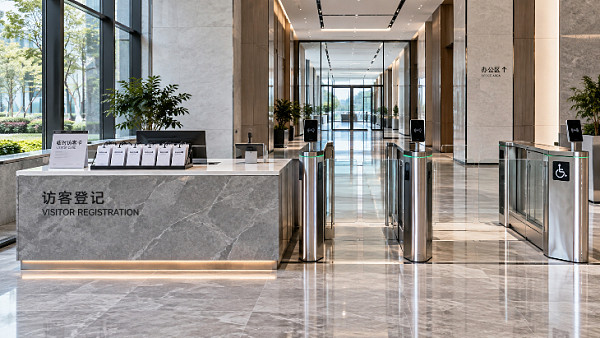
Use the map to define access zones. A practical division might include public reception, meeting areas, general workspaces, and restricted rooms. The exact boundaries should follow actual doors and circulation routes. If a meeting room sits beyond an employee-only corridor, a credential that opens the lobby gate alone will not complete the visitor journey; either the route needs an additional permission or an escort.
Set rules for each type of visit
A single visitor category rarely reflects the way a campus operates. An invited guest attending one meeting has a known host and a predictable destination. A service contractor may need recurring access to plant rooms, tools, and loading areas. A courier may only need to reach a staffed delivery point. A public event can bring a large group whose members do not have individual hosts.
Translate those differences into access rules before configuring software or ordering credentials:
- Invited visits: Record the host, destination, expected arrival, and end time. Decide whether the visitor waits for an escort or receives a credential for a defined route.
- Contract work: Separate authorization to attend the site from permission to enter a particular work area. A valid service booking does not automatically authorize access to every technical room.
- Deliveries: Keep the handover point outside controlled areas where the layout permits. If a driver must enter, define the route and who receives the delivery.
- Events and groups: Agree on a group registration method, a responsible host, and the boundary between event space and restricted areas.
- Unscheduled arrivals: Establish who can approve entry when the intended host cannot be reached, and where the visitor waits while approval is sought.
The rules should also cover early arrivals, overstays, canceled appointments, and visitors who need to move between buildings. A time-limited pass is only useful if its validity window covers the intended journey without leaving unnecessary access active afterward. Where a visit extends beyond the original booking, an authorized extension should update both the visit record and the credential.
Design check-in around real arrival conditions
Pre-registration reduces manual work at reception when the host supplies accurate details in advance. It does not eliminate the need to handle walk-ins, name mismatches, or changes of host. Decide which information is required for the visit, who verifies it, and what evidence is sufficient for each access category. A public meeting room and a sensitive laboratory need not use the same identity verification process.
At arrival, the reception workflow should establish four things: the visitor is expected or has been approved, the destination is correct, the host or receiving party is notified, and the issued credential matches the permitted access. A printed badge can make a visitor visible to staff, but the wording and visual design should avoid exposing unnecessary personal information. A badge that identifies its holder as a visitor is not proof that every door or room is authorized.
Self-service kiosks work best when exceptions have a nearby resolution path. A kiosk cannot complete a visit if the host is unavailable, the booking is missing, or the visitor cannot use the interface. Provide an accessible alternative and a way to contact reception without sending someone back outside the controlled entrance. Where identity documents are scanned, specify whether images are actually required; collecting more information than the process uses adds storage and handling obligations without improving the access decision.
Queue capacity deserves attention before equipment is installed. Estimate demand by arrival window, not by the daily visitor total. A short peak before a conference can overwhelm a desk that handles the same number of visits comfortably throughout an ordinary day. Registration time, host response, badge printing, and the time needed to resolve exceptions all affect waiting time. Observe or rehearse the process using representative groups rather than relying solely on a gate's advertised throughput.
Choose credentials and physical controls together
Temporary access can be issued through a reusable card, a printed code, a mobile credential, or a staffed release. The choice affects distribution, recovery, and failure handling. Reusable cards need an issue-and-return process; a printed code needs protection from casual copying; mobile credentials require a workable route for visitors without compatible devices or connectivity. Whatever the form, the credential should be linked to a specific visit and restricted to the necessary doors and time period.
Place controlled doors and turnstiles where reception staff can see the approach and intervene without blocking the queue. A speed gate can separate controlled space from a lobby, but its passage capacity is affected by credential presentation, luggage, accessibility needs, and people following closely behind one another. Infrared anti-tailgating detection can raise an alert when passage conditions suggest an unauthorized follower; its behavior still needs testing against suitcases, mobility aids, and group movement at the installed site.
Accessible entry must be part of the same visitor route, not an improvised exception. A wider gate or adjacent controlled door should offer equivalent authorization and a clear method of assistance. Confirm how deliveries, wheelchairs, strollers, and maintenance equipment pass through without repeatedly leaving a secure opening unattended.
Emergency egress and fire-system behavior must be resolved with the relevant building design and local requirements. A controlled entrance should not be planned as though every door remains locked during an emergency. Document which devices release, how staff direct visitors out, and how the configuration is verified during commissioning.
Connect the visit record to access permissions
Visitor registration and physical access control are separate functions, even when presented through one interface. The registration record describes the visit; the access system makes decisions at doors or gates. Define the data exchanged between them: visit identifier, credential identifier, authorized access zones, activation and expiry times, and changes or cancellations.
Test the full sequence rather than assuming a successful registration creates usable access. A representative test should create a visit, issue a credential, open an authorized entrance, reject a restricted door, extend or cancel the visit, and confirm that the change reaches the access system. Also test a credential that was issued but never collected. Unused permissions should not remain active simply because no physical badge was handed over.
Departure records require care. A person can leave without presenting a credential if the exit is free for life safety or convenience. In that arrangement, the absence of an exit event does not prove the visitor is still inside. Record whether departure is confirmed by a return point, host action, exit reader, or another process, and distinguish an unconfirmed status from a verified presence when producing an emergency visitor list.
Assign access to visitor records according to operational need, set a retention period appropriate to the information collected, and document who can retrieve or correct records. Where campus systems are managed by different organizations, agree on data ownership and support responsibilities before interfaces are built.
Plan for outages and exceptions before opening
A network interruption, unavailable host, printer failure, or access controller fault should lead to a defined operating mode. Decide which entrances remain staffed, who can authorize temporary entry, how credentials or manual passes are issued, and how the visit is recorded for later reconciliation. A paper log should capture only the information needed to maintain the process and should have a secure handover into the normal record system.
Do not assume that a door's behavior during power or network loss is identical across the campus. Confirm the installed configuration for each critical opening, including whether local controllers retain valid permissions and how an emergency release affects the door. The fallback procedure must also account for visitor exit and access to assistance, not just admission.
Before handover, run an end-to-end rehearsal across reception, security, building management, and the access-control support team. Include a visitor sent to the wrong building, a canceled appointment, a rejected credential, a person requiring accessible entry, and a communication outage. Record the responsible party and resolution path for each failure. Repeated problems at a particular entrance may call for a route or staffing change rather than another software setting.
Have questions about this sector analysis, or seeking best practices specific to your niche? Drop us a line below and let the senior consultants at MHLS assist you.
We respect your privacy. Your information is strictly confidential.
Recommended News
 JR East Plans UWB Walk-Through Gates at 40 Stations in Spring 2028Access Control StrategistJR East plans UWB walk-through gates at 40 stations in spring 2028. Explore the rollout timeline and what suppliers should watch.
 Bank Vault Security Standards: UL and EN Ratings ExplainedVault Structural ArchitectExplore bank vault security standards and learn how UL 608 classes and EN 1143-1 grades differ, what they test, and how to verify certification before you buy.
 Mechanical Lock Hardware Prices: What Buyers Should Budget for Bulk OrdersMr. Gideon CrossMechanical lock hardware price is just the starting point. Discover what drives bulk-order costs and how to compare supplier quotes with confidence.
 IndexBox Forecasts Steady Global Security Keypad Market Growth Through 2035Dr. Valerius ThorneGlobal security keypad market growth is forecast at 3.3% annually through 2035. Explore the smart home and replacement trends shaping demand.
 Choosing an Infrared Safety Sensors Manufacturer: What Buyers Should CheckUnmanned Terminal FellowChoosing an infrared safety sensors manufacturer? Compare safety evidence, integration, environmental performance and lifecycle costs before you buy.
 Choosing a Security Material Testing Service: What to Check for Lock and Safe MaterialsProf. Elara SterlingChoose a security material testing service with confidence. Learn what to check for lock and safe materials, from attack methods and accreditation to reliable reports.
 How Precision Anti-Pick Lock Cylinders Resist ManipulationSecurity Metallurgy ExpertDiscover how precision anti-pick lock technology resists manipulation, and learn what to check when comparing security features, test evidence, and everyday reliability.
 Dermalog Joins NIST FastCAP Program for Contactless Fingerprint TestingProf. Elara SterlingDermalog joins the NIST FastCAP program for contactless fingerprint testing. Discover what this means for biometric identification and digital identity.
 Choosing Security Export Compliance Services: What Providers Should CoverMr. Gideon CrossSecurity export compliance services can help prevent costly delays. Discover what to look for in classification, licensing, screening, and documentation.
 European Security Compliance Standards for Safes: EN 1143-1 vs EN 14450Dr. Valerius ThorneExplore security compliance standards Europe buyers need to know. Compare EN 1143-1 and EN 14450 to choose the right safe with confidence.
 HID Global Acquires inepro ID to Expand RFID and BLE Access SolutionsUnmanned Terminal FellowHID Global acquires inepro ID to expand RFID and BLE access solutions for printers, smart lockers and shared devices. Explore what the deal could mean for your organization.
 Choosing Networked Hotel Lock Systems: Connectivity, Integration and SecurityBiometric Auth ScientistCompare networked hotel lock systems by connectivity, PMS integration and security. Learn what to test before choosing a system for your property.