
Corundum Anti-Drill Barriers for Safes: Performance and Design Limits
Corundum can make a safe barrier harder to drill, but its hardness does not establish the burglary resistance of the finished safe. Protection depends on whether the ceramic remains supported, how consistently it occupies the barrier, and whether the surrounding construction preserves that resistance across joints, penetrations, and protected mechanisms.
The decisive distinction is between a material that disrupts drilling under controlled conditions and an assembly that withstands a defined burglary test. A specification for corundum anti drill material for safes should therefore connect composition and manufacturing controls to representative assembly testing—not treat ceramic content or a hardness value as proof of a security rating.
What corundum contributes—and what hardness cannot explain
Corundum is crystalline aluminum oxide, Al₂O₃, with a Mohs hardness of 9. Industrial barrier formulations may incorporate fused alumina aggregate or engineered alumina ceramic elements. These are not interchangeable: purity, porosity, grain structure, particle geometry, and processing influence how the ceramic behaves under concentrated mechanical loading.
Its principal contribution is a hard phase that resists penetration and abrasive wear. When sufficiently supported, corundum can increase wear on drilling tools and interrupt material removal. In an aggregate-filled composite, the tool encounters materials with different mechanical properties rather than a uniform, readily machined section.
However, Mohs hardness is an ordinal scratch-resistance scale. It does not measure drilling time, fracture toughness, or the energy needed to create an opening. A claim that a barrier is “Mohs 9” describes the corundum constituent more plausibly than the behavior of the complete composite.
Hardness must also be distinguished from toughness. Alumina is hard but brittle: concentrated loading can cause cracking, chipping, or fragmentation. Whether this substantially reduces protection depends on confinement and the surrounding matrix. Ceramic that remains trapped and load-bearing can continue to obstruct penetration; ceramic that is loosened or displaced contributes less effectively.
There is consequently no defensible conversion from alumina hardness, purity, or percentage content to a universal number of minutes of drilling resistance.
The matrix determines whether the hard phase stays useful
“Corundum barrier” can describe substantially different constructions. A cementitious fill containing alumina aggregate, a resin-bonded composite, and a dense ceramic layer supported by steel have different failure mechanisms. Their evaluation should begin with the actual architecture rather than the shared ingredient name.
Aggregate-filled barriers
In a particulate composite, the matrix transfers load, holds particles in position, and fills the spaces between them. If it cracks extensively or releases aggregate under loading, the ceramic’s hardness may not translate into sustained resistance.
Particle grading affects packing and the continuity of the matrix. Coarse particles can create substantial hard inclusions, but poorly controlled spacing can leave matrix-rich regions. Finer particles can improve packing within a suitable formulation, although increased surface area can complicate mixing and binder demand. A broad size distribution is not automatically superior: segregation, workability, and the final pore structure still require verification.
Corundum concentration should be stated on a clear basis. Mass percentage and volume percentage are not equivalent, particularly when comparing constituents with different densities. Neither value shows whether the aggregate is evenly distributed through the barrier.
Dense ceramic layers
Tiles, plates, or other consolidated ceramic elements provide a more continuous hard phase, but introduce interfaces and seams. Their response depends on support conditions, bonding, edge restraint, and the stiffness of adjacent layers. A ceramic coupon tested against a rigid laboratory backing may perform differently when installed within a more flexible door assembly.
Segmented construction can limit the extent of individual cracks, but its joints must be evaluated as part of the protective system. A nominal ceramic thickness does not describe the protection provided at every location.
For both architectures, the engineering question is the same: does the assembly keep the hard phase engaged as loading damages the surrounding material?
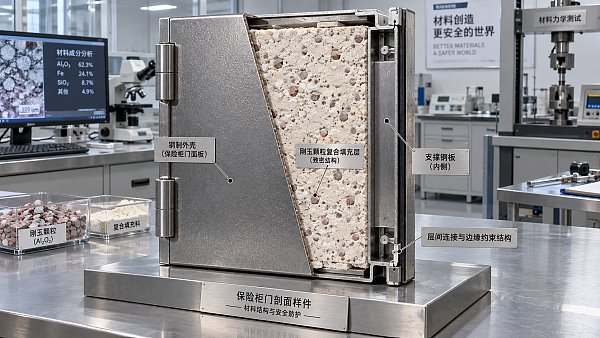
Thickness matters, but coverage and support matter with it
Increasing barrier thickness can increase the material that must be penetrated. It does not guarantee a proportional increase in resistance. Voids, discontinuities, weak interfaces, or changes in support can dominate performance before the full nominal thickness becomes effective.
A useful drawing should distinguish total door thickness, steel skin thickness, and effective protective-fill thickness. Overall door depth can include cavities, mechanism clearances, and nonstructural layers; it is not a reliable substitute for a barrier section.
Continuity deserves equal attention. Lock mounting provisions, cable passages, joints, and transitions between door components change local construction. These features should be reviewed within the complete design rather than assumed to inherit the performance of an uninterrupted material sample.
Steel and corundum also perform different functions. Steel can provide confinement, structural support, and load distribution, while the ceramic supplies a hard, wear-resistant phase. Their combined response depends on adhesion, mechanical restraint, and deformation compatibility. Adding steel thickness without addressing a poorly supported ceramic layer may leave the governing failure mechanism unchanged.
Local protection around a lock must not be confused with protection of the entire enclosure. An anti-drill plate, a corundum-filled door, and a similarly protected body represent different coverage claims. The relevant claim should match the actual assembly and certification scope.
Manufacturing variation can outweigh a formulation advantage
A well-designed formulation can underperform if production does not reproduce its intended structure. For cast composites, consequential variables include aggregate segregation, incomplete filling, trapped air, curing conditions, and dimensional changes during cure. In bonded ceramic constructions, adhesive distribution, bond-line thickness, surface preparation, and installation damage can affect support.
Density measurements provide a useful consistency check, but an average density alone cannot establish uniformity. A component may meet an overall mass requirement while containing a localized void or an uneven distribution of hard aggregate. Inspection methods must be suited to the geometry and the defect being sought.
Material substitutions require similar discipline. Changing aggregate source, particle grading, binder chemistry, reinforcement, or curing practice can alter performance even if the declared alumina percentage remains unchanged. A security specification should identify which changes require engineering review and whether additional testing or certification approval is necessary.
Why a drilling demonstration is not a burglary rating
A demonstration may show that one sample damaged a particular drill bit or delayed penetration. Without a documented protocol, that result has limited comparative value. Tool type and condition, loading, speed control, cooling conditions, specimen restraint, and the definition of completion all influence the outcome.
The endpoint is especially important. First surface damage, penetration through a coupon, and achieving a defined access condition are different results. Reporting only “drilling time” conceals that distinction.
Comparative development tests remain useful when conditions are controlled and disclosed. They can identify formulation differences, examine manufacturing variation, or screen candidate constructions before full testing. Repeated specimens and reporting of the range of results are more informative than a single favorable run.
However, a coupon test removes many assembly variables. It may exclude joints, mounting details, mechanisms, and the deformation of the surrounding structure. Its proper role is to support material development and quality control—not to replace evidence for the finished safe.
Reading EN and UL claims correctly
EN 1143-1 addresses burglary resistance for secure storage units, including safes, through defined requirements, classification, and test methods. Resistance testing uses a structured framework involving specified tools and resistance values. Resistance units are not a direct statement of the elapsed time that any real-world attack will require.
A corundum formulation does not independently acquire an EN 1143-1 safe grade because its constituents are hard or because a sample resisted drilling. The classification concerns the tested product construction within the applicable certification scope.
UL 687 covers burglary-resistant safes. Its classifications distinguish defined levels and scopes of resistance; the exact designation matters. A UL classification should not be treated as directly interchangeable with an EN 1143-1 grade, because the testing and classification frameworks differ.
Claims also need to distinguish burglary resistance from fire performance. A fire-resistance certificate does not validate resistance to drilling, and a burglary classification does not automatically establish a fire rating. A cementitious or ceramic-containing fill must be assessed against each claimed performance requirement separately.
For a standards-based claim, the useful evidence includes:
- The exact standard and edition referenced, together with the classification achieved.
- The certificate holder, model designation, and permitted construction or size variants.
- The scope of protection, including whether the claim covers the door, body, or other specified elements.
- The certification body and the applicable production-surveillance arrangements.
- Confirmation that the supplied construction corresponds to the certified design, including any approved modifications.
Detailed attack reports may be restricted for security reasons. That does not remove the need to verify certificate validity, product identity, and the boundaries of the claim. A report excerpt, a laboratory logo, and a current product certificate are different forms of evidence and should not be treated as equivalent.
Defining a defensible acceptance requirement
An acceptance requirement should separate constituent properties, manufacturing quality, and complete-product performance. Combining them into a phrase such as “high-hardness corundum anti-drill construction” leaves too much undefined.
At material level, specify the ceramic identity, formulation basis, and relevant processing controls. At component level, define the protective geometry, permissible defects, inspection methods, and traceability. At product level, require evidence against the relevant burglary-resistance standard and confirm that the delivered configuration falls within its scope.
Where no complete-product certification is available, the limitation should remain explicit. Controlled comparative testing can justify choosing one prototype over another, but cannot support a certification claim or an unrestricted promise of attack resistance.
Service and design changes also belong within this boundary. Altering a lock installation, introducing a new penetration, or changing a fill process can affect the relationship between the barrier and the assembly. Such changes need controlled review rather than an assumption that the presence of corundum preserves the original performance.
The strongest basis for accepting a corundum barrier is therefore not the highest stated hardness or ceramic loading. It is a coherent chain of evidence: a defined material, a reproducible protective structure, and validated performance of the assembly actually being supplied.
Have questions about this sector analysis, or seeking best practices specific to your niche? Drop us a line below and let the senior consultants at MHLS assist you.
We respect your privacy. Your information is strictly confidential.
Recommended News
 Parcel Locker Network Pricing: Setup Costs, Fees and Contract TermsUnmanned Terminal FellowCompare parcel locker networks pricing, from setup costs and recurring fees to contract terms. Discover hidden charges and choose the right model.
 JR East Plans UWB Walk-Through Gates at 40 Stations in Spring 2028Access Control StrategistJR East plans UWB walk-through gates at 40 stations in spring 2028. Explore the rollout timeline and what suppliers should watch.
 Bank Vault Security Standards: UL and EN Ratings ExplainedVault Structural ArchitectExplore bank vault security standards and learn how UL 608 classes and EN 1143-1 grades differ, what they test, and how to verify certification before you buy.
 Mechanical Lock Hardware Prices: What Buyers Should Budget for Bulk OrdersMr. Gideon CrossMechanical lock hardware price is just the starting point. Discover what drives bulk-order costs and how to compare supplier quotes with confidence.
 IndexBox Forecasts Steady Global Security Keypad Market Growth Through 2035Dr. Valerius ThorneGlobal security keypad market growth is forecast at 3.3% annually through 2035. Explore the smart home and replacement trends shaping demand.
 Choosing an Infrared Safety Sensors Manufacturer: What Buyers Should CheckUnmanned Terminal FellowChoosing an infrared safety sensors manufacturer? Compare safety evidence, integration, environmental performance and lifecycle costs before you buy.
 Choosing a Security Material Testing Service: What to Check for Lock and Safe MaterialsProf. Elara SterlingChoose a security material testing service with confidence. Learn what to check for lock and safe materials, from attack methods and accreditation to reliable reports.
 How Precision Anti-Pick Lock Cylinders Resist ManipulationSecurity Metallurgy ExpertDiscover how precision anti-pick lock technology resists manipulation, and learn what to check when comparing security features, test evidence, and everyday reliability.
 Dermalog Joins NIST FastCAP Program for Contactless Fingerprint TestingProf. Elara SterlingDermalog joins the NIST FastCAP program for contactless fingerprint testing. Discover what this means for biometric identification and digital identity.
 Choosing Security Export Compliance Services: What Providers Should CoverMr. Gideon CrossSecurity export compliance services can help prevent costly delays. Discover what to look for in classification, licensing, screening, and documentation.
 European Security Compliance Standards for Safes: EN 1143-1 vs EN 14450Dr. Valerius ThorneExplore security compliance standards Europe buyers need to know. Compare EN 1143-1 and EN 14450 to choose the right safe with confidence.
 HID Global Acquires inepro ID to Expand RFID and BLE Access SolutionsUnmanned Terminal FellowHID Global acquires inepro ID to expand RFID and BLE access solutions for printers, smart lockers and shared devices. Explore what the deal could mean for your organization.











