EN 1143-1:2026 Raises Safe Testing Requirements
On June 24, 2026, CEN formally released the revised EN 1143-1:2026, with mandatory enforcement set for December 1, 2026. For exporters of Jewelry/Gun Safes, High-security Safes, and Modular Vaults & Doors, this is not just a standards update but a near-term compliance change tied directly to test planning, cost structure, and access to EU public procurement from Q1 2027 onward.
What the revised standard now requires
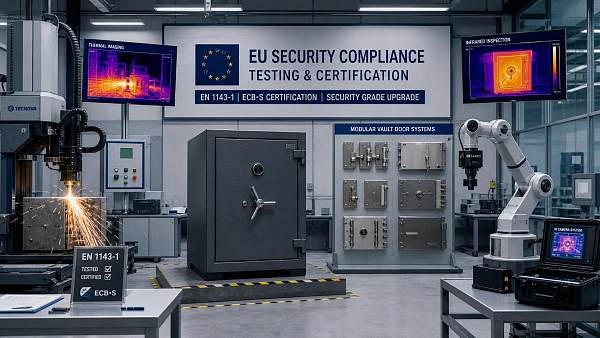
The confirmed change is that EN 1143-1:2026 was officially issued by CEN on June 24, 2026, and becomes mandatory on December 1, 2026. The revision adds two key testing requirements. First, resistance to thermal cutting must now reach at least 30 minutes, up from the previous 20 minutes. Second, the standard introduces a simulated lock-attacking scenario that combines an AI-driven robotic arm with infrared thermal imaging, with reference made to ETSI EN 303 645 Annex B.
The information provided also confirms that the revision directly affects type-testing programs and cost structures for exporters in the Jewelry/Gun Safes, High-security Safes, and Modular Vaults & Doors segments. It further indicates that companies that do not complete testing under the revised requirements in advance may lose eligibility to bid for EU government procurement starting in Q1 2027.
Where the pressure is likely to be felt first
Export manufacturers face a redesign-to-certification gap
From an industry perspective, manufacturers shipping covered product categories to the EU are likely to be affected first because the revision changes the testing basis itself. The immediate pressure point is the link between product design, type testing, and certification timing. What deserves closer attention is whether current models that passed under earlier requirements can still support new test submissions without adjustment.
Testing and compliance functions must rework validation schedules
For compliance teams, the impact is likely to concentrate on test sequencing, document preparation, and budgeting. Analysis shows that the longer thermal-cutting requirement and the new AI-assisted attack simulation may require companies to revisit how they arrange samples, lab coordination, and internal approval timelines, even before any commercial shipment discussion begins.
Procurement-facing businesses may see contract qualification risks
Businesses serving public-sector demand in the EU should pay particular attention to the procurement consequence highlighted in the provided information. Observably, the issue is not limited to product performance alone; it also affects bid eligibility. That makes sales teams, tender managers, and authorized distributors potential stakeholders in the standards transition.
What companies should watch from now to December
Separate confirmed rules from internal assumptions
Companies should distinguish between what is already confirmed and what still needs ongoing verification. The confirmed points are the publication date, the mandatory implementation date, the two added tests, and the possible procurement impact from Q1 2027. Any broader interpretation about model coverage, transition handling, or lab execution details should remain under review until supported by official wording or related implementation materials.
Review affected product lines by test pathway
What deserves closer attention is the practical screening of products already intended for the EU market. For exporters of Jewelry/Gun Safes, High-security Safes, and Modular Vaults & Doors, the key task is to identify which models are tied to upcoming type-testing activity and which commercial commitments may be exposed if revised testing is not completed in time.
Prepare for cost and delivery discussions earlier
Analysis shows that the revision is likely to affect not only testing expense but also internal planning around lead times and customer communication. Companies may need to align engineering, compliance, sales, and tender teams earlier so that quotation terms, delivery commitments, and bid participation plans reflect the revised testing timeline.
Check supplier and documentation readiness
For firms relying on external components, outsourced processing, or third-party certification support, the practical focus should be readiness of technical files, supporting documents, and supplier coordination. The issue is less about generic risk management and more about whether all materials needed for revised type testing can be assembled without delaying market access or procurement participation.
Why this looks like more than a routine revision
Observably, this update can be read in two ways at once. In the short term, it is a concrete compliance deadline with direct implications for test plans and procurement access. In a longer-view industry sense, it also signals closer attention to attack scenarios that combine physical intrusion methods with more advanced simulation logic. That said, it is more appropriate to understand this as an implemented standards change rather than a broad market conclusion, because the provided information does not establish wider commercial outcomes beyond the affected testing and bidding consequences.
How to read the signal at this stage
The clearest takeaway is that EN 1143-1:2026 should be treated as an operational compliance issue now, not as a distant regulatory discussion. For relevant exporters, the immediate significance lies in testing readiness, certification sequencing, and procurement qualification. More broadly, the development is best understood as both a short-term execution challenge and a longer-term signal that high-security safe testing is moving toward stricter and more complex attack evaluation methods.
Basis of this article
This article is based on the user-provided news title, event date, and event summary. Information of this kind is commonly associated with source categories such as official announcements, standardization body documents, industry association updates, company notices, and reporting by authoritative trade media. A specific official source link was not provided in the input, so the exact document path still requires continued verification. Follow-up attention should remain on any official implementation wording, related testing guidance, and procurement-side clarification connected to the revised standard.
Have questions about this sector analysis, or seeking best practices specific to your niche? Drop us a line below and let the senior consultants at MHLS assist you.
We respect your privacy. Your information is strictly confidential.
Recommended News
 Physical Security System Engineering: From Risk Assessment to System DesignUnmanned Terminal FellowExplore physical security system engineering, from risk assessment to integrated design, procurement and testing. Build a safer, more resilient facility.
 Apple Home Collection Smart Lock and Other Accessories Open for Preorder November 13Biometric Auth ScientistApple Home Collection preorders open November 13, 2026. Explore the LG smart lock’s Matter and Aliro support and what buyers should verify before ordering.
 Choosing Servo-Driven Flap Barriers: Throughput, Safety and Access ControlAccess Control StrategistServo-driven flap barriers can balance throughput, safety and access control. Discover how to compare lanes, test performance and choose with confidence.
 Parcel Locker Network Pricing: Setup Costs, Fees and Contract TermsUnmanned Terminal FellowCompare parcel locker networks pricing, from setup costs and recurring fees to contract terms. Discover hidden charges and choose the right model.
 JR East Plans UWB Walk-Through Gates at 40 Stations in Spring 2028Access Control StrategistJR East plans UWB walk-through gates at 40 stations in spring 2028. Explore the rollout timeline and what suppliers should watch.
 Bank Vault Security Standards: UL and EN Ratings ExplainedVault Structural ArchitectExplore bank vault security standards and learn how UL 608 classes and EN 1143-1 grades differ, what they test, and how to verify certification before you buy.
 Mechanical Lock Hardware Prices: What Buyers Should Budget for Bulk OrdersMr. Gideon CrossMechanical lock hardware price is just the starting point. Discover what drives bulk-order costs and how to compare supplier quotes with confidence.
 IndexBox Forecasts Steady Global Security Keypad Market Growth Through 2035Dr. Valerius ThorneGlobal security keypad market growth is forecast at 3.3% annually through 2035. Explore the smart home and replacement trends shaping demand.
 Choosing an Infrared Safety Sensors Manufacturer: What Buyers Should CheckUnmanned Terminal FellowChoosing an infrared safety sensors manufacturer? Compare safety evidence, integration, environmental performance and lifecycle costs before you buy.
 Choosing a Security Material Testing Service: What to Check for Lock and Safe MaterialsProf. Elara SterlingChoose a security material testing service with confidence. Learn what to check for lock and safe materials, from attack methods and accreditation to reliable reports.
 How Precision Anti-Pick Lock Cylinders Resist ManipulationSecurity Metallurgy ExpertDiscover how precision anti-pick lock technology resists manipulation, and learn what to check when comparing security features, test evidence, and everyday reliability.
 Dermalog Joins NIST FastCAP Program for Contactless Fingerprint TestingProf. Elara SterlingDermalog joins the NIST FastCAP program for contactless fingerprint testing. Discover what this means for biometric identification and digital identity.