EN 1143-1:2026 Tightens EU Safe Testing
On July 4, 2026, CEN released the revised EN 1143-1:2026, introducing stricter test requirements for high-security safes and jewelry/gun safes sold into the EU. The update centers on new dynamic-load and multi-angle impact conditions for drilling and cutting resistance, while also making thermal stability verification mandatory for composite materials. For manufacturers, exporters, certification teams, and EU-facing buyers, this matters because the revision is directly tied to CE certification review, and products without updated test reports will not be able to enter the EU market.
What the revised standard now requires
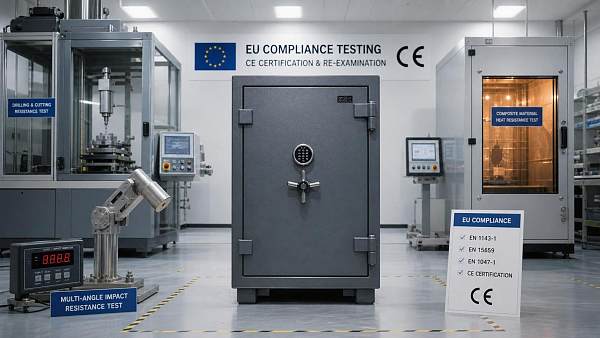
The confirmed change is that EN 1143-1:2026 was published by CEN on July 4, 2026. The revision applies to high-security safes as well as jewelry and gun safes. According to the provided event summary, the standard adds new requirements for drilling and cutting resistance testing through dynamic loads and multi-angle impact, and it also requires thermal stability verification for composite materials. The same summary states that all high-end safe products exported to the EU will be affected in CE certification re-review, and products that do not update their test reports in time will be unable to enter the EU market.
Where the pressure is likely to appear first
EU-bound manufacturers face immediate certification exposure
From an industry perspective, manufacturers of high-security safes, jewelry safes, and gun safes are the first group likely to feel the effect because the change is tied directly to testing content and certification review. The main impact is likely to fall on product validation, technical file preparation, and the timing of market access for EU-bound models. What deserves closer attention is whether existing reports, test configurations, and material documentation still align with the revised resistance and thermal verification requirements.
Export and trading teams may see disruption in shipment readiness
For exporters and direct trading companies, the issue is less about product design alone and more about whether goods remain document-ready for EU entry. The practical pressure point is likely to be shipment scheduling, customer confirmation, and pre-delivery compliance checks. Companies involved in EU trade should pay close attention to whether updated test reports and related certification materials are available before dispatch or contract execution.
Testing and certification service providers will be drawn into re-review cycles
Certification-related companies and testing service institutions are also likely to be affected because the revision changes the test basis for relevant products. Analysis shows that the business impact may center on re-testing demand, report updates, and interpretation of how the revised test methods are applied in certification review. For companies relying on external labs or certification partners, coordination on report validity and review timing becomes a practical compliance issue.
Buyers and procurement functions may need to revisit supplier qualification
Procurement teams, distributors, and project buyers sourcing EU-bound high-end safes may also need to reassess supplier readiness. The likely impact is on qualification review, tender documentation, and delivery planning, especially where procurement depends on proof of conformity. Observably, buyers should focus on whether suppliers can provide updated testing and certification evidence consistent with the revised standard before order confirmation or acceptance.
What companies should review now
Start with report validity and product scope
Analysis shows that the first practical task is to check which product lines fall within the revised standard's scope and whether their current test reports remain sufficient for CE certification re-review. This is especially relevant for companies shipping high-end safe products to the EU, because the supplied information makes clear that outdated reports can become a market-access barrier.
Review material documentation around composite structures
Because thermal stability verification for composite materials has been made mandatory, companies using composite structures should review whether existing technical documentation is complete enough for the revised compliance context. The provided information does not specify the detailed execution method, so this point is better treated as a document and evidence review priority rather than as a concluded testing outcome.
Watch certification language and downstream document changes
What deserves closer attention is not only the standard text itself, but also how the revised requirements are reflected in certification review language, test documentation, and customer-facing compliance files. Where bids, purchase specifications, or delivery documents reference EN 1143-1, companies may need to check whether those materials should be updated to avoid mismatch between product claims and current certification status.
Plan for timing risk in delivery and contract execution
Observably, the market-access consequence described in the event summary means timing risk should be treated seriously. If updated reports are not ready, the problem may surface at order confirmation, pre-shipment review, or EU entry readiness. The current information does not define an official transition path, so companies should treat schedule management and internal compliance review as active watchpoints rather than assume business-as-usual delivery timelines.
Why this reads as an execution signal
As an editorial observation, this update is more appropriate to understand as an implementation-level compliance signal than as a distant policy discussion. The reason is straightforward: the change is linked to revised test content, mandatory material verification, and CE certification re-review for EU-bound high-end products. At the same time, it is still necessary to keep watching how certification bodies, buyers, and market participants interpret and apply the revised requirements in practice, because the provided information does not include detailed enforcement guidance or downstream procedural wording.
How the market should read this update
In practical terms, this development points to a stricter compliance threshold for EU-facing high-security safes rather than a purely technical standards update with limited commercial effect. The most balanced reading is that the rule change has already become relevant for certification and market entry, while the exact execution rhythm still deserves continued observation through report review practices, procurement documents, and industry feedback. For companies in the supply chain, the immediate value lies in checking document readiness and certification alignment rather than waiting for disruption to appear in shipments or customer approvals.
Basis of this article and what still needs verification
This article is based on the user-provided news title, event date, and event summary. For events of this kind, source types commonly associated with verification may include official notices, regulator publications, trade or customs authority updates, industry association information, standards organization documents, and reporting by authoritative media. No specific official source link was provided in the input, so the exact official reference still needs to be verified on an ongoing basis. Items that remain worth monitoring include detailed implementation language, certification review practice, tender document updates, market feedback, and how affected companies execute compliance adjustments.
Have questions about this sector analysis, or seeking best practices specific to your niche? Drop us a line below and let the senior consultants at MHLS assist you.
We respect your privacy. Your information is strictly confidential.
Recommended News
 Financial Facility Security: Choosing Vault Doors for Bank BranchesVault Structural ArchitectStrengthen financial facility security with the right bank vault door. Explore certification, installation, locking controls and maintenance before you buy.
 MACO Acquires Majority Stake in Fingerprint Access Provider ekeyProf. Elara SterlingMACO acquires a majority stake in ekey, bringing fingerprint access and door hardware closer together. Discover what the deal could mean for smart buildings.
 Physical Security System Engineering: From Risk Assessment to System DesignUnmanned Terminal FellowExplore physical security system engineering, from risk assessment to integrated design, procurement and testing. Build a safer, more resilient facility.
 Apple Home Collection Smart Lock and Other Accessories Open for Preorder November 13Biometric Auth ScientistApple Home Collection preorders open November 13, 2026. Explore the LG smart lock’s Matter and Aliro support and what buyers should verify before ordering.
 Choosing Servo-Driven Flap Barriers: Throughput, Safety and Access ControlAccess Control StrategistServo-driven flap barriers can balance throughput, safety and access control. Discover how to compare lanes, test performance and choose with confidence.
 Parcel Locker Network Pricing: Setup Costs, Fees and Contract TermsUnmanned Terminal FellowCompare parcel locker networks pricing, from setup costs and recurring fees to contract terms. Discover hidden charges and choose the right model.
 JR East Plans UWB Walk-Through Gates at 40 Stations in Spring 2028Access Control StrategistJR East plans UWB walk-through gates at 40 stations in spring 2028. Explore the rollout timeline and what suppliers should watch.
 Bank Vault Security Standards: UL and EN Ratings ExplainedVault Structural ArchitectExplore bank vault security standards and learn how UL 608 classes and EN 1143-1 grades differ, what they test, and how to verify certification before you buy.
 Mechanical Lock Hardware Prices: What Buyers Should Budget for Bulk OrdersMr. Gideon CrossMechanical lock hardware price is just the starting point. Discover what drives bulk-order costs and how to compare supplier quotes with confidence.
 IndexBox Forecasts Steady Global Security Keypad Market Growth Through 2035Dr. Valerius ThorneGlobal security keypad market growth is forecast at 3.3% annually through 2035. Explore the smart home and replacement trends shaping demand.
 Choosing an Infrared Safety Sensors Manufacturer: What Buyers Should CheckUnmanned Terminal FellowChoosing an infrared safety sensors manufacturer? Compare safety evidence, integration, environmental performance and lifecycle costs before you buy.
 Choosing a Security Material Testing Service: What to Check for Lock and Safe MaterialsProf. Elara SterlingChoose a security material testing service with confidence. Learn what to check for lock and safe materials, from attack methods and accreditation to reliable reports.