
Fireproof Safes for Data Media: What Fire Ratings and Storage Conditions Matter Most?
Why are fireproof safes for data media evaluated differently from paper safes?
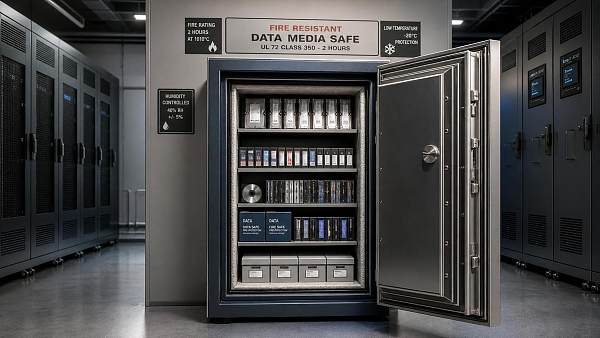
Fireproof safes for data media solve a narrower and more demanding problem than document safes.
Paper can tolerate temperatures that would already damage magnetic tape, optical discs, backup drives, and some solid-state media.
That is why a safe labeled fire resistant for records may still be unsuitable for digital archives.
In practice, the key issue is not only how long the exterior survives flame.
The real test is whether the internal chamber stays below the damage threshold for the stored media.
Humidity also matters.
During a fire event, steam generation inside low-grade enclosures can be as dangerous as heat.
For this reason, fireproof safes for data media are usually assessed around temperature control, moisture protection, seal integrity, and test duration.
Across physical security infrastructure, this distinction is increasingly important.
SHPS often frames safe selection the same way other security systems are evaluated: by matching performance limits to the real asset risk.
That approach prevents a common mistake, buying a strong safe body without confirming media protection performance.
Which fire ratings actually matter when digital storage is involved?
The most useful fire rating is the one tied to the media category you plan to protect.
A broad fire label without a stated internal temperature limit is not enough.
When comparing fireproof safes for data media, look for three elements together.
- The test standard or certification body, such as UL or equivalent regional methods.
- The rated duration, often 30, 60, 90, or 120 minutes.
- The maximum internal temperature allowed during the fire test.
Some buyers focus only on the longest duration.
A better reading is duration plus interior condition.
For example, one safe may last two hours for paper records, yet fail the lower temperature threshold needed for magnetic media.
Another may offer a shorter duration but maintain safer internal conditions for backup cartridges or removable drives.
Impact resistance after fire should also be checked.
Some standards include drop testing because safes can fall through weakened floors during building fires.
If that detail is missing, the fire rating tells only part of the story.
A quick comparison table helps filter claims
The table below is a practical screening tool for fireproof safes for data media.
How low should internal temperature and humidity stay?
This is usually the deciding question.
Different media fail at different thresholds, so a universal answer does not work.
Still, the selection logic is straightforward.
Choose the safe based on the most sensitive item inside, not the most common one.
Optical media, magnetic tapes, portable hard drives, and mixed backup sets often require lower internal temperatures than paper files.
Humidity should remain controlled enough to avoid condensation and material distortion during a fire cycle.
That means checking the tested environment, not just the advertised insulation.
In actual deployments, stable storage conditions matter before and after a fire event too.
A well-rated cabinet can still underperform if it is placed in a damp plant room or near major temperature swings.
For fireproof safes for data media, ask whether daily operating humidity, shelf layout, ventilation around the unit, and seal maintenance have been considered.
Those details often determine long-term data retention more than the headline rating alone.
What storage conditions are often missed during specification review?
Many reviews stop at the certificate and external dimensions.
That is where avoidable risk enters the project.
The more useful review checks how the safe will behave in the real room, with the real media load, over the real service cycle.
The following points are frequently overlooked.
- Door opening frequency, which affects internal humidity balance and seal wear.
- Mixed storage of paper and data media in one compartment.
- Safe location near boilers, electrical rooms, loading docks, or exterior walls.
- Lack of monitoring for ambient temperature and moisture.
- Ignoring the recovery process after a fire, including handling and media inspection.
Fireproof safes for data media should also be reviewed alongside burglary resistance.
A strong fire cabinet without suitable anti-attack protection may still create unacceptable exposure.
That cross-check is consistent with broader SHPS reporting, where fire performance and physical attack resistance are treated as linked, not separate, decisions.
Is a higher rating always better, or just more expensive?
Higher ratings are useful only when they fit the site risk and continuity target.
More protection usually means more weight, larger footprint, higher transport cost, and stricter installation planning.
So the right question is not whether a top rating exists.
It is whether the rating aligns with fire load, emergency response time, recovery expectations, and media value.
For example, a small office backup set and a regulated archive do not justify the same enclosure strategy.
Some sites are better served by combining a moderate on-site safe with off-site replication.
Others need a higher-rated safe because downtime costs exceed replacement cost.
This is one reason fireproof safes for data media should be evaluated within a larger resilience plan.
A safe is one layer.
It should support backup policy, access control, inspection routines, and incident recovery procedures.
A practical way to judge value
A balanced decision usually considers five checkpoints.
- What exact media types are stored today, and what may be added later.
- How long the contents must remain recoverable after an incident.
- Whether the room environment supports stable storage conditions.
- Whether the safe also needs burglary resistance or audit-friendly locking.
- What maintenance and inspection routine can realistically be sustained.
What should be on the final evaluation checklist before approval?
By the final review stage, the discussion should move from broad claims to verifiable details.
This is where many safe comparisons become much clearer.
For fireproof safes for data media, confirm the certificate source, rating duration, internal temperature limit, and any humidity-related test conditions.
Check the door seal design, locking reliability, service access, and replacement parts path.
Review installation constraints as well.
Floor loading, anchoring, room placement, and clearance around the door are basic, but often missed until late.
It is also worth asking for a test report summary rather than relying only on brochure language.
That habit mirrors the wider SHPS approach to security hardware assessment, where certification readiness and field suitability must both be visible.
In the end, the best fireproof safes for data media are not simply the heaviest or the highest priced.
They are the units whose tested limits, environmental fit, and operating conditions match the actual protection objective.
A useful next step is to map media sensitivity, room conditions, fire exposure time, and physical attack risk into one review sheet.
That creates a defensible basis for comparing options, refining specifications, and reducing avoidable data loss risk.
Have questions about this sector analysis, or seeking best practices specific to your niche? Drop us a line below and let the senior consultants at MHLS assist you.
We respect your privacy. Your information is strictly confidential.
Recommended News
 Physical Security Infrastructure Cost: Budgeting for Installation and MaintenanceUnmanned Terminal FellowUnderstand physical security infrastructure cost and build a smarter budget for installation, maintenance, and long-term ownership.
 Financial Facility Security: Choosing Vault Doors for Bank BranchesVault Structural ArchitectStrengthen financial facility security with the right bank vault door. Explore certification, installation, locking controls and maintenance before you buy.
 MACO Acquires Majority Stake in Fingerprint Access Provider ekeyProf. Elara SterlingMACO acquires a majority stake in ekey, bringing fingerprint access and door hardware closer together. Discover what the deal could mean for smart buildings.
 Physical Security System Engineering: From Risk Assessment to System DesignUnmanned Terminal FellowExplore physical security system engineering, from risk assessment to integrated design, procurement and testing. Build a safer, more resilient facility.
 Apple Home Collection Smart Lock and Other Accessories Open for Preorder November 13Biometric Auth ScientistApple Home Collection preorders open November 13, 2026. Explore the LG smart lock’s Matter and Aliro support and what buyers should verify before ordering.
 Choosing Servo-Driven Flap Barriers: Throughput, Safety and Access ControlAccess Control StrategistServo-driven flap barriers can balance throughput, safety and access control. Discover how to compare lanes, test performance and choose with confidence.
 Parcel Locker Network Pricing: Setup Costs, Fees and Contract TermsUnmanned Terminal FellowCompare parcel locker networks pricing, from setup costs and recurring fees to contract terms. Discover hidden charges and choose the right model.
 JR East Plans UWB Walk-Through Gates at 40 Stations in Spring 2028Access Control StrategistJR East plans UWB walk-through gates at 40 stations in spring 2028. Explore the rollout timeline and what suppliers should watch.
 Bank Vault Security Standards: UL and EN Ratings ExplainedVault Structural ArchitectExplore bank vault security standards and learn how UL 608 classes and EN 1143-1 grades differ, what they test, and how to verify certification before you buy.
 Mechanical Lock Hardware Prices: What Buyers Should Budget for Bulk OrdersMr. Gideon CrossMechanical lock hardware price is just the starting point. Discover what drives bulk-order costs and how to compare supplier quotes with confidence.
 IndexBox Forecasts Steady Global Security Keypad Market Growth Through 2035Dr. Valerius ThorneGlobal security keypad market growth is forecast at 3.3% annually through 2035. Explore the smart home and replacement trends shaping demand.
 Choosing an Infrared Safety Sensors Manufacturer: What Buyers Should CheckUnmanned Terminal FellowChoosing an infrared safety sensors manufacturer? Compare safety evidence, integration, environmental performance and lifecycle costs before you buy.











