How Pharmacies Can Choose Insurance-Grade Safes for Controlled Drug Storage
Choosing an insurance-grade safe for controlled drug storage starts with the actual exposure: the medicines held on site, the period between deliveries and dispensing, the location of the dispensary, and the insurer's stated conditions. A safe that appears substantial may still be unsuitable if its burglary-resistance claim cannot be verified, its lock arrangement does not support accountable access, or the building cannot accept the required anchoring method.
Controlled-drug storage needs to withstand both opportunistic attack and deliberate attempts to defeat the body, door, lock, hinges, and mounting. At the same time, access must remain practical during normal dispensing activity without weakening custody controls. The specification should therefore be written as a combined physical-security, access-control, installation, and evidence requirement rather than as a request for a particular external size or door-lock type.
Start with the insurer's written requirements
The term “insurance-grade” has no useful purchasing value unless it is tied to a clearly identified testing standard, resistance grade, permitted contents value, or insurer condition. Requirements can vary by jurisdiction, policy wording, drug category, storage location, alarm coverage, and whether the premises are occupied overnight. Obtain the relevant wording before a model is selected, especially where a safe must meet a stated burglary-resistance classification or be installed in a prescribed manner.
A supplier statement that a cabinet is “insurance approved” should be treated as incomplete evidence. Ask for the certificate or test documentation for the precise safe series, grade, dimensions where relevant, locking configuration, and market in which it will be installed. Confirm that the document applies to the complete product, not merely to a similar cabinet, a lock fitted to another safe, or a manufacturer’s internal test.
Where EN 1143-1, UL testing, or another recognized burglary-resistance framework is cited, establish exactly what has been tested and by whom. A grade is meaningful only in its original scope. Replacing a certified lock, changing boltwork, cutting additional cable holes, or fitting an unapproved internal compartment may affect the configuration that was evaluated. The documentation should travel with the safe record rather than disappear after installation.
Read the construction beyond the door thickness
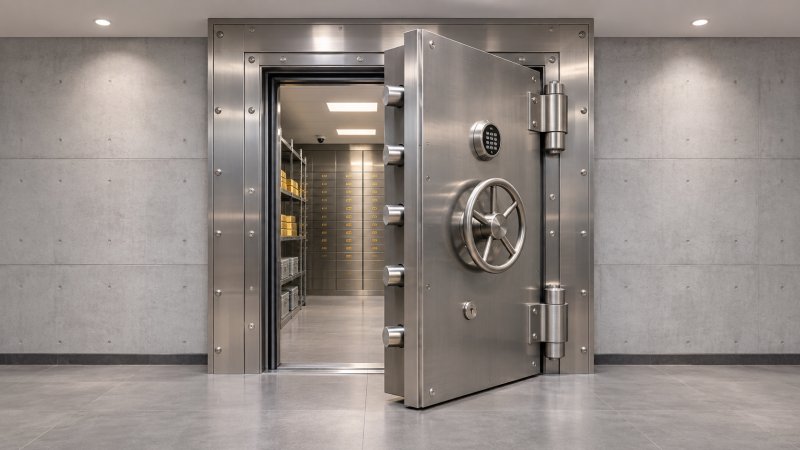
Door thickness is easy to market and easy to compare, but it is an unreliable shortcut. Resistance depends on the whole attack path: wall construction, door frame, locking bolts, boltwork protection, hinges, relocking devices, lock mounting, and the quality of joints around openings. A thick steel plate alone does not establish resistance to drilling, cutting, prying, punching, or sustained tool attack.
Request a sectional description of the body and door. Better specifications explain the steel layers, composite fill, hard-plate locations, drill-resistant barriers, protective treatment around the lock case, and how seams are formed. Composite barriers can incorporate aggregates or hardened materials intended to slow drilling and cutting. Their value depends on placement and continuity; a local protective plate around one component does not compensate for a lightly protected body or weak frame.
Examine the door perimeter and boltwork. Active bolts on multiple sides, protected bolt guides, and a robust frame can reduce pry vulnerability, while fixed hinge-side bolts may retain engagement if exterior hinges are attacked. The presence of external hinges is not automatically a weakness, since a properly designed safe can use independent hinge-side protection. Conversely, concealed hinges do not demonstrate burglary resistance on their own.
Relocking devices deserve specific attention. If an attack damages or dislodges the primary lock area, a relocker may independently block the boltwork. Ask how many relocking points are fitted, what events can trigger them, and whether post-attack servicing requires destructive entry. This is not a request for sensitive design details; it is a way to establish that the safe has a considered response to lock-area attack.

Size the safe around stock, workflow, and internal control
Capacity should be based on peak on-hand stock, not average volume. Consider original packs, bulk containers, returns awaiting reconciliation, quarantine stock, high-value lines, and space needed to avoid uncontrolled stacking. A safe filled to the point where items must be moved repeatedly to find a pack encourages rushed handling and makes inventory checks harder. Internal drawers, lockable compartments, adjustable shelves, and labeled trays can improve separation, although every internal feature should be assessed for its impact on usable capacity.
External dimensions must be evaluated with equal care. Wall thickness and door clearance reduce net internal space, while the open door can obstruct a narrow dispensary aisle. Measure the proposed position, adjacent counters, swing direction, access routes, and the turning space needed to bring a heavy unit inside. A safe that fits on a plan may be impossible to maneuver past a doorway, up stairs, or through a service lift without removing doors or arranging specialist handling.
Separate-custody requirements may call for more than one protected area. That can be achieved through independently locked internal compartments or separate safes, depending on the required degree of segregation and access allocation. Do not assume that a removable cash box or standard drawer establishes accountable separation. The lock, access log, and key or credential control for each compartment determine whether segregation is real.
Specify accountable access rather than a convenient lock
A mechanical combination lock, dual-key arrangement, electronic keypad, or biometric credential can each be appropriate in a defined environment. The question is whether the chosen arrangement supports the access rules, continuity plan, and audit expectations of the site. Convenience becomes a security defect when shared codes, unmanaged keys, or broad administrator privileges make it impossible to establish who opened the safe.
Electronic locks can support individual credentials, time-delay functions, dual authorization, opening records, and configurable user roles. Before specifying these features, verify the usable event-log capacity, timestamp behavior, export method, overwrite policy, and whether failed attempts, programming changes, door-open duration, and manager actions are recorded. A log that can be viewed only on the safe’s keypad, lacks a reliable clock, or is easily cleared may have limited value during an investigation.
Biometric access can remove some risks associated with shared PINs, but it should not be assumed to be self-validating. Fingerprint performance can be affected by moisture, damaged skin, residue, gloves, and enrollment quality. Facial or vein-based systems introduce their own environmental and enrollment considerations. Any biometric lock should have a controlled fallback method, with fallback credentials secured and the circumstances for their use recorded.
Two-person access is worth considering where policy requires independent custody or where a single person should not remove controlled stock unobserved. This can be configured as two keys, two codes, sequential authorization, or dual credentials. The chosen method should fit opening frequency. A control that is routinely bypassed during busy periods is weaker than a modest control that is consistently followed.
- Credential ownership: each active code, key, card, or biometric template should map to a named authorization record, with a defined removal process when duties change.
- Administrative authority: limit the ability to create users, alter time windows, reset locks, or clear logs. Emergency access should not become an informal master-access route.
- Lock continuity: document battery replacement, low-battery warning behavior, power-loss operation, emergency opening authority, and post-emergency re-securing steps.
Installation is part of the resistance rating
A correctly rated safe can be undermined by poor placement or inadequate anchoring. The preferred fixing method depends on the safe manufacturer’s instructions, floor structure, safe mass, site layout, and the conditions stated by the insurer. A concrete slab may accept a different fixing arrangement from a raised floor, timber structure, suspended slab, or floor containing underfloor services. Anchors must be selected for the substrate, not merely supplied because they fit the safe’s base holes.
Confirm the location before delivery. Check floor loading, building access, lift capacity, route protection, slab condition, fire separation requirements, and whether drilling is allowed. Locate concealed electrical, water, heating, drainage, communications, and post-tensioned elements before any anchor holes are drilled. A last-minute location change can create a vulnerable installation if the new position lacks a suitable structural fixing point.
Positioning also affects attack opportunity and daily use. A safe should not be placed where an intruder can work unseen for extended periods, yet it should not force controlled drugs through public or poorly supervised circulation paths. Nearby walls, counters, and cabinets may either restrict leverage against the safe or create blind spaces that conceal tampering. Door swing, lighting, camera coverage where applicable, and the ability to close and lock the door without obstruction all deserve a site review.
Retain installation evidence: photographs of the completed position, anchor specification, installer details, handover record, safe serial number, lock identifiers, and any site deviations approved by the manufacturer or insurer. This material can be important after a claim, an audit, a lock failure, or a later relocation.
Compare quotations on a common technical basis
Quotations often become misleading when one supplier includes delivery, stair carry, placement, anchoring, commissioning, and lock setup while another prices only the cabinet at kerbside. Build a common scope that identifies the exact model, certified configuration, lock type, internal fittings, delivery constraints, installation work, waste removal, documentation, and training or handover requirements. The expected lead time should distinguish factory production, transit, delivery appointment, and installation readiness.
Ask whether the quoted mass is net safe mass and whether it includes the door, lock, and internal fittings. Mass is not a rating, but it affects handling, floor assessment, and removal resistance. Where a safe may need to be relocated later, define who can decommission anchors, protect the premises, transport the unit, and reinstall it without compromising certification or warranty conditions.
Service terms should cover lock faults, electronic lock battery issues, combination changes, key replacement controls, forced-entry recovery, and availability of parts. A controlled-drug safe cannot simply remain inaccessible while a general service request is queued. At the same time, emergency-opening procedures must preserve custody: record the reason, the individuals present, the inventory condition, and the action taken to restore normal authorization.
Test the handover process before accepting the installation
Acceptance should include more than checking that the door opens. Verify the model and serial number against the order, inspect the finish and door alignment, confirm that anchors are installed as specified, and test each authorized credential. Confirm that unauthorized credentials fail, that time-delay or dual-control settings work when specified, and that event records show the expected actions with the correct time.
Review the full close-and-lock sequence under normal working conditions. Some electronic locks do not secure the boltwork until the door is physically closed and a separate action is completed. Staff turnover, alarm conditions, and interruptions make unclear sequences risky. A concise local procedure should state who may access the safe, how stock is returned after dispensing, how discrepancies are escalated, and how lock or safe faults are reported without leaving medicines exposed.
Insurance-grade safes for pharmacies should be selected as a documented control system: verified physical resistance, sufficient usable storage, traceable access, proper installation, and a handover record that can withstand later scrutiny. When those elements align, the safe supports controlled-drug custody without relying on appearance, assumptions, or informal workarounds.
Have questions about this sector analysis, or seeking best practices specific to your niche? Drop us a line below and let the senior consultants at MHLS assist you.
We respect your privacy. Your information is strictly confidential.
Recommended News
 Financial Facility Security: Choosing Vault Doors for Bank BranchesVault Structural ArchitectStrengthen financial facility security with the right bank vault door. Explore certification, installation, locking controls and maintenance before you buy.
 MACO Acquires Majority Stake in Fingerprint Access Provider ekeyProf. Elara SterlingMACO acquires a majority stake in ekey, bringing fingerprint access and door hardware closer together. Discover what the deal could mean for smart buildings.
 Physical Security System Engineering: From Risk Assessment to System DesignUnmanned Terminal FellowExplore physical security system engineering, from risk assessment to integrated design, procurement and testing. Build a safer, more resilient facility.
 Apple Home Collection Smart Lock and Other Accessories Open for Preorder November 13Biometric Auth ScientistApple Home Collection preorders open November 13, 2026. Explore the LG smart lock’s Matter and Aliro support and what buyers should verify before ordering.
 Choosing Servo-Driven Flap Barriers: Throughput, Safety and Access ControlAccess Control StrategistServo-driven flap barriers can balance throughput, safety and access control. Discover how to compare lanes, test performance and choose with confidence.
 Parcel Locker Network Pricing: Setup Costs, Fees and Contract TermsUnmanned Terminal FellowCompare parcel locker networks pricing, from setup costs and recurring fees to contract terms. Discover hidden charges and choose the right model.
 JR East Plans UWB Walk-Through Gates at 40 Stations in Spring 2028Access Control StrategistJR East plans UWB walk-through gates at 40 stations in spring 2028. Explore the rollout timeline and what suppliers should watch.
 Bank Vault Security Standards: UL and EN Ratings ExplainedVault Structural ArchitectExplore bank vault security standards and learn how UL 608 classes and EN 1143-1 grades differ, what they test, and how to verify certification before you buy.
 Mechanical Lock Hardware Prices: What Buyers Should Budget for Bulk OrdersMr. Gideon CrossMechanical lock hardware price is just the starting point. Discover what drives bulk-order costs and how to compare supplier quotes with confidence.
 IndexBox Forecasts Steady Global Security Keypad Market Growth Through 2035Dr. Valerius ThorneGlobal security keypad market growth is forecast at 3.3% annually through 2035. Explore the smart home and replacement trends shaping demand.
 Choosing an Infrared Safety Sensors Manufacturer: What Buyers Should CheckUnmanned Terminal FellowChoosing an infrared safety sensors manufacturer? Compare safety evidence, integration, environmental performance and lifecycle costs before you buy.
 Choosing a Security Material Testing Service: What to Check for Lock and Safe MaterialsProf. Elara SterlingChoose a security material testing service with confidence. Learn what to check for lock and safe materials, from attack methods and accreditation to reliable reports.