
How to Choose Fire Rated Safes for Cash: Ratings, Capacity, and Security Factors
What buyers often get wrong about fire rated safes for cash
Choosing the right fire rated safes for cash is not just about surviving a fire. It also shapes daily cash-handling discipline, insurance acceptance, replacement cost, and the practical question of whether staff can use the safe without creating new risk. The common mistake is to treat “fire rated” as a complete answer. It is not. A fire rating tells you something specific about heat exposure over a tested period. It does not automatically tell you how well the unit resists pry attacks, drilling, lock manipulation, relocation, or poor usage conditions.
That distinction matters because cash storage sits in an awkward category. Banknotes are not as heat-sensitive as some digital media, but they are still vulnerable to charring, smoke, water, and collapse damage after a building fire. At the same time, a cash safe in a retail back office, hotel cashier room, fuel station, pharmacy, or branch collection point is usually exposed to burglary pressure long before a fire ever happens. A safe that performs well in a furnace test but has weak anchoring, a light body, or a low-grade lock may still be the wrong procurement decision.
For buyers comparing models, the better approach is to look at three things together: what fire standard the product actually claims, how much usable internal volume remains after fire insulation is taken into account, and what security features protect cash in normal operating conditions.
Fire ratings are about test conditions, not marketing language
The phrase “fireproof safe” is used loosely in the market, but professional evaluation starts with the test method behind the claim. A rated product is normally tested for a defined duration and temperature profile, with acceptance criteria tied to the internal temperature limit. In some markets, buyers will encounter UL classifications such as Class 350 for paper protection. That is relevant because cash, receipts, paper records, and deposit envelopes are paper-based contents. A Class 350 fire test is designed so the internal temperature stays below the threshold at which paper chars and ignites.
The number of minutes or hours matters, but the standard matters more. A “2-hour fire safe” without a clear test body or certification reference is harder to compare than a unit tied to a recognized test regime. The market also includes products tested under other national or regional methods, and those methods are not always directly interchangeable. Buyers should ask a simple question: who tested it, to which standard, and for what content class?
This is where many procurement errors begin. A supplier may emphasize thick walls, composite filling, or gypsum-based insulation, but unless the fire claim is tied to an identifiable test standard, the statement remains incomplete. Material descriptions help explain design intent; they do not replace certification evidence.
Another point that deserves attention: a fire test is not a full representation of every real building fire. Some tests include impact or drop elements to simulate structural collapse after a fire, while others focus primarily on heat exposure. In locations where safes may be installed on upper floors or in older buildings, that difference may matter. It is not always necessary, but it is worth checking when the cash value, business interruption cost, or insurance requirement is high.
Capacity is usually overstated in buyer assumptions
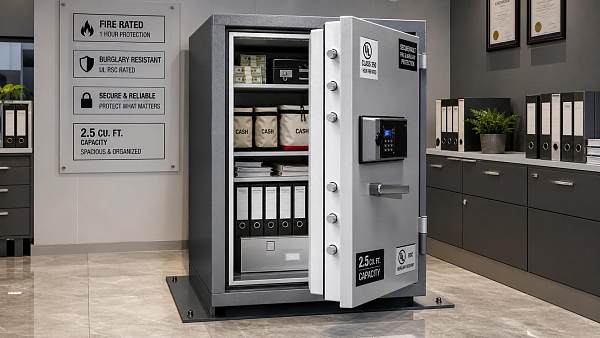
On paper, capacity sounds simple: choose the liter volume or external dimensions that fit the room. In practice, fire rated safes for cash often disappoint users because the internal chamber is much smaller than expected. Fire insulation takes space. Door structure takes space. Inner compartments, relockers, boltwork, and deposit mechanisms take more space. The result is that two safes with similar outer dimensions can have very different usable capacity.
For cash handling, usable layout matters more than raw liters. A hospitality operator may need room for till bags and shift envelopes. A retailer may need denomination trays plus deposit pouches. A pharmacy may want cash separated from controlled paper records. A service station may want a deposit slot that reduces opening frequency. These are very different use cases, even when total daily cash value is similar.
It helps to define capacity in operational terms before comparing products:
- How many cash bags, envelopes, or tills must be stored at peak load?
- Will coin storage be included? Coins add weight quickly and may change shelf design requirements.
- Is deposit intake separate from manager access?
- Does the opening need to fit bundled notes, sealed bags, or document wallets without jamming?
- Will future expansion add more shifts, more collection intervals, or more branches using the same specification?
When buyers skip these questions, they often overpay for external size while still ending up with poor workflow. Or they choose a compact unit that technically stores the cash but forces staff to stack deposits badly, leave doors open too long, or keep overflow cash outside the safe. That turns a capacity mistake into a security mistake.
Fire resistance and burglary resistance are separate performance questions
A buyer evaluating cash storage should assume that fire and burglary are different test categories unless verified otherwise. Some products are strong in one area and modest in the other. This is especially common in lower and mid-market models sold primarily for home or light office document storage. They may offer useful fire protection but limited resistance to attack with hand tools or simple forced entry methods.
For commercial cash storage, burglary resistance deserves equal attention. In Europe, EN 1143-1 is one of the recognized references for burglary-resistant safes and vaults. In the US market, buyers may also see UL burglary-related classifications on certain products. The exact class required depends on local insurance practice, site risk, and stored value, but the principle is stable: do not infer burglary performance from fire insulation or door thickness alone.
A practical way to think about specification is this: if the safe protects small amounts of working cash and the site already has strong perimeter security, a moderate burglary specification may be acceptable. If the safe is used for overnight retention, delayed collection, multi-shift deposits, or locations with higher robbery and break-in exposure, the burglary side of the specification should move up accordingly. That usually affects body construction, door design, boltwork, relocking devices, anchoring, and lock grade.
Lock choice changes both risk and operational cost
Lock selection is often treated as a preference issue, but in cash environments it is a control issue. A basic mechanical combination lock may still be appropriate in some applications because it avoids battery dependence and can be robust over long service periods. Electronic locks, however, tend to offer stronger day-to-day control for commercial use: user codes, audit trails on some models, time delay, dual custody, and easier code changes after staff turnover.
That does not mean every electronic lock is better. Buyers should look beyond keypad appearance and ask whether the lock is certified, whether the manufacturer supports code management procedures, what happens on battery failure, and how emergency opening is governed. A weak electronic lock can create a false sense of control. A good one can reduce insider risk significantly, especially in sites where multiple supervisors share responsibility.
For deposit safes, lock strategy also affects exposure. If staff can deposit cash without gaining full access to stored funds, shrinkage and coercion risk may be reduced. In other words, the best lock decision is tied to workflow design, not just hardware category.
Weight, anchoring, and installation details are part of the specification
One of the more persistent misunderstandings in procurement is that a heavy safe is automatically secure. Weight helps, especially against opportunistic removal, but it is not a substitute for certified burglary resistance or proper anchoring. Smaller fire rated safes for cash are particularly vulnerable if they can be lifted, tipped, or moved off-site for later attack.
Anchoring requirements should be confirmed before purchase because they interact with floor condition, base material, and building rules. Some sites have raised floors, limited slab depth, or landlord restrictions that complicate installation. A safe chosen without site verification may arrive with the right test credentials but no practical way to install it correctly. That becomes an avoidable procurement failure.
Door swing, clearance, ventilation around electronic components where relevant, and access path into the building also deserve early review. A safe that fits the room on a drawing may still be impossible to move through a narrow service corridor or up a stair landing. Experienced buyers usually involve facilities or installers before final approval for exactly this reason.
A useful comparison framework
When models look similar, a comparison table is more useful than a brochure narrative because it forces the critical differences into view.
Where specification should be tighter
Not every cash storage scenario needs the same safe. A small office holding modest petty cash has different exposure from a chain retail site with repeated drops and delayed collections. Buyers should tighten the specification when several conditions appear together: frequent deposits by non-manager staff, overnight cash retention, limited on-site security personnel, public-facing premises, multiple code users, or insurer scrutiny around burglary grades. In these cases, it is worth paying closer attention to certified burglary resistance, lock audit capability, deposit design, and installation quality.
It is equally reasonable to avoid over-specification. A highly engineered safe with advanced access controls may be unnecessary if cash volumes are low, collection cycles are short, and the site already uses strong procedural controls. Procurement value comes from matching risk, workflow, and compliance needs, not from selecting the most impressive specification on paper.
The best buying question is not “Which safe is best?”
The better question is: which fire rated safe is defensible for this cash-handling environment? That wording changes the decision. It pushes buyers to verify standards, understand capacity in operational terms, distinguish fire resistance from burglary resistance, and treat lock strategy as part of security design rather than an accessory choice.
When a supplier can clearly explain the fire test basis, the burglary rating where relevant, the usable internal layout, and the installation conditions, comparison becomes more reliable. When those points stay vague, the risk of buying the wrong safe rises quickly. For commercial procurement, clarity is usually a better indicator than brochure language. A safe for cash should not only survive heat; it should fit the way cash is actually collected, separated, locked, and protected on site.
Have questions about this sector analysis, or seeking best practices specific to your niche? Drop us a line below and let the senior consultants at MHLS assist you.
We respect your privacy. Your information is strictly confidential.
Recommended News
 Physical Security Infrastructure Cost: Budgeting for Installation and MaintenanceUnmanned Terminal FellowUnderstand physical security infrastructure cost and build a smarter budget for installation, maintenance, and long-term ownership.
 Financial Facility Security: Choosing Vault Doors for Bank BranchesVault Structural ArchitectStrengthen financial facility security with the right bank vault door. Explore certification, installation, locking controls and maintenance before you buy.
 MACO Acquires Majority Stake in Fingerprint Access Provider ekeyProf. Elara SterlingMACO acquires a majority stake in ekey, bringing fingerprint access and door hardware closer together. Discover what the deal could mean for smart buildings.
 Physical Security System Engineering: From Risk Assessment to System DesignUnmanned Terminal FellowExplore physical security system engineering, from risk assessment to integrated design, procurement and testing. Build a safer, more resilient facility.
 Apple Home Collection Smart Lock and Other Accessories Open for Preorder November 13Biometric Auth ScientistApple Home Collection preorders open November 13, 2026. Explore the LG smart lock’s Matter and Aliro support and what buyers should verify before ordering.
 Choosing Servo-Driven Flap Barriers: Throughput, Safety and Access ControlAccess Control StrategistServo-driven flap barriers can balance throughput, safety and access control. Discover how to compare lanes, test performance and choose with confidence.
 Parcel Locker Network Pricing: Setup Costs, Fees and Contract TermsUnmanned Terminal FellowCompare parcel locker networks pricing, from setup costs and recurring fees to contract terms. Discover hidden charges and choose the right model.
 JR East Plans UWB Walk-Through Gates at 40 Stations in Spring 2028Access Control StrategistJR East plans UWB walk-through gates at 40 stations in spring 2028. Explore the rollout timeline and what suppliers should watch.
 Bank Vault Security Standards: UL and EN Ratings ExplainedVault Structural ArchitectExplore bank vault security standards and learn how UL 608 classes and EN 1143-1 grades differ, what they test, and how to verify certification before you buy.
 Mechanical Lock Hardware Prices: What Buyers Should Budget for Bulk OrdersMr. Gideon CrossMechanical lock hardware price is just the starting point. Discover what drives bulk-order costs and how to compare supplier quotes with confidence.
 IndexBox Forecasts Steady Global Security Keypad Market Growth Through 2035Dr. Valerius ThorneGlobal security keypad market growth is forecast at 3.3% annually through 2035. Explore the smart home and replacement trends shaping demand.
 Choosing an Infrared Safety Sensors Manufacturer: What Buyers Should CheckUnmanned Terminal FellowChoosing an infrared safety sensors manufacturer? Compare safety evidence, integration, environmental performance and lifecycle costs before you buy.











