
How to Evaluate Secure Storage Solutions for High-Value Assets and Controlled Access
Selecting secure storage solutions for high-value assets is not mainly a question of cabinet size, lock preference, or purchase price. The right choice depends on what must be protected, who may access it, how quickly access is needed, and what evidence is required when something goes wrong.
A storage unit that performs well against opportunistic theft may be unsuitable for controlled pharmaceuticals, sensitive documents, precious metals, product samples, evidence, cash handling, restricted tools, or master keys. Before comparing suppliers, define the asset, the threat, and the operating process. That sequence produces a more reliable decision than starting with a catalogue specification.
Start with the loss scenario, not the product category
“High-value” does not always mean high replacement cost. An asset can be operationally critical, legally sensitive, difficult to trace, or attractive for internal misuse. A prototype, controlled key set, calibration device, confidential file, or sealed evidence package may create a larger business problem when lost than its purchase value suggests.
Map the storage requirement around the most credible loss scenarios:
- Forced attack: drilling, cutting, prying, lock manipulation, or removal of the entire unit.
- Unauthorized internal access: shared codes, copied keys, excessive administrator rights, or access after a role change.
- Process failure: an item is removed without a record, returned to the wrong compartment, or left unsecured during shift handover.
- Environmental damage: fire, water exposure, humidity, dust, corrosion, or unstable power and network conditions.
- Service disruption: failed electronics, expired credentials, lost keys, lockout events, or an emergency opening process that is too slow.
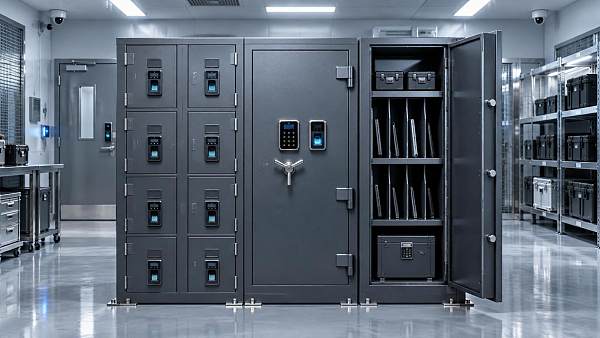
The outcome may point to very different solutions. A burglary-resistant safe can be appropriate for concentrated valuables. A vault room may be justified where asset volume, access frequency, or business continuity requirements exceed what a standalone safe can support. Compartmentalized smart lockers are often better for controlled distribution of tools, samples, devices, or parcels because they preserve separation between users and items.
Match physical resistance to the likely attack
Physical construction is the foundation of secure storage. Electronic access control can improve accountability, but it does not compensate for a weak body, poorly protected door, exposed hinges, or inadequate anchoring.
Review the safe or cabinet as a complete attack surface. The door should resist prying at the gap and should not depend on decorative external hardware for protection. Locking bolts, boltwork, relockers, hinge-side protection, and the connection between door and body matter as much as visible steel thickness. A heavy-looking unit is not automatically difficult to penetrate; construction method, reinforcement layout, and protective materials determine how resistance is distributed.
For high-risk applications, ask how the design responds to drilling and cutting around locks, boltwork, and other likely attack points. Composite bodies and specialized anti-drill materials can be valuable when they are placed around vulnerable components rather than used as a general marketing claim. The supplier should be able to explain the construction clearly and provide relevant test or certification documentation where the risk profile requires it.
Anchoring deserves separate attention. A unit that can be carried away can be opened elsewhere with more time and better tools. Confirm the installation surface, anchor arrangement, access for installers, and whether the proposed location can support the equipment weight. A well-built safe installed on an unsuitable floor or concealed by a removable partition may leave an avoidable weakness.
Controlled access should answer “who, when, and why?”
For frequently accessed assets, the lock is part of a workflow, not just a barrier. The best access method is the one that supports daily operations without weakening accountability.
A common mistake is treating biometric access as automatically stronger than every alternative. It can improve identity control, especially when paired with liveness detection and well-managed enrollment, but it still needs a fallback path for injury, failed recognition, and emergency access. That fallback must be controlled. A master PIN known by a broad group can nullify the value of a sophisticated biometric reader.
Use role-based authorization whenever possible. People should receive access because of a defined duty, during a defined period, to a defined compartment or asset category. Avoid systems in which all supervisors can open every location simply because it is convenient. Broad access creates a difficult investigation after a discrepancy and makes routine access review less meaningful.
Audit trails are only useful when they can support an investigation
Controlled-access storage should create records that help resolve a real question: who opened which location, at what time, using which credential, and what happened afterward? In some workflows, an opening record is sufficient. In others, the process should also identify the compartment, item, return status, dual authorization, or reason for access.
Evaluate event records before purchase. Check whether they are protected from casual deletion, how they are retrieved, whether timestamps can be aligned with access-control or video systems, and whether administrators’ actions are logged as well. A system that records ordinary openings but not credential changes, remote unlocks, override use, or audit-log clearing leaves major gaps.
Logging should fit the process. For a key cabinet, a record of key removal and return may be more useful than a generic door-open event. For regulated samples or evidence, chain-of-custody controls may require item-level confirmation, separation of duties, and documented exception handling. For parcel lockers, the important events may include delivery, collection, failed collection, forced opening, and compartment fault status.
Evaluate reliability under normal and abnormal conditions
Security systems are often assessed only when everything is working. Procurement should also test how the solution behaves during a power interruption, network outage, battery depletion, lock fault, attempted tampering, and emergency request.
Clarify whether the storage unit remains locked or unlocks after power loss, and whether that behavior matches the asset risk. For networked systems, determine what functions continue locally when the connection is unavailable. A locker network that cannot authorize legitimate users during a short connectivity loss may disrupt operations; a cabinet that defaults to open can create a far more serious exposure.
Mechanical override arrangements need disciplined governance. Determine who holds the override key or credential, where it is stored, what approval is needed to use it, and how the action is recorded. The override is a necessary resilience feature, not a routine shortcut.
Maintenance is also part of security performance. Battery replacement, firmware management, lock inspection, door alignment, anchoring checks, credential reviews, and alarm testing should have clear ownership. A secure unit can become unreliable when preventive maintenance is treated as an optional facilities task.
Do not separate the storage decision from the surrounding environment
The room, doorway, staff route, surveillance coverage, and response process can change the appropriate specification. A high-security safe placed in an unmonitored loading area may face more risk than a moderately rated unit inside a controlled room with layered access. Conversely, a secure room without properly designed storage may allow authorized users to access every asset inside without separation.
Consider the layers around the storage point: protective doors, access-controlled entrances, visitor management, intrusion detection, video coverage, and procedures for opening and closing. Where people flow through restricted areas, turnstiles or speed gates may help control entry, but they do not replace the authorization and audit requirements of the storage system itself.
For storage exposed to dust, moisture, temperature variation, or corrosive environments, check both the enclosure and the lock components. Electronic hardware, batteries, sensors, and mechanical parts may require a more protected location or a different equipment design. The same applies to outdoor or semi-public smart parcel lockers, where weather exposure, vandalism, remote monitoring, and service access all affect long-term suitability.
A practical evaluation sequence for procurement
Before requesting final quotations, prepare a requirement sheet that forces operational and security decisions into the open:
- List each asset category, its quantity, dimensions, handling needs, and consequences of loss.
- Define which users need access, whether access is individual or shared, and when it must be available.
- Identify the credible threats: external attack, internal diversion, unauthorized copying, environmental damage, or service interruption.
- Set the required evidence level, from simple access history to compartment, item, and approval records.
- Assess the installation location, including anchoring, floor loading, power, network, surveillance, and emergency access.
- Request documentation on construction, locking, access control, event records, maintenance, and support responsibilities.
- Run a scenario-based acceptance review before handover: normal access, denied access, credential revocation, alarm event, outage behavior, and authorized override.
This process prevents a familiar procurement failure: buying a technically impressive unit that does not fit the actual workflow. When staff have to bypass a difficult process to keep work moving, controls degrade quickly.
Compare suppliers on evidence, not feature lists
Feature lists often make products look comparable when their practical performance is very different. Ask suppliers to explain how a stated feature works in the proposed configuration. For example, an “audit trail” should be demonstrated as usable event data. “Anti-drill protection” should be connected to the lock and boltwork areas it protects. “Biometric access” should include enrollment, failed-match handling, liveness measures where relevant, credential removal, and emergency procedures.
Independent testing and recognized burglary-resistance or safe-testing frameworks can provide useful assurance when aligned with the asset value and insurer or organizational requirements. They should be read alongside installation guidance and operating controls, rather than treated as proof that every deployment is secure.
Resources from specialist physical-security intelligence platforms such as Global Smart Hardware & Physical Security Systems can help procurement teams compare construction approaches, biometric methods, electronic lock reliability, access-control integration, and compliance considerations across suppliers. The useful objective is not to find the longest specification sheet. It is to establish whether the proposed system protects the asset, creates accountable access, and remains workable when conditions are imperfect.
The final selection should therefore be based on a defensible chain of reasoning: the asset risk justifies the physical resistance, the access model matches the people and workflow, the records support accountability, and the installation and maintenance plan preserve that protection over time.
Have questions about this sector analysis, or seeking best practices specific to your niche? Drop us a line below and let the senior consultants at MHLS assist you.
We respect your privacy. Your information is strictly confidential.
Recommended News
 Parcel Locker Network Pricing: Setup Costs, Fees and Contract TermsUnmanned Terminal FellowCompare parcel locker networks pricing, from setup costs and recurring fees to contract terms. Discover hidden charges and choose the right model.
 JR East Plans UWB Walk-Through Gates at 40 Stations in Spring 2028Access Control StrategistJR East plans UWB walk-through gates at 40 stations in spring 2028. Explore the rollout timeline and what suppliers should watch.
 Bank Vault Security Standards: UL and EN Ratings ExplainedVault Structural ArchitectExplore bank vault security standards and learn how UL 608 classes and EN 1143-1 grades differ, what they test, and how to verify certification before you buy.
 Mechanical Lock Hardware Prices: What Buyers Should Budget for Bulk OrdersMr. Gideon CrossMechanical lock hardware price is just the starting point. Discover what drives bulk-order costs and how to compare supplier quotes with confidence.
 IndexBox Forecasts Steady Global Security Keypad Market Growth Through 2035Dr. Valerius ThorneGlobal security keypad market growth is forecast at 3.3% annually through 2035. Explore the smart home and replacement trends shaping demand.
 Choosing an Infrared Safety Sensors Manufacturer: What Buyers Should CheckUnmanned Terminal FellowChoosing an infrared safety sensors manufacturer? Compare safety evidence, integration, environmental performance and lifecycle costs before you buy.
 Choosing a Security Material Testing Service: What to Check for Lock and Safe MaterialsProf. Elara SterlingChoose a security material testing service with confidence. Learn what to check for lock and safe materials, from attack methods and accreditation to reliable reports.
 How Precision Anti-Pick Lock Cylinders Resist ManipulationSecurity Metallurgy ExpertDiscover how precision anti-pick lock technology resists manipulation, and learn what to check when comparing security features, test evidence, and everyday reliability.
 Dermalog Joins NIST FastCAP Program for Contactless Fingerprint TestingProf. Elara SterlingDermalog joins the NIST FastCAP program for contactless fingerprint testing. Discover what this means for biometric identification and digital identity.
 Choosing Security Export Compliance Services: What Providers Should CoverMr. Gideon CrossSecurity export compliance services can help prevent costly delays. Discover what to look for in classification, licensing, screening, and documentation.
 European Security Compliance Standards for Safes: EN 1143-1 vs EN 14450Dr. Valerius ThorneExplore security compliance standards Europe buyers need to know. Compare EN 1143-1 and EN 14450 to choose the right safe with confidence.
 HID Global Acquires inepro ID to Expand RFID and BLE Access SolutionsUnmanned Terminal FellowHID Global acquires inepro ID to expand RFID and BLE access solutions for printers, smart lockers and shared devices. Explore what the deal could mean for your organization.











