
Vault Risk Assessment Checklist for Identifying Physical Security Gaps
A vault risk assessment is only useful when it tests the complete protection system rather than treating the vault door as the security boundary. A certified door on an unreinforced opening, a strong room with uncontrolled key access, or a well-built enclosure without reliable alarm response can all leave the same high-value assets exposed.
The most important finding in many assessments is not a single failed component but a break between protection layers: construction does not match the declared threat, access rights outlive staff changes, surveillance records activity without enabling intervention, or maintenance work quietly degrades a previously compliant installation. The checklist below is designed to identify those gaps before a loss, attempted intrusion, audit failure, or insurance dispute reveals them.
Define the asset, threat, and required delay time
A vault should not be assessed in isolation from what it protects. Cash, controlled materials, confidential records, precious metals, backup media, pharmaceutical products, and high-value inventory create different attack incentives and different consequences if access is lost. The assessment should document not only replacement value, but also operational impact: how long could the organization function without the contents, who would need to be notified after a breach, and whether contractual or regulatory obligations would be triggered.
The declared threat model should be specific enough to influence the design review. Relevant questions include whether the facility faces opportunistic burglary, planned forced entry, insider theft, coercion, vehicle-assisted attack, fire, flood, civil disturbance, or a combination of these. A vault intended mainly to delay a casual attack may require a very different perimeter, anchoring method, access process, and alarm arrangement from one protecting assets that justify sustained attack with tools.
Risk acceptance should be expressed as a required period of resistance and response, not simply as “high security.” Physical protection buys time. That time has value only when detection, verification, communication, and response can occur before the attacker reaches the assets. If the site has no staffed response capability outside business hours, a short alarm transmission path may still be inadequate.
Inspect the enclosure as a continuous barrier
Walls, floor, ceiling, door frame, and service penetrations must be evaluated as one enclosure. It is a common error to focus on the visible vault door while assuming adjoining construction provides equivalent resistance. The attacker will normally select the least resistant route, not the most obvious one.
- Wall and roof continuity: Confirm that wall thickness, reinforcement, composite layers, and structural connections match approved drawings or the intended protection specification. Suspended ceilings, lightweight partitions, roof voids, adjacent tenant spaces, and plant rooms can create concealed approach routes.
- Floor and foundation: Review whether the vault is properly integrated with the slab or foundation. Check for voids, unprotected service trenches, raised-floor cavities, drainage channels, and interfaces where the wall meets the floor.
- Penetrations: Every cable, conduit, ventilation duct, pipe, drain, and communication route should be listed. Their size, location, physical protection, fire stopping, and accessibility from outside the secure area matter. A penetration approved during construction may become a weakness after later cabling work.
- Adjacent spaces: Identify who controls rooms, corridors, ceilings, basements, loading areas, and exterior walls adjoining the vault. Security assumptions are weak when access to an adjacent area is shared with contractors, tenants, cleaning crews, or building maintenance personnel.
- Signs of alteration: Look for recent drilling, patched surfaces, cut reinforcement, new conduits, water damage, corrosion, cracking, or unrecorded repairs. These conditions do not automatically mean the vault has failed, but they require engineering review before the barrier is treated as intact.
Where burglary-resistance certification is relevant, the assessment should distinguish between a tested product and an installed system. Standards such as EN 1143-1 are associated with burglary-resistant safes, ATM safes, strongroom doors, and strongrooms, while UL standards may be specified in other markets or insurance programs. The applicable requirement depends on the product type, jurisdiction, insurer, and project specification. A certificate for a door or cabinet does not automatically validate altered walls, site-built penetrations, or non-approved installation details.
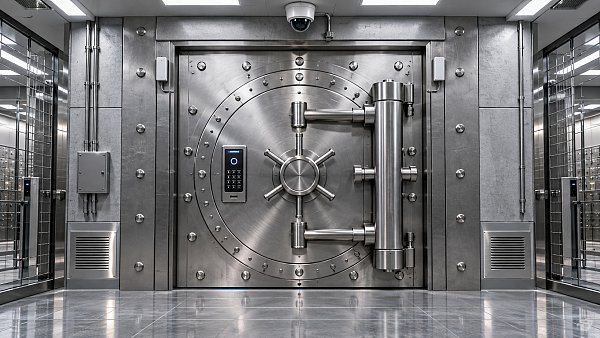
Examine the door, frame, hinges, and locking engagement
The vault door is a mechanical assembly whose security depends on correct alignment as much as on material thickness. Door leaves can incorporate barrier materials designed to resist drilling, cutting, torch attack, or tool penetration, but their performance can be undermined by poor frame anchoring, inadequate bolt engagement, excessive gaps, or damaged relocking mechanisms.
Inspection should verify that the door closes without abnormal force, that bolts fully project into the frame, and that boltwork movement is smooth throughout the locking cycle. Binding, sagging, scraping, or a change in handle resistance can indicate misalignment, wear, structural movement, or internal mechanical damage. Such symptoms should not be treated merely as maintenance inconvenience; they may prevent the locking system from reaching its designed position.
Check the condition and protection of hinges, hinge-side interlocks, bolt guides, locking cams, bolt retraction mechanisms, and any internal relocker arrangement. The door frame should be examined for movement, corrosion, loose fasteners, grout failure, cracking, or signs that surrounding construction has shifted. If a day gate or secondary security grille is installed, assess it separately. A secondary barrier can improve delay and access discipline, but only if its locking method, key control, and emergency release procedures are controlled.
Test lock integrity beyond “the lock opens”
A functioning lock is not necessarily a secure lock. The assessment should establish what locking technologies are installed, who can operate them, what happens after failed attempts, and whether the configuration supports the intended access policy.
For mechanical combination locks, verify combination-change records, service history, signs of manipulation or forced attack, and the process for changing combinations after staff transfers, contractor access, or suspected disclosure. Keys should never be evaluated only by whether they are physically present. Determine whether blanks can be copied, whether serial numbers or key codes are protected, whether a restricted keyway is genuinely controlled by the supplier, and whether key issuance and return are logged.
For electronic locks, inspect battery condition, low-power behavior, audit-event retention, time-delay settings, dual-control rules, manager override authority, and emergency opening procedures. A lock that depends on a battery or external power source needs a documented failure mode that does not create uncontrolled access or unacceptable downtime. Where network connectivity exists, physical and logical administration should be considered together: a remotely managed lock can create a physical-security gap if user permissions, administrator accounts, or credential revocation are poorly controlled.
Biometric access can reduce reliance on shared credentials, but it does not eliminate governance requirements. Enrollment approval, template protection, false-rejection handling, liveness controls where relevant, and fallback access methods must be reviewed. The fallback method often becomes the weakest route if it is rarely tested or broadly available.
Find access-control gaps created by people and process
Insider access is often difficult to assess because each individual action can appear legitimate. The practical question is whether one person can obtain unobserved access, alter evidence, or bypass a required approval without creating a meaningful record.
Dual control deserves close scrutiny. It is not achieved merely because two names appear on an authorization list. Effective dual control requires independent participation at the relevant points: opening, access to the contents, reconciliation where needed, and securing the vault again. The process also needs to prevent predictable workarounds, such as one individual holding both keys, knowing both codes, or persuading a second person to act as an unobservant witness.
Verify detection coverage and the ability to respond
Alarm and video systems should be assessed against attack paths, not device counts. A motion detector may cover interior movement but not drilling at a wall. A camera may show the vault approach but fail to identify the person at the door due to backlighting, poor lens position, or insufficient retention. Door contacts can indicate open or closed status but may not reveal attack on hinges, frames, or locks.
Map each likely approach route and attack point to at least one detection method. This may include perimeter intrusion detection, door position monitoring, seismic or vibration detection where appropriate, tamper monitoring, duress signaling, and video verification. The exact technology should follow the threat model and site conditions; excessive sensitivity can generate nuisance alarms that weaken operational discipline, while overly conservative settings may miss meaningful attack activity.
Review camera views under actual lighting conditions, including overnight operation, emergency lighting, and power-loss scenarios. Confirm that timestamps are synchronized, recording retention meets internal and contractual requirements, cameras cannot be easily obstructed from ordinary access areas, and critical views include the vault entrance, surrounding approach zone, and any key or credential storage point. A camera inside the vault may support investigation, but it does not replace coverage of the approach and entry sequence.
An alarm path is incomplete until the response is tested. Determine who receives an alarm, how signals are verified, what escalation occurs if the first contact cannot be reached, and whether responders can access the site without creating further security exposure. Documented procedures should address duress, suspected forced entry, fire, flooding, power interruption, and lock failure separately. A forced-entry response that sends staff directly to the vault without appropriate safety controls may expose people to an ongoing threat.
Review environmental, utility, and maintenance vulnerabilities
Vault security can be compromised without an intrusion attempt. Water ingress can damage lock electronics, records, inventory, and wall interfaces. High humidity can accelerate corrosion in boltwork and electronic connections. Fire exposure can affect contents, wiring, seals, and access procedures even when the structure remains standing. If asset preservation is part of the security objective, environmental controls must be included in the vault risk assessment.
Check for overhead plumbing, nearby sprinkler lines, drainage routes, HVAC condensate, roof leaks, and flood paths from adjacent areas. Review whether water sensors, fire detection, drainage provisions, and emergency access plans are suitable for the stored assets. Utility isolation should be controlled: an attacker or unauthorized person should not be able to disable essential alarm power, communications, lighting, or environmental systems from an unprotected location.
Maintenance creates a recurring change-control risk. Locksmith work, alarm servicing, CCTV replacement, network upgrades, construction activity, and fire-system modifications can all affect the secure envelope. Work orders should identify security-sensitive areas, require authorization before penetrations or configuration changes, and include post-work verification. The final check should confirm that devices are online, tamper circuits are restored, access rights are unchanged unless approved, and drawings or equipment registers reflect the modification.
Turn findings into corrective actions that can be verified
A long list of observations does not improve protection unless each finding is linked to an owner, a deadline, and a verification method. Prioritize issues by considering the likely attack route, the ease of exploitation, the value and sensitivity of exposed assets, and the time needed to correct the weakness. A missing key log may be corrected quickly; an unprotected ceiling void or inadequate wall construction may require capital work and interim controls.
Interim controls should reduce exposure without being mistaken for permanent remediation. Examples include restricting access to adjacent rooms, increasing patrols, applying temporary seals, requiring additional witnesses for vault openings, relocating vulnerable assets, or enhancing remote alarm monitoring. These measures are useful only when their duration, ownership, and review date are explicit.
Close each corrective action with evidence rather than verbal confirmation. Evidence may include updated access lists, lock-change certificates, photographs of completed construction, alarm test records, revised drawings, maintenance reports, training acknowledgments, or documented tabletop and live-response tests. A vault is defensible when its protective layers remain aligned: the barrier delays attack, locks control entry, detection identifies abnormal activity, procedures limit insider opportunity, and response converts warning into protection.
Have questions about this sector analysis, or seeking best practices specific to your niche? Drop us a line below and let the senior consultants at MHLS assist you.
We respect your privacy. Your information is strictly confidential.
Recommended News
 Physical Security Infrastructure Cost: Budgeting for Installation and MaintenanceUnmanned Terminal FellowUnderstand physical security infrastructure cost and build a smarter budget for installation, maintenance, and long-term ownership.
 Financial Facility Security: Choosing Vault Doors for Bank BranchesVault Structural ArchitectStrengthen financial facility security with the right bank vault door. Explore certification, installation, locking controls and maintenance before you buy.
 MACO Acquires Majority Stake in Fingerprint Access Provider ekeyProf. Elara SterlingMACO acquires a majority stake in ekey, bringing fingerprint access and door hardware closer together. Discover what the deal could mean for smart buildings.
 Physical Security System Engineering: From Risk Assessment to System DesignUnmanned Terminal FellowExplore physical security system engineering, from risk assessment to integrated design, procurement and testing. Build a safer, more resilient facility.
 Apple Home Collection Smart Lock and Other Accessories Open for Preorder November 13Biometric Auth ScientistApple Home Collection preorders open November 13, 2026. Explore the LG smart lock’s Matter and Aliro support and what buyers should verify before ordering.
 Choosing Servo-Driven Flap Barriers: Throughput, Safety and Access ControlAccess Control StrategistServo-driven flap barriers can balance throughput, safety and access control. Discover how to compare lanes, test performance and choose with confidence.
 Parcel Locker Network Pricing: Setup Costs, Fees and Contract TermsUnmanned Terminal FellowCompare parcel locker networks pricing, from setup costs and recurring fees to contract terms. Discover hidden charges and choose the right model.
 JR East Plans UWB Walk-Through Gates at 40 Stations in Spring 2028Access Control StrategistJR East plans UWB walk-through gates at 40 stations in spring 2028. Explore the rollout timeline and what suppliers should watch.
 Bank Vault Security Standards: UL and EN Ratings ExplainedVault Structural ArchitectExplore bank vault security standards and learn how UL 608 classes and EN 1143-1 grades differ, what they test, and how to verify certification before you buy.
 Mechanical Lock Hardware Prices: What Buyers Should Budget for Bulk OrdersMr. Gideon CrossMechanical lock hardware price is just the starting point. Discover what drives bulk-order costs and how to compare supplier quotes with confidence.
 IndexBox Forecasts Steady Global Security Keypad Market Growth Through 2035Dr. Valerius ThorneGlobal security keypad market growth is forecast at 3.3% annually through 2035. Explore the smart home and replacement trends shaping demand.
 Choosing an Infrared Safety Sensors Manufacturer: What Buyers Should CheckUnmanned Terminal FellowChoosing an infrared safety sensors manufacturer? Compare safety evidence, integration, environmental performance and lifecycle costs before you buy.











