
What Defines High-End Security Products in Commercial and Residential Projects?
In commercial towers, luxury homes, banks, and logistics sites, high-end security products are judged by performance, not appearance alone.
They are expected to resist attack, control access accurately, stay reliable under daily use, and fit wider building operations.
That matters more now because physical risk has become more complex. Forced entry, credential abuse, delivery theft, and unmanaged traffic all create measurable business exposure.
For that reason, high-end security products sit at the intersection of materials engineering, mechanical design, biometrics, software, and compliance.
What the term really means
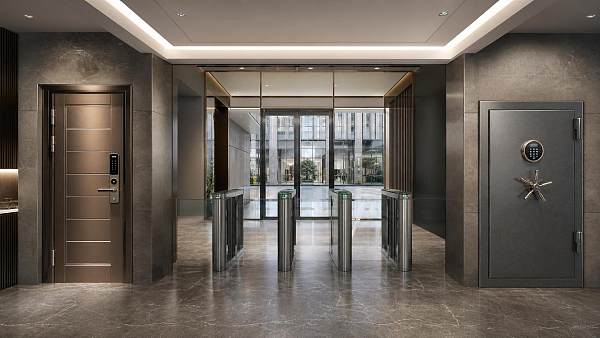
At a practical level, high-end security products deliver verified protection with predictable long-term operation.
That includes products such as high-security safes, vault systems, biometric smart locks, anti-theft lock cylinders, protective doors, speed gates, turnstiles, and smart parcel lockers.
The premium tier is usually defined by five signals: tested resistance, stronger construction, smarter authentication, stable system integration, and lower lifecycle uncertainty.
In other words, a product becomes high-end when it can prove how it protects assets, people, entrances, and restricted spaces under real operating conditions.
Why the market pays closer attention
Security buying has shifted from basic equipment sourcing to risk-informed infrastructure planning.
A residential entrance now needs more than a lock. It may need anti-spoof biometrics, durable lock bodies, secure app permissions, and emergency override planning.
A commercial lobby needs more than access points. It may require high-speed passage, anti-tailgating detection, visitor traceability, and smooth integration with building platforms.
Financial facilities, luxury retail, and records rooms place even higher demands on attack resistance, auditability, and service continuity.
This is why platforms such as SHPS have gained relevance. They connect compliance, hardware design, biometrics, materials, and deployment logic into one usable decision framework.
The technical markers behind premium performance
The best way to understand high-end security products is to look at the attributes that separate them from decorative or lightly upgraded alternatives.
Certified burglary resistance
Claims should be supported by recognized testing, not brochure language.
For safes and vault systems, references such as EN 1143-1 or UL testing matter because they show resistance against drilling, cutting, and other forced attack methods.
For doors, cylinders, and access hardware, the same principle applies. A premium product should state what threat level it addresses and how that level was validated.
Advanced materials and structural design
High-end security products often use composite bodies, anti-drill layers, reinforced lock chambers, and carefully engineered boltwork.
Corundum-based barriers, hardened plates, and anti-pry structures are not cosmetic upgrades. They directly raise attack time and tool difficulty.
In mechanical cylinders, pin-in-pin systems, blade displacement structures, and anti-picking features show whether the design is truly defensive.
Biometric credibility
Many products advertise biometrics, but not all biometric systems belong in the high-end category.
The stronger options use liveness detection, near-infrared vein recognition, or 3D facial recognition to reduce spoofing risk.
That is especially important in homes with high asset value, managed apartments, executive offices, and shared commercial spaces.
Reliability under repeated use
A security product may test well once and still fail in daily operation.
Cycle life, motor stability, sensor consistency, battery behavior, electronic lock endurance, and fault recovery all matter.
This is one reason buyers increasingly evaluate high-end security products through lifecycle cost, not only purchase price.
Where value appears in real projects
The business value of high-end security products changes by setting, but the underlying logic is consistent: lower risk, better control, and fewer weak points.
From an investment perspective, the premium category often reduces downstream loss more effectively than mid-range alternatives.
That reduction may come from fewer unauthorized entries, lower maintenance disruption, better incident records, or stronger insurance confidence.
How to read product claims more carefully
The phrase high-end security products is widely used, so judgment has to move beyond surface specifications.
A useful review usually starts with the threat model. What exactly needs protection: cash, documents, private homes, tenant areas, server rooms, parcels, or mixed-use lobbies?
After that, compare products through evidence rather than feature count.
- Check whether certifications match the actual deployment risk.
- Review materials, internal structure, and mechanical backup design.
- Ask how biometric systems address spoof attempts and environmental variation.
- Verify software compatibility with access control, alarms, or building systems.
- Look at service life, maintenance access, spare parts, and firmware support.
- Consider whether logs, permissions, and alerts are usable in daily management.
This is where specialized intelligence sources become useful. SHPS, for example, frames products through engineering logic, testing standards, and deployment relevance rather than simple feature promotion.
Integration matters as much as the hardware
A single strong device cannot compensate for a weak system design.
High-end security products perform best when they are part of an integrated strategy linking entrances, restricted areas, valuables, and movement data.
For example, a premium smart lock should connect logically with user permissions, emergency procedures, and property management workflows.
A turnstile should not only open quickly. It should coordinate with identity verification, fire safety logic, and anti-tailgating sensors.
A parcel locker network should protect packages physically while also maintaining stable connectivity, access records, and remote fault visibility.
The premium layer, then, is not just a product category. It is a deployment standard.
Signals of a stronger buying decision
In practice, the most reliable decisions tend to come from structured comparison, not brand perception alone.
A stronger evaluation process usually includes attack resistance, authentication quality, mechanical durability, integration readiness, service support, and total ownership cost.
It also helps to compare products by failure consequences. If a device fails, does it create inconvenience, a security breach, an operational bottleneck, or a compliance problem?
That question often reveals why some high-end security products justify a higher initial budget.
Useful next checks
Before selecting a solution, map the site by threat level, traffic type, asset value, and management complexity.
Then build a shortlist using standards, test evidence, integration fit, and expected operating life.
That approach makes it easier to separate truly high-end security products from products that simply look premium.
The next step is not to chase every advanced feature. It is to define the protection objective clearly, compare technical proof carefully, and judge each option in its real operating context.
Have questions about this sector analysis, or seeking best practices specific to your niche? Drop us a line below and let the senior consultants at MHLS assist you.
We respect your privacy. Your information is strictly confidential.
Recommended News
 Physical Security Infrastructure Cost: Budgeting for Installation and MaintenanceUnmanned Terminal FellowUnderstand physical security infrastructure cost and build a smarter budget for installation, maintenance, and long-term ownership.
 Financial Facility Security: Choosing Vault Doors for Bank BranchesVault Structural ArchitectStrengthen financial facility security with the right bank vault door. Explore certification, installation, locking controls and maintenance before you buy.
 MACO Acquires Majority Stake in Fingerprint Access Provider ekeyProf. Elara SterlingMACO acquires a majority stake in ekey, bringing fingerprint access and door hardware closer together. Discover what the deal could mean for smart buildings.
 Physical Security System Engineering: From Risk Assessment to System DesignUnmanned Terminal FellowExplore physical security system engineering, from risk assessment to integrated design, procurement and testing. Build a safer, more resilient facility.
 Apple Home Collection Smart Lock and Other Accessories Open for Preorder November 13Biometric Auth ScientistApple Home Collection preorders open November 13, 2026. Explore the LG smart lock’s Matter and Aliro support and what buyers should verify before ordering.
 Choosing Servo-Driven Flap Barriers: Throughput, Safety and Access ControlAccess Control StrategistServo-driven flap barriers can balance throughput, safety and access control. Discover how to compare lanes, test performance and choose with confidence.
 Parcel Locker Network Pricing: Setup Costs, Fees and Contract TermsUnmanned Terminal FellowCompare parcel locker networks pricing, from setup costs and recurring fees to contract terms. Discover hidden charges and choose the right model.
 JR East Plans UWB Walk-Through Gates at 40 Stations in Spring 2028Access Control StrategistJR East plans UWB walk-through gates at 40 stations in spring 2028. Explore the rollout timeline and what suppliers should watch.
 Bank Vault Security Standards: UL and EN Ratings ExplainedVault Structural ArchitectExplore bank vault security standards and learn how UL 608 classes and EN 1143-1 grades differ, what they test, and how to verify certification before you buy.
 Mechanical Lock Hardware Prices: What Buyers Should Budget for Bulk OrdersMr. Gideon CrossMechanical lock hardware price is just the starting point. Discover what drives bulk-order costs and how to compare supplier quotes with confidence.
 IndexBox Forecasts Steady Global Security Keypad Market Growth Through 2035Dr. Valerius ThorneGlobal security keypad market growth is forecast at 3.3% annually through 2035. Explore the smart home and replacement trends shaping demand.
 Choosing an Infrared Safety Sensors Manufacturer: What Buyers Should CheckUnmanned Terminal FellowChoosing an infrared safety sensors manufacturer? Compare safety evidence, integration, environmental performance and lifecycle costs before you buy.











