
What Is Safe Testing? Key Methods, Standards, and Failure Points Explained
Safe testing sits at the center of physical security evaluation because a safe is only as credible as the evidence behind its resistance claims. In practice, safe testing examines how a unit performs against forced entry, heat, impact, lock abuse, and repeated operation.
That matters far beyond the safe industry itself. Banks, retailers, logistics sites, luxury storage, pharmacies, data-rich offices, and residential projects all depend on reliable containment of cash, documents, valuables, devices, and controlled materials.
Within the SHPS intelligence landscape, safe testing also connects with broader questions around compliance, material engineering, export readiness, and risk reduction. It is not just a lab exercise. It is a decision tool for comparing products in real business conditions.
What safe testing actually measures
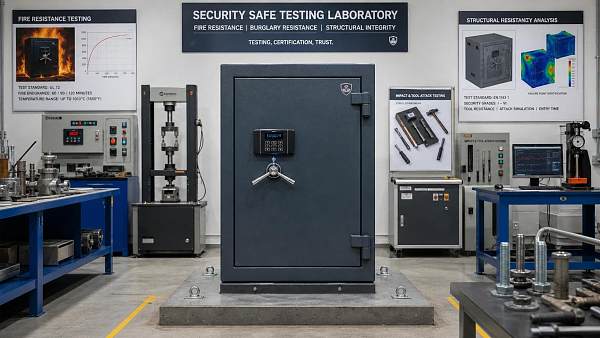
At a basic level, safe testing measures resistance time, attack pathways, structural weakness, lock integrity, and post-attack usability. The goal is not to prove a safe is impossible to open. The goal is to quantify how difficult forced access becomes.
Different tests focus on different threats. Burglary tests simulate deliberate attacks using tools. Fire tests examine internal temperature rise over time. Durability tests look at hinges, bolts, relockers, electronic systems, and repeated opening cycles.
A meaningful safe testing program also considers where attacks happen. Door edges, boltwork interfaces, lock mounting points, body corners, anchoring locations, and cable access zones often reveal more than a headline rating does.
Why the topic draws attention now
Security buyers increasingly face two pressures at once: stronger attack tools and louder marketing claims. Safe testing helps separate measured resistance from generic statements such as anti-theft, reinforced, or high security.
Cross-border trade adds another layer. A product accepted in one market may need different documentation elsewhere. That is why standards, certification bodies, and test scope matter as much as the product structure itself.
There is also more integration between safes and smart security systems. Electronic locks, audit trails, biometric access, and remote monitoring create operational value, but they also introduce new failure points that traditional metal strength alone cannot address.
Main safe testing methods in use
Not every test asks the same question. Some evaluate burglary resistance under controlled tool sets. Others evaluate thermal survival or everyday reliability. Reading the method behind the result is essential.
Burglary resistance testing
This is the most cited branch of safe testing. Attack teams use specified tools, often including drills, grinders, pry devices, cutting equipment, and impact tools, within formal rules that define attack time and scoring.
The result usually reflects resistance units, grades, or classes rather than a simple pass or fail label. A higher grade suggests more attack effort is required, but only within the defined test methodology.
Fire endurance testing
Fire-focused safe testing studies whether internal contents remain protected when exterior temperatures rise rapidly. The exact threshold depends on the intended contents, since paper, media, and electronics tolerate heat differently.
A fire label without content category is incomplete. Protection for paper records does not automatically mean protection for data media or lithium-powered devices.
Lock and operational testing
Operational safe testing examines lock cycling, bolt extension consistency, keypad endurance, battery interruption behavior, relocker response, and tamper handling. This area becomes more important as smart locking features expand.
In commercial use, many failures are not dramatic break-ins. They are lockouts, misalignment, jammed mechanisms, weak cable routing, or unstable electronics after years of service.
Standards that shape market trust
Several standards appear repeatedly in procurement and compliance discussions. They are not interchangeable, and a claimed rating should always be tied to a named standard and an identifiable test body.
From an SHPS perspective, the key point is traceability. A credible safe testing claim should reveal the standard reference, test scope, date, rating level, and whether design changes occurred after certification.
Where safes usually fail
Failure points are rarely random. They usually come from predictable compromises in materials, structure, or integration. Understanding them helps interpret test reports more accurately.
- Door-to-body gaps that allow prying or concentrated wedge attacks.
- Lock mounting regions with insufficient drill protection.
- Boltwork systems that lose alignment after impact or repeated load.
- Composite fill materials with inconsistent density or poor bonding.
- Weak relocker design that fails after partial penetration.
- Anchoring systems that are weaker than the safe body itself.
- Electronic lock components exposed to heat, moisture, or voltage instability.
More worth noting is that safe testing often exposes interface failures before material failures. A thick steel wall means less if hinges, hardplates, relockers, or anchoring details are underdesigned.
How to read safe testing results in business context
A rating should never be treated as a universal answer. The right interpretation depends on threat profile, location, value concentration, insurance requirements, and operational patterns.
For example, a jewelry storage room, a pharmacy narcotics cabinet, and a parcel handover point do not face the same attack behavior. They should not rely on the same safe testing evidence.
This is where SHPS-style cross-domain analysis becomes useful. The safe is one layer. Lock technology, access control, surveillance, installation method, and response planning all influence the actual protection level.
Questions that sharpen evaluation
- Which threat was the safe testing designed to simulate?
- Was the test performed by an accredited third party?
- Does the certified model match the sold configuration?
- Were electronic locks or biometric add-ons included in testing?
- How does anchoring affect the final installed performance?
- What maintenance conditions are required to preserve rated behavior?
Why material and design details still matter
Safe testing produces results, but design explains those results. Composite anti-drill fills, corundum-based barriers, hardplates, layered steel, reinforced bolt chambers, and protected relocker paths each affect attack resistance differently.
The same applies to fire performance. Seal quality, insulation chemistry, joint stability, and internal layout influence how long contents remain protected. A certificate is useful, but design literacy makes the certificate more meaningful.
That is especially relevant when comparing suppliers across regions. Two products may sound similar in brochures while showing major differences in metallurgy, lock sourcing, internal reinforcement, and quality consistency.
What to do next when reviewing a safe
Start with the threat scenario, not the catalog page. Define whether the main concern is burglary delay, fire endurance, controlled access, cash management, document security, or mixed risk.
Then compare safe testing evidence in layers: standard, grade, tested configuration, lock system, anchoring method, and post-installation conditions. This quickly exposes gaps between certified performance and real deployment.
For ongoing market research, it also helps to track adjacent signals. Changes in lock technology, biometric access, insurance rules, and export compliance often reshape what counts as acceptable protection.
A well-informed review of safe testing does not end with a label. It builds a clearer framework for comparing claims, identifying weak points, and choosing security solutions that fit the site, the assets, and the operating reality.
Have questions about this sector analysis, or seeking best practices specific to your niche? Drop us a line below and let the senior consultants at MHLS assist you.
We respect your privacy. Your information is strictly confidential.
Recommended News
 Parcel Locker Network Pricing: Setup Costs, Fees and Contract TermsUnmanned Terminal FellowCompare parcel locker networks pricing, from setup costs and recurring fees to contract terms. Discover hidden charges and choose the right model.
 JR East Plans UWB Walk-Through Gates at 40 Stations in Spring 2028Access Control StrategistJR East plans UWB walk-through gates at 40 stations in spring 2028. Explore the rollout timeline and what suppliers should watch.
 Bank Vault Security Standards: UL and EN Ratings ExplainedVault Structural ArchitectExplore bank vault security standards and learn how UL 608 classes and EN 1143-1 grades differ, what they test, and how to verify certification before you buy.
 Mechanical Lock Hardware Prices: What Buyers Should Budget for Bulk OrdersMr. Gideon CrossMechanical lock hardware price is just the starting point. Discover what drives bulk-order costs and how to compare supplier quotes with confidence.
 IndexBox Forecasts Steady Global Security Keypad Market Growth Through 2035Dr. Valerius ThorneGlobal security keypad market growth is forecast at 3.3% annually through 2035. Explore the smart home and replacement trends shaping demand.
 Choosing an Infrared Safety Sensors Manufacturer: What Buyers Should CheckUnmanned Terminal FellowChoosing an infrared safety sensors manufacturer? Compare safety evidence, integration, environmental performance and lifecycle costs before you buy.
 Choosing a Security Material Testing Service: What to Check for Lock and Safe MaterialsProf. Elara SterlingChoose a security material testing service with confidence. Learn what to check for lock and safe materials, from attack methods and accreditation to reliable reports.
 How Precision Anti-Pick Lock Cylinders Resist ManipulationSecurity Metallurgy ExpertDiscover how precision anti-pick lock technology resists manipulation, and learn what to check when comparing security features, test evidence, and everyday reliability.
 Dermalog Joins NIST FastCAP Program for Contactless Fingerprint TestingProf. Elara SterlingDermalog joins the NIST FastCAP program for contactless fingerprint testing. Discover what this means for biometric identification and digital identity.
 Choosing Security Export Compliance Services: What Providers Should CoverMr. Gideon CrossSecurity export compliance services can help prevent costly delays. Discover what to look for in classification, licensing, screening, and documentation.
 European Security Compliance Standards for Safes: EN 1143-1 vs EN 14450Dr. Valerius ThorneExplore security compliance standards Europe buyers need to know. Compare EN 1143-1 and EN 14450 to choose the right safe with confidence.
 HID Global Acquires inepro ID to Expand RFID and BLE Access SolutionsUnmanned Terminal FellowHID Global acquires inepro ID to expand RFID and BLE access solutions for printers, smart lockers and shared devices. Explore what the deal could mean for your organization.











