
Custom Vault Doors vs Standard Models: What to Compare Before You Specify
Custom Vault Doors vs Standard Models: What to Compare Before You Specify
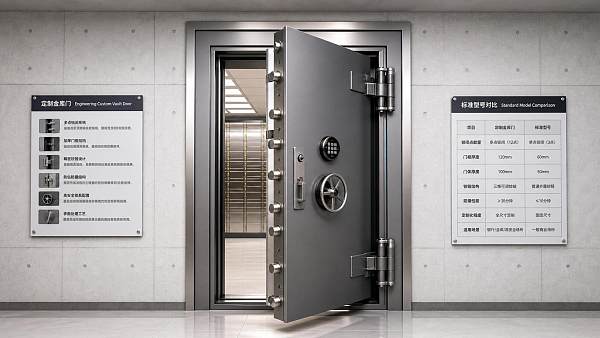
When specifying vault protection for commercial, banking, or high-risk facilities, the door decision shapes the whole security package.
The real question is not whether custom vault doors are better in every case.
It is whether a standard model can satisfy the project without forcing compromises later.
That distinction matters because vault systems are rarely isolated products.
They interact with wall construction, lock strategy, traffic flow, compliance requirements, and installation sequencing.
In practice, custom vault doors usually enter the discussion when site realities start pushing beyond standard dimensions or standard hardware packages.
That may involve oversized openings, unusual wall thickness, dual-use rooms, or integrated access control expectations.
A standard vault door, by contrast, often works well when the opening, risk level, and compliance scope are already well defined.
The safest way to compare options is to look at six factors before drawings are frozen.
Start with the security rating, not the door size
Many selection errors begin with dimensions and finish before the resistance class is fully reviewed.
That order should be reversed.
For both custom vault doors and standard models, the primary benchmark is the certified protection level.
Depending on the market, that may involve EN 1143-1, UL testing, or project-specific insurer requirements.
A larger opening can reduce practical resistance if the structural design is not re-engineered correctly.
This is where custom vault doors need careful scrutiny.
A custom size is useful only if the rating still applies to the delivered configuration.
Ask whether the exact leaf size, frame design, locking points, and barrier materials match tested or certifiable conditions.
- Confirm the certified burglary resistance grade.
- Check whether the rating covers the full custom configuration.
- Review attack resistance against drilling, cutting, prying, and torch exposure.
- Align the door rating with the vault wall and room construction.
If the room shell and the door are not matched, the stronger component does not rescue the weaker one.
Compare opening dimensions and usable clearance
Size sounds simple, but it often hides the biggest difference between standard and custom vault doors.
Catalog dimensions usually describe nominal frame or rough opening values.
What matters on site is clear passage width, clear height, swing path, and threshold condition.
This becomes critical in cash handling rooms, archive storage, jewelry facilities, and pharmaceutical sites.
Equipment carts, pallet movement, or secure transfer containers may need more space than a standard vault door allows.
A custom vault door can solve that problem, but only with full layout verification.
Look beyond the opening itself.
Check corridor width, wall returns, adjacent equipment, ventilation grilles, and emergency egress routes.
A custom door that cannot rotate cleanly into position is still a bad specification.
Questions that prevent dimension mistakes
- What is the actual rough opening tolerance after civil works?
- What is the net clear opening after frame and leaf installation?
- Will daily operations require wheeled asset movement?
- Does the hinge side interfere with nearby walls or cabinets?
- Can the structure support the increased mass of custom vault doors?
Review locking systems and control layers together
The next comparison point is the locking architecture.
Standard models often come with proven lock combinations that are easier to source and maintain.
That may include key locks, mechanical combination locks, electronic locks, time delay functions, or dual custody arrangements.
Custom vault doors usually expand those choices.
They can support multiple lock bodies, audit trail devices, alarm contacts, biometrics, and integration with access control platforms.
That flexibility is valuable, but it adds coordination work.
Every added control layer affects wiring paths, power backup, door thickness, service access, and failure mode planning.
In actual projects, this is where delays often begin.
A custom vault door may be technically right, yet poorly defined for integration responsibility.
The right specification names not just the locks, but also ownership for programming, testing, and commissioning.
Check site constraints before approving custom vault doors
From recent projects, a clearer signal is that logistics often decide feasibility before security design is finished.
Custom vault doors are heavier, less forgiving, and more sensitive to field conditions.
Delivery route, crane access, floor loading, and staging space all matter.
So does the sequence between masonry, reinforcement, frame anchoring, and finish trades.
Standard models usually reduce this uncertainty because installers already know the frame geometry and anchor details.
A custom vault door needs tighter site surveys and clearer shop drawings.
This also means tolerances become a commercial issue.
If the opening is out of range, redesign costs and schedule extensions can erase the benefits of customization.
- Request final structural opening measurements before release.
- Confirm transport path from unloading point to installation room.
- Verify slab capacity and temporary lifting requirements.
- Define who owns field adjustment risk.
Compare lifecycle cost, not just purchase price
A standard vault door often wins on upfront price and lead time.
That can make it attractive during budget pressure.
Still, the lowest acquisition cost is not always the lowest project cost.
If a standard model forces wall modification, workflow limits, or lock retrofits, savings disappear quickly.
Custom vault doors typically cost more at procurement, but they may reduce downstream change orders.
They can also support future operational changes better, especially in mixed-use secure rooms.
A useful comparison should include five cost layers.
- Door and frame purchase price.
- Structural and opening preparation cost.
- Integration, wiring, and commissioning cost.
- Maintenance, lock service, and spare parts cost.
- Risk cost from delay, redesign, or operational restriction.
This wider view usually leads to a more defensible decision.
Use a practical decision framework before specification freeze
In real procurement work, the best choice is rarely the most customized or the most standardized.
It is the option that fits the risk profile, construction reality, and operating model with the fewest unresolved assumptions.
Choose standard models when the opening is conventional, the rating is already suitable, and the locking package is straightforward.
Move toward custom vault doors when dimensions are non-standard, integration is complex, or workflow demands special clearance and hardware.
Before issuing the final specification, confirm these points in writing.
- Certified rating and test basis.
- Exact rough opening and net clear opening.
- Frame detail, anchoring method, and wall interface.
- Locking arrangement and access control responsibilities.
- Installation sequence, commissioning scope, and acceptance criteria.
- Lead time, service model, and spare parts availability.
That approach makes the comparison between custom vault doors and standard models much clearer.
More importantly, it helps prevent avoidable security gaps, installation friction, and last-minute commercial disputes.
When the requirement is defined early and checked against real site conditions, the final vault door specification becomes easier to defend and easier to deliver.
Have questions about this sector analysis, or seeking best practices specific to your niche? Drop us a line below and let the senior consultants at MHLS assist you.
We respect your privacy. Your information is strictly confidential.
Recommended News
 Physical Security Infrastructure Cost: Budgeting for Installation and MaintenanceUnmanned Terminal FellowUnderstand physical security infrastructure cost and build a smarter budget for installation, maintenance, and long-term ownership.
 Financial Facility Security: Choosing Vault Doors for Bank BranchesVault Structural ArchitectStrengthen financial facility security with the right bank vault door. Explore certification, installation, locking controls and maintenance before you buy.
 MACO Acquires Majority Stake in Fingerprint Access Provider ekeyProf. Elara SterlingMACO acquires a majority stake in ekey, bringing fingerprint access and door hardware closer together. Discover what the deal could mean for smart buildings.
 Physical Security System Engineering: From Risk Assessment to System DesignUnmanned Terminal FellowExplore physical security system engineering, from risk assessment to integrated design, procurement and testing. Build a safer, more resilient facility.
 Apple Home Collection Smart Lock and Other Accessories Open for Preorder November 13Biometric Auth ScientistApple Home Collection preorders open November 13, 2026. Explore the LG smart lock’s Matter and Aliro support and what buyers should verify before ordering.
 Choosing Servo-Driven Flap Barriers: Throughput, Safety and Access ControlAccess Control StrategistServo-driven flap barriers can balance throughput, safety and access control. Discover how to compare lanes, test performance and choose with confidence.
 Parcel Locker Network Pricing: Setup Costs, Fees and Contract TermsUnmanned Terminal FellowCompare parcel locker networks pricing, from setup costs and recurring fees to contract terms. Discover hidden charges and choose the right model.
 JR East Plans UWB Walk-Through Gates at 40 Stations in Spring 2028Access Control StrategistJR East plans UWB walk-through gates at 40 stations in spring 2028. Explore the rollout timeline and what suppliers should watch.
 Bank Vault Security Standards: UL and EN Ratings ExplainedVault Structural ArchitectExplore bank vault security standards and learn how UL 608 classes and EN 1143-1 grades differ, what they test, and how to verify certification before you buy.
 Mechanical Lock Hardware Prices: What Buyers Should Budget for Bulk OrdersMr. Gideon CrossMechanical lock hardware price is just the starting point. Discover what drives bulk-order costs and how to compare supplier quotes with confidence.
 IndexBox Forecasts Steady Global Security Keypad Market Growth Through 2035Dr. Valerius ThorneGlobal security keypad market growth is forecast at 3.3% annually through 2035. Explore the smart home and replacement trends shaping demand.
 Choosing an Infrared Safety Sensors Manufacturer: What Buyers Should CheckUnmanned Terminal FellowChoosing an infrared safety sensors manufacturer? Compare safety evidence, integration, environmental performance and lifecycle costs before you buy.











