
How to Specify Explosion-Resistant Vault Systems for High-Hazard Facilities
Specifying explosion-resistant vault systems for a high-hazard facility is not a matter of buying the heaviest door or adding thicker steel to a conventional strongroom. A vault that performs well against burglary, drilling, or cutting may still be unsuitable when the design basis includes internal deflagration, external blast overpressure, flying debris, fire, toxic release, or loss of critical utilities.
For project leaders, the difficult part is rarely identifying that a protected enclosure is needed. The difficult part is translating a site-specific hazard assessment into a coordinated vault specification that can be designed, fabricated, delivered, installed, tested, and maintained without creating new operational risks. The vault body, foundation, door assembly, penetrations, ventilation, locking hardware, and access-control logic all need to work as one system.
This is especially relevant in facilities handling energetic materials, hazardous chemicals, high-value controlled goods, sensitive records, critical equipment, or restricted operational assets. In these environments, a weak interface can defeat a strong structure. A blast-resistant wall is of limited value if the door frame is poorly anchored, a cable penetration is unprotected, or emergency egress cannot be managed after an incident.
Start With the Hazard Scenario, Not the Vault Catalogue
The phrase “explosion-resistant” can mean very different things from one project to another. A facility may need protection from an accidental internal event, an external blast generated elsewhere on the site, pressure propagation through a connected corridor, or an intentional attack scenario. These are not interchangeable design conditions.
Before comparing suppliers, establish a written design-basis brief with the facility safety team, structural engineer, security lead, insurer, and relevant authority. That brief should identify the credible hazard source, likely blast direction, occupancy conditions, protected contents, required continuity period, and acceptable level of damage. It should also state whether the vault must remain operable after an event or whether its primary purpose is containment and life protection.
A common procurement mistake is asking vendors for a generic “blast-proof vault.” That wording leaves too much room for interpretation. A better request asks how a proposed assembly performs under the project’s stated load assumptions, including reflected pressure, impulse, rebound behavior, door response, fragment hazards, and support-structure interaction where applicable. The answer should be traceable to engineering calculations, testing evidence, or a project-specific design review—not simply a marketing label.
The project team should also distinguish between protection of people, protection of contents, and containment of an event. A room intended to protect staff sheltering from an external blast may require different access, air handling, visibility, and escape provisions from a vault intended to isolate hazardous stock. Trying to combine all functions in one enclosure can create avoidable compromises.
Treat the Vault as a Structural Assembly
Explosion-resistant vault systems are often discussed as though the door is the product and everything around it is ordinary construction. In practice, the door is usually the most visible part of a larger load path. Blast energy will seek the weakest route through walls, joints, frames, anchors, ceilings, floors, cable sleeves, ducts, and service openings.
The specification should therefore clarify whether the scope includes a complete integrated enclosure, a reinforced door-and-frame package, or a component intended for integration into a separately designed structural shell. These procurement routes carry very different coordination risks. If different contractors supply the vault door, reinforced concrete works, ventilation dampers, and electronic access hardware, responsibility for the interfaces must be unambiguous.
Pay particular attention to the connection between frame and surrounding structure. Anchors, embedment arrangements, reinforcement detailing, grout zones, tolerances, and wall thickness can materially affect performance. A well-engineered door leaf cannot compensate for a frame that is allowed to rotate, pull out, or deform beyond its intended range. The same applies to prefabricated modular vault panels: panel-to-panel joints and panel-to-slab connections deserve as much scrutiny as the panel face itself.
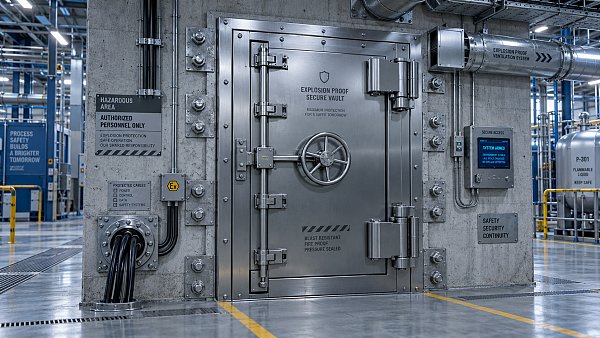
For underground, retrofitted, or space-constrained facilities, the supporting structure may be the limiting factor. Existing slabs may not accept additional concentrated loads. Door swing zones may conflict with evacuation paths. Low headroom can restrict lifting and installation methods. These problems are cheaper to discover during survey and design coordination than when a finished vault door arrives at site.
Specify Door Performance Beyond “Strength”
The door is normally the most complex moving element in an explosion-resistant vault. Its selection should balance structural resistance with daily usability. Very heavy leaves, multi-point locking systems, and deep frame sections may improve resistance in some configurations, but they can complicate operation, inspection, emergency release, and long-term alignment.
A useful door specification addresses the opening direction, clear passage width, threshold detail, hinge arrangement, locking points, seal compression, hold-open controls, and expected operating cycles. If pallets, evidence carts, maintenance equipment, or mobile racks must enter the vault, the operational clearance must be defined early. It is not unusual for a design to meet a structural requirement but fail a simple logistics test because the usable opening is too narrow or the threshold creates an unacceptable handling obstacle.
Door rebound and post-event operability should be discussed openly. Some projects require the door to remain closed and retain contents; others need a route that can be opened by authorized personnel after an incident, assuming conditions are safe. These objectives may require different hardware and control strategies. Do not assume that a high-security locking arrangement automatically supports emergency procedures.
Where electronic locking, biometrics, or networked access control are included, define the failure mode. The system may need to fail secure, fail safe, move to a controlled local mode, or require a supervised manual override. That decision depends on the risk assessment. For example, a vault containing controlled assets may require strong retention during a power failure, while an occupied refuge space may require a very different egress approach.
Do Not Let Security Requirements Undermine Life Safety
High-hazard facilities frequently add layers of security: mechanical lock cylinders, electronic locks, biometric readers, anti-tailgating controls, CCTV, intrusion alarms, and access-event records. These measures can be appropriate, but they must be designed around emergency operation rather than added after the structural package is complete.
A secure vault entrance may have several authentication steps for normal access. That is manageable when the process is deliberate and predictable. It becomes problematic if staff must enter quickly while wearing gloves, respiratory protection, hearing protection, or other personal protective equipment. Fingerprint readers can be affected by dirty or damaged hands; facial systems may be unsuitable where masks or visors are mandatory. A credential-plus-PIN arrangement, a supervised local release, or a protected mechanical override may be more practical in some operating environments.
Project teams should document who can override the locking system, where override tools or credentials are held, whether the override itself is protected from blast damage, and how the event is logged. A manual key left in an adjacent cabinet is not a resilient recovery plan if that cabinet sits in the same hazard zone.
It is equally important to avoid treating access control as a substitute for physical resistance. Smart locks, biometric verification, and alarm integration improve accountability and reduce unauthorized access risk, but they do not change the structural behavior of a door leaf, frame, or wall. The physical enclosure and the access-control layer should be evaluated separately, then integrated through a clear operational design.
Penetrations, Ventilation, and Services Are Usually the Hard Part
Every penetration through an explosion-resistant enclosure should be justified. Electrical conduits, data cables, sprinkler pipes, drainage, HVAC ducts, communications links, and monitoring sensors can all introduce weak points. The practical question is not whether services are needed—they usually are—but whether each route preserves the intended performance of the barrier.
Ventilation deserves early attention. Some vaults require temperature control for electronics, documents, pharmaceuticals, or stored materials. Others require a managed pressure relationship with adjoining rooms. A ventilation concept should consider shutoff requirements, duct routing, damper compatibility, smoke and fire behavior, maintenance access, and whether the system could become a path for pressure, flame, contaminants, or unauthorized entry.
Avoid writing a vague requirement such as “all penetrations shall be sealed.” The contractor needs a coordinated penetration schedule showing type, size, location, intended protection method, responsible discipline, and inspection requirement. Late additions are particularly risky. A single unreviewed core drill through a wall can invalidate the assumptions made during the structural design review.
Fire, Burglary, and Blast Ratings Are Not Interchangeable
Security teams often reference burglary-resistance standards, fire-resistance classifications, or safe testing requirements when comparing vault products. Those documents can be useful, particularly when evaluating resistance to forced entry, drilling, cutting, thermal attack, or fire exposure. However, they should not be treated as automatic evidence of explosion resistance.
For example, a vault system may use composite barriers, high-hardness materials, or anti-drill components that are highly relevant to burglary protection. Its blast performance still depends on the full assembly, including geometry, joints, anchoring, deformation limits, and interaction with the supporting structure. Similarly, a fire-rated door may provide meaningful protection during a fire scenario while having no demonstrated suitability for the project’s blast design basis.
Ask suppliers to separate what has been tested, what has been calculated, what is based on a comparable configuration, and what still requires project-specific engineering. This is not an adversarial exercise. It prevents a common procurement problem: a compliance statement is accepted at tender stage, only for the detailed design team to discover that the evidence applies to a different wall type, opening size, hardware arrangement, or support condition.
Build a Procurement Package That Can Be Evaluated Fairly
A strong specification does not prescribe a manufacturer’s proprietary solution without reason, but it also does not leave critical performance questions open to interpretation. Tender documentation should define required outcomes, interfaces, evidence expectations, installation responsibilities, commissioning procedures, and documentation deliverables.
For an explosion-resistant vault system, request a clear submission covering at least the following:
- the stated design scenario and assumptions used for the proposed solution;
- vault layout, wall and roof arrangement, door orientation, and clear opening dimensions;
- structural support requirements, anchoring details, imposed loads, and installation tolerances;
- door hardware, lock configuration, emergency release logic, and power-loss behavior;
- details for all approved penetrations, vents, cable routes, and service interfaces;
- available test records, engineering calculations, certifications, or third-party review documents relevant to the proposed configuration;
- inspection, maintenance, spare-parts, training, and post-installation adjustment requirements.
The commercial comparison should include more than acquisition cost. Transport constraints, lifting plans, installation sequencing, foundation preparation, electrical works, integration with building management systems, and future door maintenance can significantly alter the delivered cost and project schedule. Imported vault assemblies also need careful review for shipping dimensions, site access, customs timing, and availability of qualified local installation support.
Plan for Inspection, Not Just Handover
A vault system can leave the factory in good condition and still lose reliability through poor installation, settlement, corrosion, unauthorized modifications, or neglected door maintenance. Hinges, locking bolts, seals, closers, access readers, backup power devices, and emergency-release components all need periodic attention.
Commissioning should verify the installed condition rather than merely confirm that components arrived. Check door alignment under normal operation, locking engagement, access-control sequences, backup procedures, penetration sealing, signage, and communication arrangements. Where the design depends on a particular operational procedure, run a controlled drill with the people who will actually use the space. This often exposes issues that drawings do not: a release handle hidden by stored equipment, an unreadable instruction label in low light, or a biometric reader placed where protective gear makes it impractical.
For teams assessing explosion-resistant vault systems, the most dependable decision is usually the one that begins with a defined hazard and ends with a verified installed assembly. Security hardware, protective doors, structural materials, electronic locks, and access controls all matter, but none should be selected in isolation. The right vault is not simply the strongest-looking enclosure; it is the one whose tested or engineered performance, installation details, operating procedures, and maintenance plan match the facility’s real risk profile.
Have questions about this sector analysis, or seeking best practices specific to your niche? Drop us a line below and let the senior consultants at MHLS assist you.
We respect your privacy. Your information is strictly confidential.
Recommended News
 Physical Security System Engineering: From Risk Assessment to System DesignUnmanned Terminal FellowExplore physical security system engineering, from risk assessment to integrated design, procurement and testing. Build a safer, more resilient facility.
 Apple Home Collection Smart Lock and Other Accessories Open for Preorder November 13Biometric Auth ScientistApple Home Collection preorders open November 13, 2026. Explore the LG smart lock’s Matter and Aliro support and what buyers should verify before ordering.
 Choosing Servo-Driven Flap Barriers: Throughput, Safety and Access ControlAccess Control StrategistServo-driven flap barriers can balance throughput, safety and access control. Discover how to compare lanes, test performance and choose with confidence.
 Parcel Locker Network Pricing: Setup Costs, Fees and Contract TermsUnmanned Terminal FellowCompare parcel locker networks pricing, from setup costs and recurring fees to contract terms. Discover hidden charges and choose the right model.
 JR East Plans UWB Walk-Through Gates at 40 Stations in Spring 2028Access Control StrategistJR East plans UWB walk-through gates at 40 stations in spring 2028. Explore the rollout timeline and what suppliers should watch.
 Bank Vault Security Standards: UL and EN Ratings ExplainedVault Structural ArchitectExplore bank vault security standards and learn how UL 608 classes and EN 1143-1 grades differ, what they test, and how to verify certification before you buy.
 Mechanical Lock Hardware Prices: What Buyers Should Budget for Bulk OrdersMr. Gideon CrossMechanical lock hardware price is just the starting point. Discover what drives bulk-order costs and how to compare supplier quotes with confidence.
 IndexBox Forecasts Steady Global Security Keypad Market Growth Through 2035Dr. Valerius ThorneGlobal security keypad market growth is forecast at 3.3% annually through 2035. Explore the smart home and replacement trends shaping demand.
 Choosing an Infrared Safety Sensors Manufacturer: What Buyers Should CheckUnmanned Terminal FellowChoosing an infrared safety sensors manufacturer? Compare safety evidence, integration, environmental performance and lifecycle costs before you buy.
 Choosing a Security Material Testing Service: What to Check for Lock and Safe MaterialsProf. Elara SterlingChoose a security material testing service with confidence. Learn what to check for lock and safe materials, from attack methods and accreditation to reliable reports.
 How Precision Anti-Pick Lock Cylinders Resist ManipulationSecurity Metallurgy ExpertDiscover how precision anti-pick lock technology resists manipulation, and learn what to check when comparing security features, test evidence, and everyday reliability.
 Dermalog Joins NIST FastCAP Program for Contactless Fingerprint TestingProf. Elara SterlingDermalog joins the NIST FastCAP program for contactless fingerprint testing. Discover what this means for biometric identification and digital identity.











