
How Do You Integrate Parcel Locker Locks With Existing Access Control?
When a parcel locker is installed beside a residential lobby, office reception area, or controlled loading entrance, the lock is often treated as a separate device: couriers use one workflow, residents use another, and facility staff have a third. That separation creates practical problems. A resident may have valid building access but no locker entitlement, a locker door may remain shown as available after a failed unlock, or a fire alarm release may conflict with the access-control policy for secured deliveries.
The direct answer to “How do I integrate parcel locker locks with an existing access control system?” is to connect the locker hardware and locker-management software to the existing identity, permission, event, and emergency-control architecture—not merely to connect a lock relay to an access controller. The integration should establish who can open each compartment, under what condition, through which credential, how the action is recorded, and what happens when the network, power, or emergency system is unavailable.
Start by defining the operating model
Before selecting wiring interfaces or API connectors, map the actual access journey. A parcel locker can support several distinct users: delivery personnel depositing parcels, recipients collecting them, site staff managing exceptions, and maintenance technicians servicing the locker. These groups should not automatically receive the same access rights just because they use the same cabinet.
A typical access-control platform already contains identities, credentials, time schedules, door groups, anti-passback rules, visitor records, and audit events. The locker system has a different operational layer: compartment availability, parcel assignment, pickup deadlines, failed delivery attempts, door-open duration, and returned-parcel workflows. Integration works best when each system retains responsibility for the data it manages well.
- The access-control system should normally remain the authority for staff, resident, tenant, or contractor identity and credential validity.
- The locker platform should normally manage compartment allocation, delivery status, collection windows, and parcel-related notifications.
- A defined integration layer should translate an approved identity or one-time pickup token into permission to release one specific locker door.
This division avoids a common mistake: importing every locker user as a permanent access-control cardholder, or trying to run parcel allocation directly from a door-controller database. Either approach can create duplicate records, slow administration, and unclear audit trails.
Choose the integration route that matches the existing system
There is no single connection method for every site. The right route depends on the age of the access-control platform, the type of electronic locker lock, the required credential experience, and whether the locker needs real-time parcel status.
API-based integration
An application programming interface is usually the most flexible option when both systems support it. The access-control platform can validate a user identity, while the locker service requests or receives permission to open a particular compartment. API integration can support mobile credentials, QR codes, PINs, RFID cards, biometric identity verification, and temporary visitor credentials, depending on the devices deployed.
For example, when a recipient presents a building card at the locker reader, the locker application can send the credential identifier to the access-control platform for validation. If the credential is active and the user has a parcel assigned, the locker software releases only the relevant door. Once the door opens and closes, the locker reports the event back for logging and status updates.
API integration requires clear handling of timeouts and failures. A request should not leave a compartment unlocked because a status confirmation was lost. The systems need defined responses for an unavailable API, delayed event delivery, duplicate requests, and a credential that has been deleted in one system but still appears in the other.
Wiegand, OSDP, relay, or input/output connection
Some existing systems cannot support modern API connections, especially where controllers were designed only for standard door readers. In those environments, physical interfaces may still provide a workable integration path.
A relay-only approach is sometimes acceptable for a small staff-operated locker bank, but it is rarely enough for recipient self-service. It may unlock a door, yet it does not reliably answer which parcel was collected, whether the correct compartment opened, or whether the door was closed afterward. For unattended installations, lock-state and door-state feedback are as important as the unlock command.
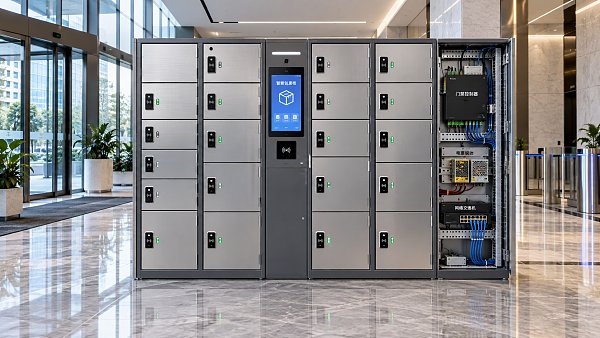
Inventory the hardware before making connection assumptions
Locker locks may be solenoid-driven, motorized, electronic cam locks, swing-handle locking units, or purpose-built intelligent locks with onboard sensors. Their electrical behavior matters. A controller output that is suitable for a standard low-current access-control relay may not safely power a motorized lock or handle its inrush current. A lock may also need a separate regulated power supply, a specified pulse duration, or polarity control.
Document each compartment or locker bank with the following details:
- Lock operating voltage, current draw, duty cycle, and whether it is fail-secure or fail-safe.
- Unlock method: maintained power, momentary pulse, reverse polarity, network command, or local controller command.
- Available feedback points, including door-open sensor, latch status, lock fault, tamper switch, and cabinet power status.
- Reader type and credential format already used at the site.
- Controller capacity, output type, panel location, cable paths, and available network ports.
Fail-secure and fail-safe behavior needs particular care. A parcel compartment that opens automatically during power loss may expose stored goods, while a compartment that stays locked can complicate emergency procedures or maintenance. The proper choice depends on the compartment’s location, local life-safety requirements, means of egress, and the function of the locker. Parcel doors are generally not exit doors, but they may be situated in spaces that have specific emergency access procedures. The physical-security team and the responsible building safety personnel should agree on the intended behavior before commissioning.
Use one identity model, but keep parcel authorization separate
The most usable experience is usually one in which residents or employees use the credential they already understand: a card, mobile badge, PIN, or approved biometric credential. However, valid access to the building should not automatically permit access to every locker compartment. The integration needs a second decision: does this identity currently have a parcel allocated to this door?
A practical permission sequence may look like this:
- The user presents a credential at the locker reader or enters a collection code.
- The system verifies that the credential is active and belongs to an authorized identity.
- The locker application checks for an active parcel assignment, permitted collection period, and compartment state.
- The authorized compartment receives an unlock command.
- Door-open and door-close signals confirm the physical action.
- The parcel record changes only after the expected collection event is confirmed.
This logic prevents a valid credential from becoming a universal locker key. It also helps resolve disputed collections. If a card was accepted but the door never opened, the event history should show an authorization event without a confirmed collection. If the door opened but did not close, the system should create an operational exception rather than treating the parcel as fully collected.
Temporary access needs its own rules. Delivery personnel may require limited access to a delivery interface or a designated loading mode, not a permanent building credential. Recipients without registered cards may need a one-time PIN or QR code. Contractors and site staff may require time-limited administrative access. These permissions should expire automatically and should be traceable to a defined role or action.
Build the event map before commissioning
Integration failures are often not caused by a bad wire or API endpoint. They occur because the two systems use different meanings for the same event. “Door unlocked,” “door opened,” “parcel deposited,” and “parcel collected” are not interchangeable records.
Create an event map that identifies the source system, destination system, timestamp, user reference, locker or compartment identifier, and expected next state. At minimum, distinguish between authentication accepted, authentication denied, unlock command issued, lock released, door opened, door held open, door closed, tamper detected, power fault, communication fault, parcel deposited, and parcel collected.
Use a stable identity reference rather than depending only on a display name or card number. Card numbers can be reissued, mobile credentials can be replaced, and a person’s access entitlement can change. A unique internal identifier, synchronized through a controlled integration process, reduces the chance that a recycled credential receives access to an old parcel assignment.
Protect the connection like a security system, not a convenience feature
A parcel locker connected to an access-control network becomes part of the physical-security boundary. The integration should use authenticated communication, restricted service accounts, encrypted transport where supported, and network segmentation appropriate to the site design. Do not expose locker controllers or management interfaces directly to the public internet simply to enable remote support or courier access.
Permissions for the integration account should be limited to the actions it needs. A locker application may need to validate selected identities and write defined events, but it should not automatically have broad rights to change building-wide access groups, issue credentials, or alter controller configurations. Administrative interfaces also need role separation: the staff member who handles a missed delivery may not need the ability to change emergency-release settings.
Credential data deserves the same discipline. Store only the identifiers and personal information required for operation. If biometric access is used at the building level, the locker integration should normally receive an authorization result or secure identity reference, not raw biometric templates.
Plan for offline operation and exception handling
Network interruption is not unusual in basements, loading areas, outdoor locker locations, or sites where network changes are managed separately from the security team. The key question is not whether an outage can occur, but what the locker should do during one.
Decide in advance whether approved users can retrieve parcels when the central platform is unavailable. Local cached authorization may support continuity, but the cache must have limits: expiration rules, revocation handling, restricted scope, and secure storage. For higher-risk environments, the chosen policy may be to deny new releases during a communication failure while allowing supervised staff recovery. Neither approach is universally correct; the decision should match the value of stored items, operating hours, and available support procedures.
Also define manual recovery without turning it into an uncontrolled bypass. Authorized staff may need a mechanical override, a local maintenance credential, or a supervised release procedure for a jammed door, abandoned parcel, or lock fault. Every override should be logged, and the compartment should be inspected before being returned to service. A door that appears closed but does not confirm latch engagement should not be marked available for the next delivery.
Test real workflows, not just unlock commands
Commissioning should include more than presenting a valid card and hearing a lock click. Test active and disabled credentials, collection after credential replacement, expired pickup codes, repeated scans, delivery deposits, door-held-open alarms, forced-door events, controller reboot, network loss, power restoration, and failed lock feedback. Where an alarm or emergency interface is involved, test the agreed sequence under the site’s approved safety procedure.
Acceptance testing should confirm that the system can reconcile state after an interruption. For example, if a door opened during a network outage and later closed, the locker platform must not leave the compartment permanently marked as unknown. The system should identify the last confirmed state, flag any uncertainty, and direct staff to inspect only the compartments that require attention.
Questions that often arise during integration
Can existing access cards be used to collect parcels?
Yes, provided the locker reader and access-control system support the same credential technology or can translate credential identifiers securely. The card validates identity; the locker application still needs to verify that the person has an active parcel assignment.
Do I need one controller output for every compartment?
Not always. Intelligent locker controllers can manage multiple locks through a local networked module. Individual control and individual door-state feedback are still important, because grouped releases reduce accountability and make exception handling harder.
Should locker events appear in the access-control audit log?
Relevant events should be available to the security operation, especially denied attempts, forced openings, tamper conditions, and administrative overrides. Parcel-specific details can remain in the locker system when they are not needed for routine access monitoring, provided the records can be correlated during an investigation.
A reliable integration is achieved when identity validation, compartment assignment, physical lock control, door feedback, and audit records remain consistent under normal use and under failure conditions. Treating the locker as a monitored access point with parcel-specific authorization produces a more controlled result than adding an unlock relay after the system has already been designed.
Have questions about this sector analysis, or seeking best practices specific to your niche? Drop us a line below and let the senior consultants at MHLS assist you.
We respect your privacy. Your information is strictly confidential.
Recommended News
 Physical Security Infrastructure Cost: Budgeting for Installation and MaintenanceUnmanned Terminal FellowUnderstand physical security infrastructure cost and build a smarter budget for installation, maintenance, and long-term ownership.
 Financial Facility Security: Choosing Vault Doors for Bank BranchesVault Structural ArchitectStrengthen financial facility security with the right bank vault door. Explore certification, installation, locking controls and maintenance before you buy.
 MACO Acquires Majority Stake in Fingerprint Access Provider ekeyProf. Elara SterlingMACO acquires a majority stake in ekey, bringing fingerprint access and door hardware closer together. Discover what the deal could mean for smart buildings.
 Physical Security System Engineering: From Risk Assessment to System DesignUnmanned Terminal FellowExplore physical security system engineering, from risk assessment to integrated design, procurement and testing. Build a safer, more resilient facility.
 Apple Home Collection Smart Lock and Other Accessories Open for Preorder November 13Biometric Auth ScientistApple Home Collection preorders open November 13, 2026. Explore the LG smart lock’s Matter and Aliro support and what buyers should verify before ordering.
 Choosing Servo-Driven Flap Barriers: Throughput, Safety and Access ControlAccess Control StrategistServo-driven flap barriers can balance throughput, safety and access control. Discover how to compare lanes, test performance and choose with confidence.
 Parcel Locker Network Pricing: Setup Costs, Fees and Contract TermsUnmanned Terminal FellowCompare parcel locker networks pricing, from setup costs and recurring fees to contract terms. Discover hidden charges and choose the right model.
 JR East Plans UWB Walk-Through Gates at 40 Stations in Spring 2028Access Control StrategistJR East plans UWB walk-through gates at 40 stations in spring 2028. Explore the rollout timeline and what suppliers should watch.
 Bank Vault Security Standards: UL and EN Ratings ExplainedVault Structural ArchitectExplore bank vault security standards and learn how UL 608 classes and EN 1143-1 grades differ, what they test, and how to verify certification before you buy.
 Mechanical Lock Hardware Prices: What Buyers Should Budget for Bulk OrdersMr. Gideon CrossMechanical lock hardware price is just the starting point. Discover what drives bulk-order costs and how to compare supplier quotes with confidence.
 IndexBox Forecasts Steady Global Security Keypad Market Growth Through 2035Dr. Valerius ThorneGlobal security keypad market growth is forecast at 3.3% annually through 2035. Explore the smart home and replacement trends shaping demand.
 Choosing an Infrared Safety Sensors Manufacturer: What Buyers Should CheckUnmanned Terminal FellowChoosing an infrared safety sensors manufacturer? Compare safety evidence, integration, environmental performance and lifecycle costs before you buy.











