
How Should Parcel Lockers Handle Offline Access and Post-Outage Data Sync?
What should happen when a parcel locker loses network connection? It should continue only the transactions it can authorize securely, record every access attempt locally, and clearly identify operations that require connectivity. When service returns, it should reconcile those records with the central platform before releasing uncertain compartments for new deliveries.
Keeping the touchscreen responsive is only part of the requirement. A credible offline design must establish who may open which door, how long that permission remains valid, and what happens if power fails during an opening. Recovery must preserve the difference between an unlock command, a door opening, and a confirmed parcel collection.
Separate a network outage from a power or controller failure
A locker can lose its connection while its controller, reader, locks, and sensors remain operational. Local authorization is then possible if the necessary credentials and policies are already available. A powered cabinet with a failed controller presents a different problem: cached permissions offer little help if the equipment that evaluates them cannot run.
Power loss also changes the physical constraints. Backup power must support the components needed to complete a transaction, including lock actuation and durable event recording. A display that remains lit does not prove that a door can open or that its opening will survive in the audit log.
For parcel compartments, preserving secure closure during power loss is generally desirable. Staff service access still needs a controlled procedure. Any building egress obligations belong to the applicable access design and should not be inferred from parcel-locker behavior.
Offline access needs a limited, verifiable permission
An offline locker needs evidence it can validate locally. This may be a previously provisioned authorization record or a digitally signed credential presented by a phone or QR code. A signature allows the controller to verify the issuer and detect alteration; the permission must also identify the intended locker, parcel or compartment assignment, permitted action, and validity period.
A QR code is simply a carrier for data. Its appearance does not make it secure, and copying an image should not create another usable pickup right. For numeric codes, local guessing limits and protection of stored verification data matter because the cloud cannot enforce those controls during an outage.
Credential validation should answer several practical questions:
- Does this permission apply to this cabinet and its current parcel assignment?
- Is the requested action allowed, and is the permission still within its validity window?
- Has it already been used, reserved by another transaction, or revoked in the latest locally available records?
- Can the controller record the decision durably before attempting to open the door?
Binding permission to the current assignment matters because compartments are reused. A credential tied only to a door number could otherwise become dangerous when a different parcel occupies that door.
Revocation creates an unavoidable boundary: a disconnected locker cannot learn about a newly canceled credential unless it has another working communication path. Shorter validity periods reduce that exposure but also shorten useful offline operation. The acceptable window should reflect parcel value, site supervision, and the consequences of unauthorized collection.
Expiration also depends on trustworthy time. A clock that resets or moves backward can extend permission unintentionally. The design should retain a trusted time reference, detect suspicious changes, and define what happens when time uncertainty becomes too large. Requiring online validation in that condition is a reasonable restriction.
Pickup and delivery need different offline rules
Collection is usually easier to support offline because the parcel already has an established location and recipient permission. New deliveries require the system to allocate capacity and prevent competing assignments. A compartment that appears empty in a stale cloud record may already contain a parcel deposited locally.
Offline delivery therefore needs explicit allocation authority. One approach gives the local controller control of a defined compartment pool while the central platform avoids assigning those compartments independently. Another suspends new deposits during disconnection while allowing previously authorized pickups. Both can be appropriate, depending on service requirements and system architecture.
The same concern applies when several controllers share a cabinet bank. A single-use credential must have one authoritative redemption point, or the controllers need a coordination mechanism that remains available. Independent copies of an unused credential can otherwise permit multiple attempts before synchronization exposes the conflict.
The interface should explain the available service plainly: collection available, deliveries paused, or online verification required. It should also distinguish a locally confirmed pickup from a notification still waiting to reach the central system. Users should not need to repeat an opening because a remote confirmation is delayed.
Record the transaction before acting on the lock
Offline reliability depends on durable local storage. An event queue held only in memory can disappear during a restart. The controller should persist the authorization decision and transaction intent before issuing the unlock command, then append the observed outcome as the operation progresses.
A useful record links the transaction identifier, cabinet and compartment identity, assignment version, credential reference, action, local event sequence, timestamp, and result. Sensitive credentials should not be copied into logs unnecessarily. Integrity protection and access controls help preserve the records as audit evidence.
The transaction should distinguish authorization accepted, unlock requested, door opened, and door closed. Parcel presence is a separate observation where suitable sensing exists. A closed door alone does not establish that the recipient removed the parcel, just as an unlock command does not establish that the mechanism moved.
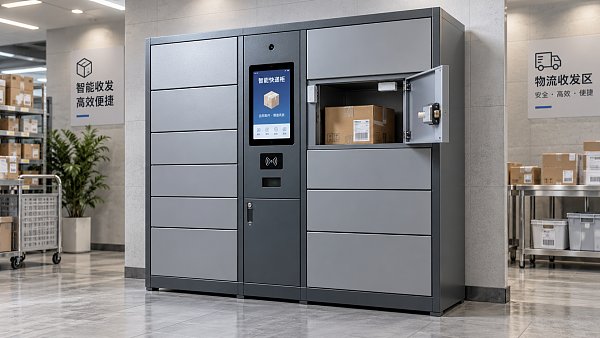
Consider a restart immediately after the lock receives an opening command. On recovery, the controller should inspect its persisted intent and available sensor evidence. Blindly repeating the command could reopen a door; marking the pickup complete could conceal a failed opening. An uncertain result needs a defined recovery state that preserves evidence and controls further access.
Single-use credentials also need a controlled retry path. Reserving the credential before actuation prevents concurrent redemption, but a jammed lock should not leave the user with an unexplained failure. Any retry should remain bound to the same transaction and compartment, with limits that prevent it from becoming reusable access.
Storage exhaustion must have a policy. If the controller cannot reliably record another transaction, silently overwriting unacknowledged access events undermines recovery. The system should warn before capacity is exhausted and restrict operations when it can no longer preserve the required evidence.
Reconnect through reconciliation, not a bulk overwrite
When connectivity returns, both sides may hold valid information the other has not seen. The locker may have completed pickups while the platform processed cancellations or new reservations. Recovery needs explicit rules for combining those changes.
Make retries safe
Each transaction needs a stable identifier that survives retries and controller restarts. The platform should recognize an uploaded event it has already accepted and avoid repeating its business effects, such as recording another collection or sending another completion notification.
This is idempotent processing: receiving the same operation again produces the same business result. It matters because a server can accept an upload while its acknowledgment is lost. The controller must then retry without creating a duplicate transaction.
Local records should remain available until the platform durably acknowledges them. Recovery should identify missing sequence ranges and handle partially uploaded batches. A successful connection alone is insufficient evidence that the backlog has been reconciled.
Resolve conflicts according to their meaning
Using the latest timestamp to choose a winning record is unreliable when clocks differ or records describe different facts. A cloud cancellation, local door opening, and later sensor reading should not overwrite one another as though they were equivalent status updates.
If a pickup occurred offline before a cancellation reached the cabinet, recovery should retain the pickup evidence and flag the authorization conflict. If the cloud assigns a new parcel to a compartment still occupied locally, that assignment should be blocked pending resolution. Physical observations, permissions, and business status need distinct treatment.
After uploading events and receiving policy changes, the controller should compare compartment states and assignment versions with the platform. Unresolved compartments should remain unavailable for reassignment. An authorized operator can then resolve exceptions through an action that is itself logged.
Short bursts of connectivity make this harder. A connection that lasts only long enough to upload half the backlog must not trigger an unrestricted return to normal operation. Recovery should resume from acknowledged progress, preserve pending work, and prevent new assignments from racing with unresolved offline activity.
Demonstrate failure handling before accepting the system
A useful acceptance exercise follows a parcel through disconnection, local access, interruption, and recovery. Demonstrating that a cached code opens a door proves only one part of the design. The exercise should inspect the cabinet’s behavior and the resulting central records.
- Disconnect before pickup: Test valid, expired, wrong-cabinet, and previously used credentials. Check local attempt limits and recorded rejection reasons.
- Restart during an opening: Interrupt the controller after authorization and around lock actuation. Check recovery of transaction intent and treatment of uncertain door state.
- Lose the upload acknowledgment: Allow the platform to accept an event, then interrupt communication. Confirm that retrying creates one completed transaction.
- Create an allocation conflict: Combine local activity with a competing cloud assignment. Confirm that the affected compartment cannot be reused silently.
- Exhaust an operating limit: Exercise credential expiry, uncertain clock state, and constrained log capacity. Check that restrictions match the documented policy.
- Restore an unstable connection: Reconnect intermittently and confirm that synchronization resumes without missing events or premature completion.
Review the evidence together: local sequence records, platform acknowledgments, compartment observations, and operator-visible exceptions. A dashboard showing “online” should be separate from indicators showing that the event backlog is cleared and compartment reconciliation is complete.
Before selection, request a failure-state diagram, the offline authorization policy, the local event format, and the synchronization conflict rules. Those documents should explain exactly when access continues, when it stops, and how uncertain transactions are resolved. A parcel locker’s offline capability is credible when it can preserve that chain from permission to physical action to reconciled record.
Have questions about this sector analysis, or seeking best practices specific to your niche? Drop us a line below and let the senior consultants at MHLS assist you.
We respect your privacy. Your information is strictly confidential.
Recommended News
 Financial Facility Security: Choosing Vault Doors for Bank BranchesVault Structural ArchitectStrengthen financial facility security with the right bank vault door. Explore certification, installation, locking controls and maintenance before you buy.
 MACO Acquires Majority Stake in Fingerprint Access Provider ekeyProf. Elara SterlingMACO acquires a majority stake in ekey, bringing fingerprint access and door hardware closer together. Discover what the deal could mean for smart buildings.
 Physical Security System Engineering: From Risk Assessment to System DesignUnmanned Terminal FellowExplore physical security system engineering, from risk assessment to integrated design, procurement and testing. Build a safer, more resilient facility.
 Apple Home Collection Smart Lock and Other Accessories Open for Preorder November 13Biometric Auth ScientistApple Home Collection preorders open November 13, 2026. Explore the LG smart lock’s Matter and Aliro support and what buyers should verify before ordering.
 Choosing Servo-Driven Flap Barriers: Throughput, Safety and Access ControlAccess Control StrategistServo-driven flap barriers can balance throughput, safety and access control. Discover how to compare lanes, test performance and choose with confidence.
 Parcel Locker Network Pricing: Setup Costs, Fees and Contract TermsUnmanned Terminal FellowCompare parcel locker networks pricing, from setup costs and recurring fees to contract terms. Discover hidden charges and choose the right model.
 JR East Plans UWB Walk-Through Gates at 40 Stations in Spring 2028Access Control StrategistJR East plans UWB walk-through gates at 40 stations in spring 2028. Explore the rollout timeline and what suppliers should watch.
 Bank Vault Security Standards: UL and EN Ratings ExplainedVault Structural ArchitectExplore bank vault security standards and learn how UL 608 classes and EN 1143-1 grades differ, what they test, and how to verify certification before you buy.
 Mechanical Lock Hardware Prices: What Buyers Should Budget for Bulk OrdersMr. Gideon CrossMechanical lock hardware price is just the starting point. Discover what drives bulk-order costs and how to compare supplier quotes with confidence.
 IndexBox Forecasts Steady Global Security Keypad Market Growth Through 2035Dr. Valerius ThorneGlobal security keypad market growth is forecast at 3.3% annually through 2035. Explore the smart home and replacement trends shaping demand.
 Choosing an Infrared Safety Sensors Manufacturer: What Buyers Should CheckUnmanned Terminal FellowChoosing an infrared safety sensors manufacturer? Compare safety evidence, integration, environmental performance and lifecycle costs before you buy.
 Choosing a Security Material Testing Service: What to Check for Lock and Safe MaterialsProf. Elara SterlingChoose a security material testing service with confidence. Learn what to check for lock and safe materials, from attack methods and accreditation to reliable reports.











