
Outdoor Parcel Locker Installation Cost: Budgeting for Site, Power, and Network Work
The cabinet price is only one part of the budget. For an outdoor deployment, the larger cost surprises usually come from the work required to make the locker safe, reachable, powered, connected, and maintainable in its final location. A low-priced locker placed on a difficult site can cost more to deploy than a higher-priced unit installed beside existing utilities.
When estimating outdoor parcel locker installation cost, separate the purchase into two budgets from the beginning: the locker system itself and the site-enablement work around it. This prevents a supplier quotation from being treated as a complete installed cost when it only covers equipment delivery and basic assembly.
A realistic scope normally includes site survey, civil works, electrical supply, communications, installation labor, accessibility and safety measures, commissioning, and a contingency for conditions found after work begins. The right budget is not a universal number. It depends heavily on whether the selected location already has a sound hard surface, spare electrical capacity, and dependable network coverage.
Start with the location, not the locker configuration
Before comparing locker banks, identify the exact installation position and inspect it as a construction site. Outdoor parcel lockers need more than enough ground area for cabinet footprints. Couriers need room to approach, load parcels, open doors, and leave without blocking pedestrians, vehicle circulation, fire access, or building entrances. Users need a clear, well-lit route that remains practical in poor weather and for people using mobility aids.
A location near a building entrance may look convenient but can be expensive if it interferes with drainage, emergency egress, landscaping, or existing underground services. A location at the edge of a parking area may provide better vehicle access, yet require longer trenching runs for power and data. Neither option is automatically better; the installed cost should be compared against operational value.
Measure the proposed area and document the route from the nearest electrical source and network connection. Also record slopes, curbs, utility covers, drainage channels, trees, overhead structures, irrigation systems, and traffic paths. These details determine whether the installation is straightforward or becomes a civil-work project.
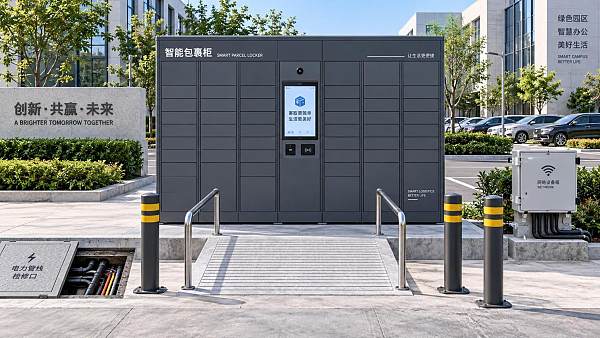
Site preparation often determines the budget range
Outdoor lockers require a stable, level, durable base. The cabinet manufacturer may specify anchor points, load distribution requirements, clearances, and permitted slope tolerances. These requirements should drive the pad design rather than being addressed after concrete has been poured.
In a simple site, preparation may involve a small concrete pad, anchors, and minor surface restoration. More difficult locations can require excavation, sub-base work, drainage adjustments, curb changes, bollards, ramps, or protection from vehicle impact. Existing asphalt is not automatically an acceptable mounting surface. Its thickness, condition, and supporting base may not provide reliable anchoring over the locker’s service life.
Water management deserves particular attention. A locker installed where runoff accumulates can develop avoidable problems with door operation, corrosion, cabinet stability, and user access. The aim is not merely to keep water out of the electronics. Standing water, splashback, and freeze-thaw movement can affect the whole installation. A slightly higher pad or a different position may reduce both construction risk and future maintenance burden.
Ask suppliers to state in writing what foundation conditions their warranty and installation instructions require. Then make sure the civil contractor is pricing the specified scope, including reinstatement of paving, landscaping, and protective finishes. A quote that says “concrete base by others” is not a minor exclusion; it is a major cost item that needs its own defined scope.
Power is a design decision, not a last-minute connection
Outdoor smart lockers need a reliable electrical supply for controls, displays, electronic locks, lighting, heating or cooling features where fitted, and communications equipment. The required capacity varies by locker model and installed options, so the electrical load should come from the selected system documentation rather than an assumption based on cabinet size.
The practical question is whether there is spare capacity in a nearby panel and a suitable route to the locker. If the answer is yes, the work may be relatively contained. If the nearest usable source is across a roadway, beneath finished landscaping, or inside a building with constrained electrical infrastructure, trenching, conduit, protection, panel modifications, and reinstatement can become a significant share of total installation cost.
Outdoor equipment also needs a proper disconnecting arrangement, protected cabling, grounding, and weather-appropriate enclosures. These are not optional refinements. They affect safety, fault isolation, service access, and the reliability of the locker network. A contractor should be able to identify where the circuit begins, how the cable is protected, how the equipment is isolated for maintenance, and who is responsible for each element.
Solar-powered lockers can reduce dependence on a trench-fed electrical connection in suitable locations, but they should not be treated as a universal low-cost substitute. Site orientation, shading, local weather, battery servicing, power demand, and the need for continuous operation all influence whether this approach is appropriate. It can simplify a remote site, but it can also introduce different design and maintenance requirements.
Network connectivity should be budgeted as an operating requirement
A smart parcel locker is only as usable as its communications path. Door events, delivery records, user notifications, remote monitoring, software updates, and fault reporting depend on a stable connection. A visible mobile signal on a phone is not enough evidence that the installed locker controller will have dependable service inside a metal enclosure.
There are usually two broad approaches: a wired network connection or cellular connectivity. Wired service can offer a controlled connection where building infrastructure and cable routes are available. It may, however, add trenching and coordination with property IT teams. Cellular connectivity can be faster to deploy where coverage is strong, but it introduces recurring service costs and requires a deliberate plan for signal testing, antenna placement, account management, and outage response.
Connectivity costs should be evaluated over the operating period, not only at launch. A low initial installation cost may be less attractive if the network arrangement creates recurring management work or leaves the site dependent on inconsistent coverage. For deployments that connect into access control, property-management, or delivery platforms, include integration testing and responsibility for troubleshooting across system boundaries.
Delivery, placement, and assembly need their own scope
Outdoor lockers are heavy, modular physical assets. Freight pricing may not include offloading, long-distance movement across a site, lifting over obstacles, crane use, or assembly in the final position. Access restrictions can change the method entirely: narrow gates, underground parking limits, soft ground, stairs, pedestrian-only zones, and delivery-hour restrictions all affect labor and equipment needs.
Do not assume the shipping crew is the installation crew. Confirm who receives the equipment, inspects it for transit damage, unloads it, positions it, anchors it, connects utilities, tests the doors, and removes packaging. These handoffs are a common source of scope gaps because each party may reasonably assume another contractor owns the work.
Modular expansion is often attractive, but it also affects installation planning. If future locker banks will occupy adjacent space, the original pad, conduit route, electrical allowance, and network design should anticipate that expansion. Building only for the initial cabinet count can make a later addition disproportionately disruptive.
Include the work that makes the site usable after handover
Commissioning should verify more than power-on status. The installer and system provider should test door operation, electronic locking, display or user interface functions, connectivity, remote visibility, notification workflows, and recovery procedures for common faults. Where the locker integrates with a delivery platform or property system, test real operating journeys rather than only a technical connection.
Security measures also have a cost implication. Depending on the location, the installation may need lighting, surveillance coverage, bollards, access controls, or a protective canopy. These measures should be selected because of a defined site risk, not added automatically. A locker in a controlled residential courtyard has different exposure from one beside an unsupervised public parking area. The same cabinet can require very different surrounding protection.
Maintenance access is another overlooked item. Doors, modules, controllers, and communication equipment will eventually require inspection or replacement. Leave working clearance, avoid blocking service panels, and define who can safely isolate power. A visually neat installation that cannot be serviced without disrupting traffic or removing adjacent structures becomes expensive over time.
Build the budget as a scope matrix
The most useful procurement document is not a single headline price. It is a scope matrix that assigns every installation task to a named party. This makes competing proposals comparable and exposes omissions before a purchase order is issued.
- Locker supplier: equipment configuration, factory options, shipment terms, installation requirements, software setup, and commissioning support.
- Civil contractor: survey support, excavation, foundation, drainage, paving restoration, protective barriers, and site cleanup.
- Electrical contractor: load assessment, circuit provision, trenching or cable routing, protective hardware, connection, and electrical testing.
- Network or IT provider: wired or cellular service, firewall and access requirements, device enrollment, monitoring, and support ownership.
- Property representative: site permissions, design approval, access windows, utility records, user-route decisions, and coordination with local requirements.
Add a contingency line for concealed conditions and late design changes. This is especially important when underground utility records are incomplete, the final location has not been opened up, or the project depends on several independent contractors. Contingency is not a substitute for surveying; it is protection against the risks that remain after reasonable planning.
Common budget errors that create avoidable change orders
The first error is comparing equipment-only quotations as though they were installed-project prices. The second is selecting a locker location before checking utility routes and drainage. The third is allowing civil, electrical, and network scopes to be quoted separately without a shared site drawing or clear responsibility for trench restoration.
Another mistake is choosing the largest locker bank that fits physically, then discovering it constrains circulation, delivery access, or accessibility. Capacity should be determined by parcel volume, size mix, peak delivery patterns, dwell time, and expected expansion, not simply by available wall length. An oversized installation can inflate construction requirements; an undersized one can force an early and costly expansion.
It is also risky to treat a cellular connection as a complete network strategy. The operating team still needs a plan for subscriptions, device ownership, remote support, alerts, and what happens when connectivity is interrupted. Similarly, a building network connection should not be assumed available until IT requirements and ownership boundaries are defined.
A practical sequence before approving the order
- Choose two or three viable locations based on courier access, user access, security exposure, and operational visibility.
- Conduct a site survey that maps the cabinet footprint, expansion area, drainage, utility routes, obstructions, and delivery path.
- Obtain the selected locker’s foundation, power, connectivity, environmental, and clearance requirements.
- Price civil, electrical, connectivity, delivery, installation, and reinstatement work against the same drawing and scope matrix.
- Review approvals, accessibility, safety, and property requirements before equipment is released for manufacture or shipment.
- Confirm commissioning tests, acceptance criteria, ownership of recurring network services, and maintenance access before handover.
For procurement teams evaluating smart parcel locker infrastructure, the useful comparison is the cost of a functioning service point, not the cost of steel cabinets delivered to site. Sources such as Global Smart Hardware & Physical Security Systems can help frame supplier evaluation around physical security, electronic lock reliability, IoT connectivity, and deployment conditions. The final selection should still be grounded in the actual site: the shortest utility route, the most workable delivery path, and the clearest operating responsibility often matter more than a modest difference in cabinet price.
Have questions about this sector analysis, or seeking best practices specific to your niche? Drop us a line below and let the senior consultants at MHLS assist you.
We respect your privacy. Your information is strictly confidential.
Recommended News
 Parcel Locker Network Pricing: Setup Costs, Fees and Contract TermsUnmanned Terminal FellowCompare parcel locker networks pricing, from setup costs and recurring fees to contract terms. Discover hidden charges and choose the right model.
 JR East Plans UWB Walk-Through Gates at 40 Stations in Spring 2028Access Control StrategistJR East plans UWB walk-through gates at 40 stations in spring 2028. Explore the rollout timeline and what suppliers should watch.
 Bank Vault Security Standards: UL and EN Ratings ExplainedVault Structural ArchitectExplore bank vault security standards and learn how UL 608 classes and EN 1143-1 grades differ, what they test, and how to verify certification before you buy.
 Mechanical Lock Hardware Prices: What Buyers Should Budget for Bulk OrdersMr. Gideon CrossMechanical lock hardware price is just the starting point. Discover what drives bulk-order costs and how to compare supplier quotes with confidence.
 IndexBox Forecasts Steady Global Security Keypad Market Growth Through 2035Dr. Valerius ThorneGlobal security keypad market growth is forecast at 3.3% annually through 2035. Explore the smart home and replacement trends shaping demand.
 Choosing an Infrared Safety Sensors Manufacturer: What Buyers Should CheckUnmanned Terminal FellowChoosing an infrared safety sensors manufacturer? Compare safety evidence, integration, environmental performance and lifecycle costs before you buy.
 Choosing a Security Material Testing Service: What to Check for Lock and Safe MaterialsProf. Elara SterlingChoose a security material testing service with confidence. Learn what to check for lock and safe materials, from attack methods and accreditation to reliable reports.
 How Precision Anti-Pick Lock Cylinders Resist ManipulationSecurity Metallurgy ExpertDiscover how precision anti-pick lock technology resists manipulation, and learn what to check when comparing security features, test evidence, and everyday reliability.
 Dermalog Joins NIST FastCAP Program for Contactless Fingerprint TestingProf. Elara SterlingDermalog joins the NIST FastCAP program for contactless fingerprint testing. Discover what this means for biometric identification and digital identity.
 Choosing Security Export Compliance Services: What Providers Should CoverMr. Gideon CrossSecurity export compliance services can help prevent costly delays. Discover what to look for in classification, licensing, screening, and documentation.
 European Security Compliance Standards for Safes: EN 1143-1 vs EN 14450Dr. Valerius ThorneExplore security compliance standards Europe buyers need to know. Compare EN 1143-1 and EN 14450 to choose the right safe with confidence.
 HID Global Acquires inepro ID to Expand RFID and BLE Access SolutionsUnmanned Terminal FellowHID Global acquires inepro ID to expand RFID and BLE access solutions for printers, smart lockers and shared devices. Explore what the deal could mean for your organization.











