
Smart Locker Solutions for Apartments vs Parcel Rooms: Which Fits Multi-Family Projects?
Why this choice matters more than it used to
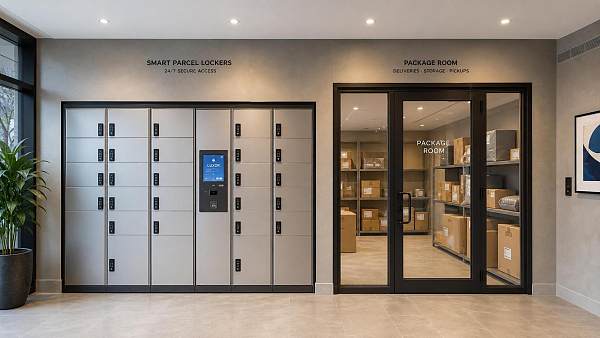
Package volume in multi-family housing has changed the math of building operations.
A few years ago, parcel handling was treated as a convenience issue.
Now it sits closer to access control, risk management, and resident retention.
That is why smart locker solutions for apartments are being evaluated alongside traditional parcel rooms, not after them.
The real question is not which option sounds more modern.
The better question is which model fits parcel volume, labor capacity, building layout, and delivery security expectations.
In practical terms, both models can work.
But they solve different operational problems and create different long-term obligations.
Within SHPS coverage, parcel systems are not isolated amenities.
They belong to the wider physical security stack, together with electronic locks, access platforms, and smart building controls.
Are smart lockers and parcel rooms solving the same problem?
Not exactly.
A parcel room is mainly a shared storage zone.
It depends on room access rules, camera coverage, staff oversight, and resident behavior.
Smart locker solutions for apartments work more like controlled handoff infrastructure.
Each parcel is assigned to a locked compartment, usually with digital notification and retrieval records.
That difference matters because chain of custody changes.
In a parcel room, several people may enter the same space.
In a locker system, each delivery is tied to a specific box event.
This usually improves accountability for missing packages, failed notifications, and resident disputes.
It also changes workflow for carriers.
Some can complete drop-off faster with lockers.
Others slow down if compartment sizes are mismatched or software steps are unclear.
So when comparing options, start with the operating model, not the furniture format.
When do smart locker solutions for apartments usually outperform parcel rooms?
They usually win when parcel volume is high and staffing is limited.
They also perform well where theft claims, delivery disputes, or after-hours access are already pain points.
The advantage is not only convenience.
It is repeatable control.
That includes audit trails, timed pickup alerts, remote management, and more predictable package turnover.
In mixed-use or premium projects, smart locker solutions for apartments also support resident experience goals.
The pickup process feels organized, and front desk interruption tends to decrease.
More importantly, the hardware can often integrate with wider building security logic.
That may include credential management, remote unlock policies, event logging, and IoT status monitoring.
SHPS often frames this as a systems question.
If the building already values electronic lock reliability, access control coordination, and operational traceability, lockers fit naturally.
- High daily package counts with regular peak periods
- Limited onsite staff for intake and dispute handling
- Frequent resident complaints about missed or lost deliveries
- Projects seeking measurable security events and digital records
- Buildings where unattended delivery is expected every day
Where can a parcel room still be the better fit?
Parcel rooms still make sense in more cases than vendors sometimes admit.
They are often better when package sizes vary widely, oversized items are common, or floor area is available but capital budgets are tight.
A room is also more forgiving during abnormal volume spikes.
Holiday overflow, grocery bags, furniture parts, and irregular courier behavior can overwhelm fixed locker banks.
That does not mean a parcel room is simple.
It means its flexibility comes from space, not automation.
The tradeoff is that security performance depends heavily on access design.
A room with weak door hardware, poor surveillance, or shared access codes can become a liability fast.
In practical deployments, the stronger parcel rooms behave more like controlled security zones.
They use commercial-grade doors, reliable electronic locks, clear event logs, and camera coverage aligned with entry points.
Without those controls, the lower upfront cost may be offset by recurring claims and staff time.
A quick decision table helps narrow the choice
The comparison below captures the most common selection signals.
What costs and implementation details are often underestimated?
The biggest mistake is comparing hardware price to room construction cost and stopping there.
That misses several operating variables.
Smart locker solutions for apartments may require power, network resilience, software onboarding, carrier workflow setup, and service support.
Parcel rooms may need reinforced doors, better locking hardware, surveillance upgrades, signage, and more staff supervision.
In other words, both models carry hidden costs.
They are just hidden in different places.
A useful evaluation should include five checkpoints.
- Expected parcel count by unit, not by building only
- Item size distribution, including groceries and oversized deliveries
- Required uptime, notification speed, and incident response process
- Integration with access control, credentials, and audit reporting
- Upgrade path for future expansion or mixed delivery models
Connectivity deserves special attention.
In SHPS intelligence coverage, 4G or 5G backup, electronic lock reliability, and remote diagnostics are not minor technical details.
They directly affect whether lockers remain dependable during network interruptions or service spikes.
What risks show up after installation if the choice was wrong?
The wrong choice rarely fails on day one.
It usually fails through friction that builds over months.
For lockers, the common risk is undersizing.
Compartments fill too early, carriers bypass the system, and staff create manual exceptions.
At that point, the building pays for automation but operates like a parcel room.
For parcel rooms, the usual risk is weak control discipline.
One shared space becomes crowded, retrieval disputes increase, and missing items become hard to verify.
Another overlooked issue is resident expectation drift.
Once a project promotes secure package handling, tolerance for delays and ambiguity drops quickly.
That is why security infrastructure should be judged like any other controlled access point.
Mechanical strength, lock reliability, audit visibility, and exception handling all matter.
A practical way to reduce selection mistakes
Before finalizing the model, confirm these operational questions:
- How many packages arrive on the heaviest day each week?
- What share of deliveries cannot fit standard compartments?
- Will couriers reliably use the intended process?
- What happens when the system is full or offline?
- Which security events must be logged for claims or compliance review?
So which model fits a modern multi-family project better?
There is no universal winner, but there is usually a more defensible fit.
Smart locker solutions for apartments tend to fit projects that value controlled delivery handoff, lower labor dependence, and measurable security performance.
Parcel rooms still fit projects that need flexible storage, support large-item volume, or have space conditions that make lockers inefficient.
In many developments, the strongest answer is a hybrid model.
Lockers handle routine parcels, while a secured room manages overflow and oversized items.
That approach often balances traceability with flexibility.
The next step is straightforward.
Map parcel volume, item profiles, space constraints, and security requirements before comparing suppliers.
Then assess hardware durability, electronic lock performance, connectivity options, audit functions, and expansion capacity as one decision set.
That is usually where better apartment package infrastructure decisions begin.
Have questions about this sector analysis, or seeking best practices specific to your niche? Drop us a line below and let the senior consultants at MHLS assist you.
We respect your privacy. Your information is strictly confidential.
Recommended News
 Physical Security System Engineering: From Risk Assessment to System DesignUnmanned Terminal FellowExplore physical security system engineering, from risk assessment to integrated design, procurement and testing. Build a safer, more resilient facility.
 Apple Home Collection Smart Lock and Other Accessories Open for Preorder November 13Biometric Auth ScientistApple Home Collection preorders open November 13, 2026. Explore the LG smart lock’s Matter and Aliro support and what buyers should verify before ordering.
 Choosing Servo-Driven Flap Barriers: Throughput, Safety and Access ControlAccess Control StrategistServo-driven flap barriers can balance throughput, safety and access control. Discover how to compare lanes, test performance and choose with confidence.
 Parcel Locker Network Pricing: Setup Costs, Fees and Contract TermsUnmanned Terminal FellowCompare parcel locker networks pricing, from setup costs and recurring fees to contract terms. Discover hidden charges and choose the right model.
 JR East Plans UWB Walk-Through Gates at 40 Stations in Spring 2028Access Control StrategistJR East plans UWB walk-through gates at 40 stations in spring 2028. Explore the rollout timeline and what suppliers should watch.
 Bank Vault Security Standards: UL and EN Ratings ExplainedVault Structural ArchitectExplore bank vault security standards and learn how UL 608 classes and EN 1143-1 grades differ, what they test, and how to verify certification before you buy.
 Mechanical Lock Hardware Prices: What Buyers Should Budget for Bulk OrdersMr. Gideon CrossMechanical lock hardware price is just the starting point. Discover what drives bulk-order costs and how to compare supplier quotes with confidence.
 IndexBox Forecasts Steady Global Security Keypad Market Growth Through 2035Dr. Valerius ThorneGlobal security keypad market growth is forecast at 3.3% annually through 2035. Explore the smart home and replacement trends shaping demand.
 Choosing an Infrared Safety Sensors Manufacturer: What Buyers Should CheckUnmanned Terminal FellowChoosing an infrared safety sensors manufacturer? Compare safety evidence, integration, environmental performance and lifecycle costs before you buy.
 Choosing a Security Material Testing Service: What to Check for Lock and Safe MaterialsProf. Elara SterlingChoose a security material testing service with confidence. Learn what to check for lock and safe materials, from attack methods and accreditation to reliable reports.
 How Precision Anti-Pick Lock Cylinders Resist ManipulationSecurity Metallurgy ExpertDiscover how precision anti-pick lock technology resists manipulation, and learn what to check when comparing security features, test evidence, and everyday reliability.
 Dermalog Joins NIST FastCAP Program for Contactless Fingerprint TestingProf. Elara SterlingDermalog joins the NIST FastCAP program for contactless fingerprint testing. Discover what this means for biometric identification and digital identity.











