
UL 365 Update Tightens U.S. Rules for Smart Parcel Lockers
On July 22, 2026, the U.S. Consumer Product Safety Commission (CPSC) formally made the revised UL 365-2026 standard mandatory for Outdoor Smart Parcel Lockers entering the U.S. market. The immediate point of attention is not only compliance itself, but the fact that the new requirement adds two separate checks: resistance to physical violent damage and protection against remote command hijacking at the network layer. For exporters, manufacturers, certification teams, logistics platform participants, and buyers serving the U.S. market, this matters because products without the updated certification cannot clear customs or be listed on major logistics platforms.
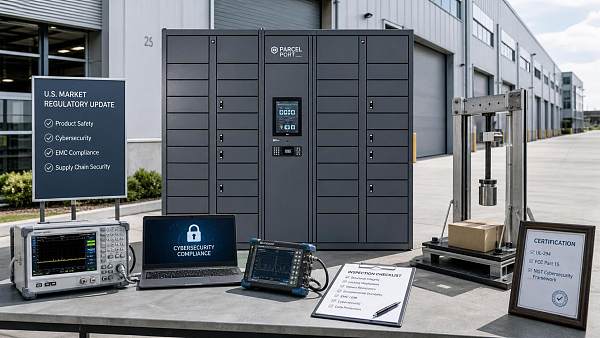
What the new requirement formally changes
According to the provided information, the CPSC began mandatory enforcement of the revised UL 365-2026 standard on July 22, 2026. The rule applies to Outdoor Smart Parcel Lockers entering the U.S. market.
The revised version adds two required areas of testing: physical anti-vandal or anti-forced-damage performance, and protection against remote instruction hijacking at the network layer. The same information also states that the change directly affects the UL certification route, testing cycle, and bill of materials cost for Chinese exporters.
It is also confirmed that products without certification under the updated version will not be able to clear customs or go live on major logistics platforms.
Where the pressure is likely to appear first
Export-facing product lines will face a certification bottleneck
From an industry perspective, companies shipping smart parcel lockers to the United States are likely to feel the first impact in compliance planning and shipment readiness. The reason is straightforward: the certification path itself has changed, and market access now depends on the updated version rather than prior assumptions about UL approval.
The business effect is likely to show up in model qualification, export scheduling, and communication with U.S.-bound customers. What deserves closer attention is whether current products in the sales pipeline are aligned with the revised testing scope.
Manufacturing and sourcing teams may see cost and component implications
Analysis shows that the mention of BOM cost is a practical signal for manufacturers and procurement teams. Once a standard adds tests related to physical destruction resistance and network-layer command security, the impact is not limited to documentation. It may also affect how product configurations are reviewed for U.S.-market versions.
The immediate concern for these teams is less about broad strategy and more about whether existing designs, component selections, and compliance documentation remain suitable for products destined for the United States.
Platform access and delivery execution become commercial risks
For channel operators, logistics platform participants, and delivery-side service providers, the clearest business risk lies in market entry interruption. The provided information states that products lacking the revised certification cannot clear customs or be listed on major logistics platforms.
That means the issue is not confined to factory testing. It extends into listing readiness, order fulfillment timing, and contract execution wherever U.S.-market delivery depends on compliant outdoor smart locker deployments.
What companies should track now
Check whether current certifications still match the required version
The first practical question is whether products already prepared for the U.S. market are certified under the newly mandatory UL 365-2026 requirements. Companies should distinguish between having a prior compliance basis and meeting the revised version now in force.
Review products that combine outdoor deployment with connected control
The new test structure matters especially where a product combines outdoor installation, physical access control, and network-connected command functions. The operational focus should be on identifying which SKUs, project bids, or export batches fall directly within the rule as described in the provided information.
Reassess timing across testing, shipment, and customer commitments
Because the provided information explicitly points to changes in testing cycle, companies should pay attention to how certification timing may affect delivery schedules. In practice, this is a coordination issue across testing arrangements, production planning, shipment release, and customer communication.
Prepare document and supplier coordination more carefully
Observably, this type of rule change increases the importance of version control in technical files, certification materials, and supplier-facing specifications. What deserves closer attention is whether upstream partners understand that access to the U.S. market now depends on the revised compliance threshold, not only on product availability.
How this should be read at this stage
Analysis shows that this is more than a routine standards update, because the consequences described in the provided information are directly tied to customs clearance and platform listing. At the same time, it is more appropriate to understand this as a concrete compliance shift rather than a broad market conclusion about all smart locker demand or all connected hardware categories.
Observably, the strongest signal here is that market access expectations for Outdoor Smart Parcel Lockers in the United States are becoming more specific in two directions at once: physical attack resistance and network-command security. That makes the development worth continued monitoring as an operating requirement, not merely as a policy headline.
Why the update matters beyond the headline
The significance of this development lies in its direct link between product qualification and commercial continuity. Based on the provided information, the revised UL 365-2026 requirement changes not only what must be tested, but also how exporters and related participants need to plan certification, cost, and delivery into the U.S. market.
At this point, it is more appropriate to understand the update as an active compliance threshold with immediate business relevance, while keeping further observation focused on implementation details, certification practice, and any follow-on clarification that may emerge from official or standards-related channels.
Basis of this article and what still needs verification
This article is based on the user-provided news title, event date, and event summary. The confirmed factual basis used here consists of the July 22, 2026 effective date, the CPSC-linked mandatory enforcement of the revised UL 365-2026 standard, the added dual testing requirements for physical damage resistance and remote command hijacking protection, and the stated impact on certification route, testing cycle, BOM cost, customs clearance, and major logistics platform listing.
For this type of development, source categories typically worth checking include official notices, standard-organization documents, company compliance disclosures, industry association updates, and reporting from authoritative trade media. No specific official source link was provided in the input, so the exact official reference still requires ongoing verification. Continued attention should be given to any further official wording, implementation clarification, or documentation guidance related to the revised standard.
Have questions about this sector analysis, or seeking best practices specific to your niche? Drop us a line below and let the senior consultants at MHLS assist you.
We respect your privacy. Your information is strictly confidential.
Recommended News
 Physical Security System Engineering: From Risk Assessment to System DesignUnmanned Terminal FellowExplore physical security system engineering, from risk assessment to integrated design, procurement and testing. Build a safer, more resilient facility.
 Apple Home Collection Smart Lock and Other Accessories Open for Preorder November 13Biometric Auth ScientistApple Home Collection preorders open November 13, 2026. Explore the LG smart lock’s Matter and Aliro support and what buyers should verify before ordering.
 Choosing Servo-Driven Flap Barriers: Throughput, Safety and Access ControlAccess Control StrategistServo-driven flap barriers can balance throughput, safety and access control. Discover how to compare lanes, test performance and choose with confidence.
 Parcel Locker Network Pricing: Setup Costs, Fees and Contract TermsUnmanned Terminal FellowCompare parcel locker networks pricing, from setup costs and recurring fees to contract terms. Discover hidden charges and choose the right model.
 JR East Plans UWB Walk-Through Gates at 40 Stations in Spring 2028Access Control StrategistJR East plans UWB walk-through gates at 40 stations in spring 2028. Explore the rollout timeline and what suppliers should watch.
 Bank Vault Security Standards: UL and EN Ratings ExplainedVault Structural ArchitectExplore bank vault security standards and learn how UL 608 classes and EN 1143-1 grades differ, what they test, and how to verify certification before you buy.
 Mechanical Lock Hardware Prices: What Buyers Should Budget for Bulk OrdersMr. Gideon CrossMechanical lock hardware price is just the starting point. Discover what drives bulk-order costs and how to compare supplier quotes with confidence.
 IndexBox Forecasts Steady Global Security Keypad Market Growth Through 2035Dr. Valerius ThorneGlobal security keypad market growth is forecast at 3.3% annually through 2035. Explore the smart home and replacement trends shaping demand.
 Choosing an Infrared Safety Sensors Manufacturer: What Buyers Should CheckUnmanned Terminal FellowChoosing an infrared safety sensors manufacturer? Compare safety evidence, integration, environmental performance and lifecycle costs before you buy.
 Choosing a Security Material Testing Service: What to Check for Lock and Safe MaterialsProf. Elara SterlingChoose a security material testing service with confidence. Learn what to check for lock and safe materials, from attack methods and accreditation to reliable reports.
 How Precision Anti-Pick Lock Cylinders Resist ManipulationSecurity Metallurgy ExpertDiscover how precision anti-pick lock technology resists manipulation, and learn what to check when comparing security features, test evidence, and everyday reliability.
 Dermalog Joins NIST FastCAP Program for Contactless Fingerprint TestingProf. Elara SterlingDermalog joins the NIST FastCAP program for contactless fingerprint testing. Discover what this means for biometric identification and digital identity.











