
What Drives Logistics Security Solutions Cost in Warehouses and Transit Hubs?
Why logistics security solutions cost changes from one site to another
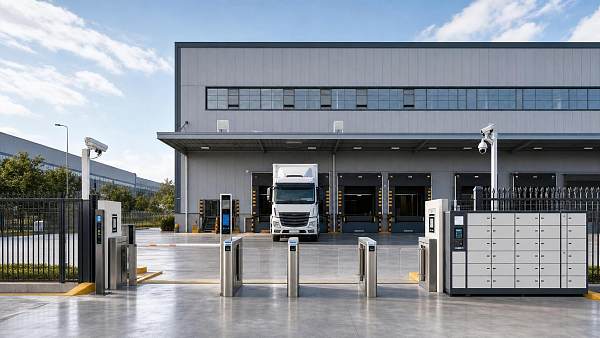
Logistics security solutions cost rarely comes from one device alone.
In warehouses and transit hubs, spending is shaped by traffic speed, asset value, access complexity, and expected downtime tolerance.
A small regional warehouse may need reliable perimeter control and camera coverage.
A high-volume cross-dock often needs anti-tailgating lanes, smart access control, locker networks, and stronger incident traceability.
That is why logistics security solutions cost should be read as a system-level question, not a product-price question.
In practical planning, the real issue is how physical security hardware, access logic, and operating flow work together under site pressure.
This is also where SHPS-style security intelligence matters.
The cost picture becomes clearer when smart hardware, mechanical barriers, biometric controls, parcel locker security, and compliance expectations are evaluated together.
The first cost split usually appears between storage-heavy and flow-heavy facilities
Not every logistics site protects risk in the same way.
Storage-heavy facilities concentrate value in fixed zones, while flow-heavy hubs manage constant movement through doors, gates, docks, and transfer lanes.
In storage-focused operations, logistics security solutions cost often rises with compartmentalization.
More protected rooms, stronger doors, hardened lock cylinders, and layered access rights add material and integration cost.
In transit hubs, cost grows faster around throughput control.
Turnstiles, speed gates, infrared anti-tailgating systems, visitor processing, and lane-safe egress design become more important than static barriers alone.
A common mistake is treating both environments as simple access control projects.
When the operating rhythm differs, the cost structure also changes.
Where budget pressure usually comes from
- More entry points requiring separate control logic
- Higher employee or contractor turnover
- Need for audit trails across shifts and vendors
- Mixed indoor and outdoor hardware exposure
- Integration with existing CCTV, alarm, or building systems
At loading docks, the cost driver is rarely the camera alone
Loading docks look simple until timing pressure is added.
Vehicles arrive, staff changes occur quickly, and pallets move through semi-controlled boundaries.
Here, logistics security solutions cost is influenced by how many decisions must be made in real time.
If dock access needs badge verification, trailer logging, door sensors, and exception alerts, the system moves beyond surveillance into active control.
That changes both software and hardware requirements.
More robust readers, industrial enclosures, protective doors, electronic locking, and event-linked video raise installation cost.
Maintenance costs also increase because docks face vibration, dust, impacts, and weather shifts.
The better approach is to define which dock events truly need automatic intervention.
Otherwise, systems become expensive without improving loss control.
High-volume parcel handling adds a different layer of logistics security solutions cost
Parcel operations create smaller loss events, but in far higher numbers.
This shifts spending toward traceability, user authentication, and compartment-level control.
Smart parcel lockers, electronic locks, IoT connectivity, and access logs become central.
When locker networks span multiple zones, logistics security solutions cost grows through communications reliability and service support.
A locker door failure is not just a hardware issue.
It can disrupt handover timing, customer claims, and chain-of-custody records.
That is why lower upfront pricing may become more expensive over time.
Sites with continuous parcel turnover often benefit from stronger lock cycle life, better remote diagnostics, and stable 4G or 5G fallback options.
Different logistics environments create different cost priorities
This comparison helps explain why logistics security solutions cost cannot be benchmarked accurately by square footage alone.
Restricted areas push spending toward stronger hardware and better identity control
Some zones need more than standard access credentials.
Pharmaceutical storage, customs-hold cargo, bonded goods, and return-fraud investigation rooms often require a higher proof threshold.
In these spaces, logistics security solutions cost increases because the physical layer must resist attack, not just discourage entry.
That may involve protective doors, anti-picking cylinders, reinforced frames, biometric readers, and tamper reporting.
The decision is not simply whether biometrics cost more.
The better question is whether badges, PINs, or shared credentials create too much uncertainty for that room.
Where incident accountability matters, stronger identity proof may reduce claim exposure and internal investigation cost.
That broader effect should be included in the cost calculation.
Integration depth often decides whether a low quote stays low
Many projects look affordable before integration is defined.
Then requirements emerge around access platforms, visitor systems, HR databases, alarm triggers, and video verification.
At that point, logistics security solutions cost shifts from device count to interoperability.
Open protocols, API readiness, event synchronization, and remote health monitoring all affect total spend.
The same issue appears with smart parcel locker fleets.
Standalone lockers may be cheaper initially, but networked deployments need stable dashboards, permission logic, firmware management, and fault alerts.
In security hardware markets, this is where hidden lifecycle cost usually sits.
SHPS coverage of IoT locker networks, access control platforms, electronic lock reliability, and physical security integration reflects this exact pressure point.
Cost questions worth answering before selection
- How many systems must exchange events in real time
- Whether credentials need biometric or multi-factor validation
- Which components must continue working during network disruption
- How quickly failed locks, readers, or sensors must be replaced
- Whether future expansion will reuse or replace the current platform
The most common cost misread happens after installation
Upfront equipment pricing is easy to compare.
Ongoing reliability is harder, yet it has more influence on long-term logistics security solutions cost.
Readers exposed to dust, locker locks cycling thousands of times, and gates used across every shift do not age equally.
Maintenance intervals, spare part access, firmware support, and technician availability should be treated as cost drivers from the start.
Another misread is copying a solution from a similar site.
Two transit hubs may handle similar volume but face different insurance conditions, labor patterns, or restricted goods rules.
Similar appearance does not mean equal risk logic.
That is why site surveys should include environment, workflow, compliance, and service constraints together.
A more useful way to estimate logistics security solutions cost
Start with operating conditions, not catalog categories.
Map where goods pause, where people transfer responsibility, and where unauthorized access would create the highest recovery burden.
Then rank each zone by access complexity, attack exposure, and downtime sensitivity.
That process gives more accurate logistics security solutions cost ranges than broad price averages.
A practical next step is to build a short comparison matrix.
List required hardware strength, identity method, integration depth, maintenance cycle, and expansion risk for each area.
When those conditions are visible, it becomes easier to separate necessary investment from feature overload.
For any warehouse or transit hub, the strongest decisions come from matching security architecture to real operating pressure, then confirming cost, timeline, and support against that reality.
Have questions about this sector analysis, or seeking best practices specific to your niche? Drop us a line below and let the senior consultants at MHLS assist you.
We respect your privacy. Your information is strictly confidential.
Recommended News
 Parcel Locker Network Pricing: Setup Costs, Fees and Contract TermsUnmanned Terminal FellowCompare parcel locker networks pricing, from setup costs and recurring fees to contract terms. Discover hidden charges and choose the right model.
 JR East Plans UWB Walk-Through Gates at 40 Stations in Spring 2028Access Control StrategistJR East plans UWB walk-through gates at 40 stations in spring 2028. Explore the rollout timeline and what suppliers should watch.
 Bank Vault Security Standards: UL and EN Ratings ExplainedVault Structural ArchitectExplore bank vault security standards and learn how UL 608 classes and EN 1143-1 grades differ, what they test, and how to verify certification before you buy.
 Mechanical Lock Hardware Prices: What Buyers Should Budget for Bulk OrdersMr. Gideon CrossMechanical lock hardware price is just the starting point. Discover what drives bulk-order costs and how to compare supplier quotes with confidence.
 IndexBox Forecasts Steady Global Security Keypad Market Growth Through 2035Dr. Valerius ThorneGlobal security keypad market growth is forecast at 3.3% annually through 2035. Explore the smart home and replacement trends shaping demand.
 Choosing an Infrared Safety Sensors Manufacturer: What Buyers Should CheckUnmanned Terminal FellowChoosing an infrared safety sensors manufacturer? Compare safety evidence, integration, environmental performance and lifecycle costs before you buy.
 Choosing a Security Material Testing Service: What to Check for Lock and Safe MaterialsProf. Elara SterlingChoose a security material testing service with confidence. Learn what to check for lock and safe materials, from attack methods and accreditation to reliable reports.
 How Precision Anti-Pick Lock Cylinders Resist ManipulationSecurity Metallurgy ExpertDiscover how precision anti-pick lock technology resists manipulation, and learn what to check when comparing security features, test evidence, and everyday reliability.
 Dermalog Joins NIST FastCAP Program for Contactless Fingerprint TestingProf. Elara SterlingDermalog joins the NIST FastCAP program for contactless fingerprint testing. Discover what this means for biometric identification and digital identity.
 Choosing Security Export Compliance Services: What Providers Should CoverMr. Gideon CrossSecurity export compliance services can help prevent costly delays. Discover what to look for in classification, licensing, screening, and documentation.
 European Security Compliance Standards for Safes: EN 1143-1 vs EN 14450Dr. Valerius ThorneExplore security compliance standards Europe buyers need to know. Compare EN 1143-1 and EN 14450 to choose the right safe with confidence.
 HID Global Acquires inepro ID to Expand RFID and BLE Access SolutionsUnmanned Terminal FellowHID Global acquires inepro ID to expand RFID and BLE access solutions for printers, smart lockers and shared devices. Explore what the deal could mean for your organization.











