Choosing Intelligent Storage Security Solutions for Shared Tools and Equipment
When tools and equipment move between teams, a locked cabinet alone cannot establish who accessed an asset, whether it was returned, or how exceptions were handled. Choosing intelligent storage security solutions means evaluating physical protection and operational accountability together. Electronic locks, user credentials, RFID readers, and management software all matter, but the real test is whether they produce trustworthy records without making routine work unnecessarily difficult.
A maintenance workshop sharing torque tools has different requirements from a laboratory issuing calibrated instruments or a contractor managing portable test equipment. The strongest specification starts with those differences—not with a supplier’s feature list.
Define what the system must prove
“Track tool usage” is too vague for a purchase specification. Does the operation need evidence that someone opened a cabinet, removed a particular tool, returned it to the correct location, or returned it in usable condition? These are separate claims, and each requires different evidence.
A cabinet-level access log proves that a credential was accepted and access was granted. It does not necessarily prove which item left the cabinet. An RFID inventory can identify tagged assets, but tag presence does not establish that an instrument is complete, undamaged, or within its calibration period. A return declaration records what the user reported; it is not an inspection.
For ordinary hand tools, shared cabinet access with periodic inventory may be sufficient. Expensive diagnostic equipment may justify individually locked compartments. Instruments requiring calibration may need an issue block linked to maintenance status. Avoid paying for item-level control everywhere if only a small group of assets needs it.
Map the awkward transactions early: a supervisor collecting several tools for a team, a contractor without a permanent badge, an item returned damaged, and equipment transferred directly between shifts. If the software cannot represent these situations, staff will eventually invent workarounds that weaken the records.
Examine the cabinet and lock as one security assembly
An electronically controlled latch does not make a cabinet burglary-resistant. Door stiffness, hinge protection, latch engagement, frame construction, mounting, and accessible wiring all affect the result. A strong lock fitted to a flexible door can offer less protection than its specification suggests.
This reflects a distinction central to Global Smart Hardware & Physical Security Systems (SHPS) coverage: access-control capability and physical attack resistance are different properties. If a supplier claims safe-grade or certified protection, request documentation identifying the tested model, applicable standard, configuration, and scope. Do not extend a component certificate to the complete cabinet.
Ask how the system distinguishes an unlock command from an actual door opening, and a closed door from a secured latch. Door-position sensing alone may not detect incomplete bolt engagement. During evaluation, close doors gently, leave equipment obstructing the opening, and apply normal pressure from stored contents. These checks expose problems a tidy demonstration can hide.
Lock endurance claims also need context. Request the test load, operating conditions, duty assumptions, and replacement procedure. A cycle figure without those details says little about performance in a dusty workshop with frequent shift changes.
Choose authentication for the working environment
Using existing employee badges can simplify enrollment, but “compatible with our cards” needs clarification. Confirm whether the reader uses secure credential authentication or merely reads a card identifier, and whether the organization controls the necessary keys. Matching card frequency does not establish secure interoperability.
Biometrics may reduce casual credential sharing, but suitability depends on working conditions. Gloves, contamination, lighting, accessibility needs, and enrollment quality can affect the chosen method. Test recognition with representative users and normal protective equipment. Where spoofing resistance matters, request evidence relevant to the actual sensor and implementation rather than accepting a generic claim about liveness detection.
Permissions should reflect tasks, not just job titles. A technician may be allowed to collect a meter but not release an instrument awaiting inspection. Contractor permissions should expire automatically where appropriate. Any fallback method must remain attributable: a shared emergency PIN can undermine otherwise careful identity controls.
Test asset detection with the equipment you actually store
RFID-based tool tracking is attractive because it can reduce manual scanning. Its reliability, however, depends on tag selection, attachment, antenna placement, cabinet geometry, and the assets themselves. Metal tools, dense arrangements, and equipment containing liquids can complicate reading. A successful demonstration with empty plastic cases proves little about a loaded service cabinet.
Run trials with actual items in their normal cases, trays, and storage positions. Include similar-looking tools, stacked equipment, and items near compartment boundaries. Check for missed tags and unintended reads from adjacent storage. Establish how long the system waits before deciding an item has been removed or returned.
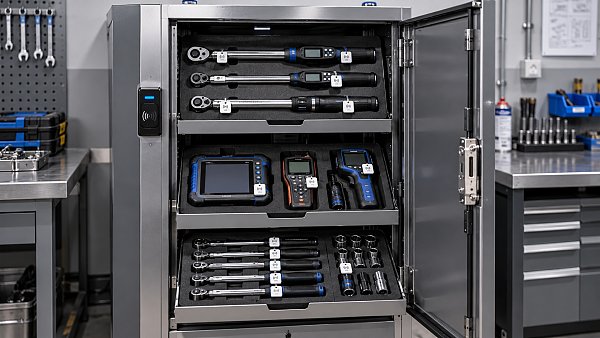
Tag attachment deserves equal attention. A detached tag left inside the cabinet can create a misleading inventory record. The attachment method should withstand expected cleaning, abrasion, and handling without affecting equipment safety, warranties, or calibration requirements.
RFID is not always the best answer. Individually sensed slots can suit fixed tool sets; barcode scanning may be adequate for lower-volume stores. Weight sensing can flag a discrepancy but usually cannot independently establish asset identity. Select the least complicated method that provides the evidence the operation needs.
Make offline behavior and emergency access explicit
“Works offline” can mean several things: existing users can authenticate locally, transactions are buffered, or only an administrator can open the cabinet. Ask suppliers to describe exactly what remains available when the network, cloud service, authentication service, or local power supply fails.
Local authorization creates a trade-off. It supports continuity, but a disconnected controller may retain permissions that have since been revoked centrally. Specify which assets remain available offline, how cached permissions expire, and what happens when event storage fills. On reconnection, records must reconcile without silently losing transactions or issuing duplicate events.
Emergency access is another separate decision. Depending on the assets, power loss may need to leave storage secured while permitting controlled mechanical release. Confirm the actual lock behavior rather than relying on “fail-safe” or “fail-secure” terminology alone. Those terms do not explain the complete recovery procedure.
Override keys need named custodians, controlled duplication, and a procedure for reconciling inventory afterward. Battery backup should be assessed against the expected outage and operating load, including readers, controllers, communications, and lock actuation—not just idle consumption.
Require usable audit trails and a clear integration boundary
A useful audit trail separates access requests, authorization decisions, door events, asset movements, alarms, and administrative changes. Look for records showing who changed permissions, who overrode a restriction, and whether a transaction occurred offline. Reliable timestamps and clear asset identifiers matter more than an impressive dashboard.
Ask the supplier to reconstruct a disputed return from exported records. Can an investigator distinguish “door opened” from “asset detected”? Can corrections be traced without erasing the original event? Logs support accountability, but they should not be treated as conclusive proof of individual conduct when detection or credential-sharing limitations remain.
Integration with existing access control should define the system of record for identities and permissions. A connector that imports names once is not equivalent to ongoing provisioning and revocation. Confirm synchronization delays, failure alerts, API licensing, and responsibility when software versions change.
Cybersecurity review should cover unique device credentials, encrypted communications, administrator privileges, update authenticity, support periods, and vulnerability handling. Establish who can access the cabinets remotely and how that access is approved and logged. For employee activity records and biometric templates, determine retention, deletion, hosting, and applicable privacy requirements before deployment.
Use a pilot to expose recovery work, not just normal operation
A useful pilot includes normal workload and deliberate exceptions. Define acceptance criteria before testing so that a smooth demonstration does not substitute for evidence. The following checks reveal different weaknesses:
- Revoke a user, then test access online and during disconnection to verify the documented authorization policy.
- Remove several assets and return only some, checking whether the remaining loan records stay accurate.
- Interrupt power during a transaction and compare the physical inventory with recovered records.
- Attempt a return with an unreadable tag or an obstructed door, checking whether uncertainty is clearly reported.
- Replace a reader or controller and verify configuration recovery, credential protection, and retained history.
Measure transaction time during a realistic shift handover, not only with one trained operator. Slow authentication or repeated inventory rescans can encourage users to leave doors open or exchange tools outside the system. Exception handling should be tested by ordinary supervisors, not only by the supplier’s technician.
Compare lifecycle costs alongside purchase prices: software subscriptions, integration maintenance, replacement tags, spare locks, battery service, training, and support response. Confirm whether records remain exportable after contract termination and whether a failed component disables one compartment or the whole installation.
The better intelligent storage security solutions are not necessarily those with the most identification technologies. Favor the system that demonstrates the required physical protection, records asset movements with understood limitations, and gives staff a controlled way to recover when something goes wrong. Before approval, require the supplier to show that recovery on your equipment, with your users, under your operating conditions.
Have questions about this sector analysis, or seeking best practices specific to your niche? Drop us a line below and let the senior consultants at MHLS assist you.
We respect your privacy. Your information is strictly confidential.
Recommended News
 JR East Plans UWB Walk-Through Gates at 40 Stations in Spring 2028Access Control StrategistJR East plans UWB walk-through gates at 40 stations in spring 2028. Explore the rollout timeline and what suppliers should watch.
 Bank Vault Security Standards: UL and EN Ratings ExplainedVault Structural ArchitectExplore bank vault security standards and learn how UL 608 classes and EN 1143-1 grades differ, what they test, and how to verify certification before you buy.
 Mechanical Lock Hardware Prices: What Buyers Should Budget for Bulk OrdersMr. Gideon CrossMechanical lock hardware price is just the starting point. Discover what drives bulk-order costs and how to compare supplier quotes with confidence.
 IndexBox Forecasts Steady Global Security Keypad Market Growth Through 2035Dr. Valerius ThorneGlobal security keypad market growth is forecast at 3.3% annually through 2035. Explore the smart home and replacement trends shaping demand.
 Choosing an Infrared Safety Sensors Manufacturer: What Buyers Should CheckUnmanned Terminal FellowChoosing an infrared safety sensors manufacturer? Compare safety evidence, integration, environmental performance and lifecycle costs before you buy.
 Choosing a Security Material Testing Service: What to Check for Lock and Safe MaterialsProf. Elara SterlingChoose a security material testing service with confidence. Learn what to check for lock and safe materials, from attack methods and accreditation to reliable reports.
 How Precision Anti-Pick Lock Cylinders Resist ManipulationSecurity Metallurgy ExpertDiscover how precision anti-pick lock technology resists manipulation, and learn what to check when comparing security features, test evidence, and everyday reliability.
 Dermalog Joins NIST FastCAP Program for Contactless Fingerprint TestingProf. Elara SterlingDermalog joins the NIST FastCAP program for contactless fingerprint testing. Discover what this means for biometric identification and digital identity.
 Choosing Security Export Compliance Services: What Providers Should CoverMr. Gideon CrossSecurity export compliance services can help prevent costly delays. Discover what to look for in classification, licensing, screening, and documentation.
 European Security Compliance Standards for Safes: EN 1143-1 vs EN 14450Dr. Valerius ThorneExplore security compliance standards Europe buyers need to know. Compare EN 1143-1 and EN 14450 to choose the right safe with confidence.
 HID Global Acquires inepro ID to Expand RFID and BLE Access SolutionsUnmanned Terminal FellowHID Global acquires inepro ID to expand RFID and BLE access solutions for printers, smart lockers and shared devices. Explore what the deal could mean for your organization.
 Choosing Networked Hotel Lock Systems: Connectivity, Integration and SecurityBiometric Auth ScientistCompare networked hotel lock systems by connectivity, PMS integration and security. Learn what to test before choosing a system for your property.