
Courier Access Control for High-Rise Mailrooms: A Safer Delivery Workflow
Courier access control for high-rise mailrooms works best when delivery access is treated as a short, traceable building event rather than a broad permission to enter. A courier needs enough access to complete a handoff, but not a route through residential floors, amenities, plant rooms, or private storage areas. The delivery workflow should therefore define where identity is checked, which door unlocks, how long that permission remains active, where parcels are placed, and what record remains after the door closes.
The most effective arrangement separates the building into delivery zones. The public entrance, reception point, secure mailroom, parcel locker bank, loading area, lift lobby, and residential corridors should not automatically share the same access rule. A door that is appropriate for a courier during an active delivery window may be inappropriate once the parcel has been deposited. This distinction reduces the common weakness of using one temporary credential to open multiple unrelated doors.
Start with the delivery path, not the access device
A high-rise property can have a well-specified card reader, intercom, camera, or electronic lock and still create avoidable exposure if the physical route is poorly defined. The delivery path should be mapped from arrival to exit, including the points at which a courier waits, presents a credential, crosses a controlled opening, deposits a package, and leaves the building.
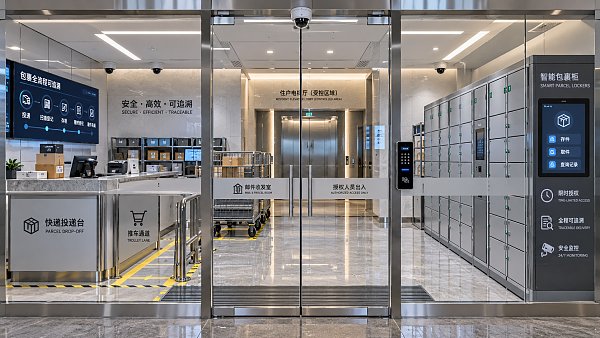
For many buildings, the preferred path is entrance or loading bay to a controlled mailroom, followed by immediate exit through the same monitored route. This keeps delivery activity away from apartment corridors. Where a dedicated mailroom cannot be reached without using a lift, lift access should be limited to the mailroom level or service level. Granting unrestricted lift selection because the mailroom is on an upper floor defeats the purpose of controlling the entrance.
Physical layout changes the correct design. A mailroom beside the lobby can often use a supervised door and a parcel drop counter. A room reached through a rear corridor needs clearer wayfinding, camera coverage at decision points, and a reliable return path so couriers do not test adjacent doors. In a tower with a shared loading dock, access control must distinguish between delivery personnel arriving at the dock and people entering from a tenant parking area. These routes may join at the same door, yet their identity verification and supervision conditions are different.
Before selecting credentials, record practical constraints: expected parcel volume peaks, whether oversized items are common, the number of courier firms arriving within the same period, door opening direction, fire egress requirements, network availability in the loading zone, and the time needed to move from entry to mailroom. A short unlock duration that works for a document envelope may fail when a person is moving a wheeled cart through a heavy fire-rated door. Extending the timer without reviewing the door and route, however, can create an open-door opportunity that is much longer than the delivery task requires.
Verify identity at the point where access begins
Intercom calls alone provide weak assurance when the person at the entrance is not visually verified. A resident may approve a call without seeing the caller clearly, may misunderstand which door is being released, or may be unavailable during a busy delivery period. The resulting access event is difficult to connect to a specific parcel handoff.
A stronger workflow uses a combination of scheduled delivery context, visual verification, and a limited credential. The courier can be expected through a delivery appointment, a building-issued invitation, a dispatch reference, or an attended reception process. The objective is not to force every delivery into one rigid method. It is to prevent an unidentified visitor from receiving the same access path as a verified delivery person.
Temporary mobile credentials are useful when they are issued for a defined route, time interval, and purpose. The credential should unlock only the necessary entrance and mailroom doors. It should expire automatically after the assigned period and should not become reusable simply because a delivery was delayed. A delayed courier may need a new authorization or a revised time window; extending an old credential indefinitely removes the value of time-limited access.
QR codes and PINs require particular care. A static QR code on a printed notice can be photographed or forwarded. A shared PIN leaves little evidence of which individual used it. Where these methods are necessary, they are safer when linked to a narrow time window, a single delivery task, and a camera-observed door. The system record should show the credential identifier, door, opening time, and result. It should not rely on a generic event such as “delivery access granted,” which is too vague to reconstruct an incident.
Access duration should reflect the actual handoff
Timing is often configured as a convenience setting, but it is a control parameter. There are two separate intervals: the door release time and the authorization window. The first is the number of seconds during which the lock permits passage. The second is the period during which a credential remains valid. Treating them as the same setting causes errors.
A mailroom door may release briefly while the credential remains valid long enough for a courier to make several legitimate trips between a cart and the room. If the building permits repeated entries during that period, each opening should be logged. If only one entry is intended, the workflow needs a clear alternative for bulky deliveries rather than an improvised habit of propping the door open.
Keep the mailroom secure after the courier enters
The access-controlled door is only one part of the mailroom boundary. A room with an unlocked internal exit, an unprotected adjacent storage door, or a direct opening into a residential corridor can still permit unauthorized movement. Doors should be reviewed as a sequence: approach side, controlled opening, room interior, secondary exits, and nearby spaces that can be entered after a parcel is deposited.
Door hardware must match the use of the opening. A high-traffic mailroom door may need a commercial-grade closer, latch monitoring, and an electric locking arrangement suitable for its fire and life-safety function. A weak closer or misaligned strike can produce recurrent “door forced” or “door held” alarms that are actually caused by latch failure. Repeated nuisance events are damaging because they train staff to disregard a condition that could later indicate real unauthorized entry.
Tailgating deserves a separate assessment. A camera aimed only at the exterior face of the door may show the credential presentation but not whether another person passed through on the same release. For a narrow, lightly used mailroom entrance, a correctly placed camera and a self-closing door may be sufficient. For a busy lobby where delivery personnel and residents converge, a vestibule, monitored reception point, or controlled lane may be needed to stop an authorized opening from becoming shared entry.
Anti-tailgating sensors can add value, but their output must be interpreted in context. A second detection during a wide parcel-cart passage can be a legitimate obstruction rather than a second person. Conversely, a door held open without an alarm may result from a sensor installed too far from the threshold or configured with a delay that masks brief following events. Commissioning should test actual delivery movements, including carts, stacked parcels, mobility devices, and people approaching from both sides of the door.
Make package traceability separate from door access
A valid access event does not prove that a parcel reached the correct location, and a parcel scan does not prove that the courier used an authorized route. These are related records with different purposes. Door events establish movement through a controlled boundary. Parcel records establish custody, location, and notification status. Combining them conceptually is useful; treating one as proof of the other creates blind spots.
Where a smart parcel locker is installed, the handoff process should confirm the compartment selection, door closure, and parcel association before the courier leaves. A compartment that appears closed but has not latched is a different fault from a locker door that never received an unlock command. The first concerns mechanical closure or obstruction; the second may concern power, communication, credential validation, or controller status. These faults require different corrective actions and should not be logged under one generic “locker unavailable” category.
Open shelving requires a stricter room-access process because it offers little parcel-level accountability after delivery. The building may record a courier entering the mailroom, but it cannot establish which package was left on which shelf unless a scan, photo record, shelf identifier, or supervised acceptance step exists. This does not mean open shelving is unusable. It means the room itself must provide the custody boundary, with clear delivery zones, controlled access, and prompt resident notification.
Resident privacy should also shape the record design. Access logs need enough detail to investigate a delivery issue, but broad exposure of resident names, unit numbers, delivery contents, or contact details on a lobby screen creates another form of risk. Courier-facing interfaces should reveal only the information needed to complete the delivery route. Detailed delivery records should remain within the access control, parcel management, or property management environment with role-appropriate visibility.
Test exceptions before they become informal workarounds
Most failures occur during exceptions: a courier arrives early, the mailroom is full, a parcel is too large for the locker, a mobile credential cannot be retrieved because of poor signal, or a lobby door is held by another visitor. When the approved workflow cannot handle these conditions, people create shortcuts such as leaving doors unsecured, accepting parcels in unmonitored areas, or using a shared staff credential.
Each exception needs a defined disposition. An oversized item may be redirected to an attended service point. A full locker bank may trigger a controlled shelf placement process rather than a forced compartment closure. A credential failure may require visual confirmation at an intercom or reception desk, with the manually granted door event recorded. The response should preserve the same boundaries as the normal path: verified identity, limited movement, a documented handoff, and a secure exit.
Testing should include more than successful unlocks. Verify that an expired credential is rejected, that a cancelled invitation stops working, that forced-door and held-door events reach the correct monitoring point, and that the door re-latches after a cart passes through. Review what happens during controller outage, network interruption, power loss, and fire alarm release. Fail-safe or fail-secure behavior must be compatible with the opening’s life-safety requirements while avoiding a prolonged uncontrolled route into residential areas.
Use event reviews to find configuration drift
Access systems gradually drift away from their intended workflow. A temporary courier group remains active, an old PIN is retained for convenience, a mailroom door timer is increased after one difficult delivery, or an adjacent door is added to the same access group without considering the route. These changes rarely look serious in isolation. Together, they can turn a restricted delivery path into broad building access.
Periodic review should compare configured permissions with the current delivery route and physical layout. Look for credentials with unusually long validity, door events outside expected delivery periods, repeated rejected attempts, frequent held-open signals, manual overrides, and access to doors that are not necessary for package placement. Camera footage is most useful when it is reviewed against a specific anomaly, such as a credential opening a door repeatedly without a corresponding delivery or a mailroom door remaining open after a recorded exit.
A safer workflow remains practical when every delivery has a short path, every exception has a controlled alternative, and every access event leaves enough evidence to distinguish a routine handoff from an unexplained entry.
Have questions about this sector analysis, or seeking best practices specific to your niche? Drop us a line below and let the senior consultants at MHLS assist you.
We respect your privacy. Your information is strictly confidential.
Recommended News
 Physical Security System Engineering: From Risk Assessment to System DesignUnmanned Terminal FellowExplore physical security system engineering, from risk assessment to integrated design, procurement and testing. Build a safer, more resilient facility.
 Apple Home Collection Smart Lock and Other Accessories Open for Preorder November 13Biometric Auth ScientistApple Home Collection preorders open November 13, 2026. Explore the LG smart lock’s Matter and Aliro support and what buyers should verify before ordering.
 Choosing Servo-Driven Flap Barriers: Throughput, Safety and Access ControlAccess Control StrategistServo-driven flap barriers can balance throughput, safety and access control. Discover how to compare lanes, test performance and choose with confidence.
 Parcel Locker Network Pricing: Setup Costs, Fees and Contract TermsUnmanned Terminal FellowCompare parcel locker networks pricing, from setup costs and recurring fees to contract terms. Discover hidden charges and choose the right model.
 JR East Plans UWB Walk-Through Gates at 40 Stations in Spring 2028Access Control StrategistJR East plans UWB walk-through gates at 40 stations in spring 2028. Explore the rollout timeline and what suppliers should watch.
 Bank Vault Security Standards: UL and EN Ratings ExplainedVault Structural ArchitectExplore bank vault security standards and learn how UL 608 classes and EN 1143-1 grades differ, what they test, and how to verify certification before you buy.
 Mechanical Lock Hardware Prices: What Buyers Should Budget for Bulk OrdersMr. Gideon CrossMechanical lock hardware price is just the starting point. Discover what drives bulk-order costs and how to compare supplier quotes with confidence.
 IndexBox Forecasts Steady Global Security Keypad Market Growth Through 2035Dr. Valerius ThorneGlobal security keypad market growth is forecast at 3.3% annually through 2035. Explore the smart home and replacement trends shaping demand.
 Choosing an Infrared Safety Sensors Manufacturer: What Buyers Should CheckUnmanned Terminal FellowChoosing an infrared safety sensors manufacturer? Compare safety evidence, integration, environmental performance and lifecycle costs before you buy.
 Choosing a Security Material Testing Service: What to Check for Lock and Safe MaterialsProf. Elara SterlingChoose a security material testing service with confidence. Learn what to check for lock and safe materials, from attack methods and accreditation to reliable reports.
 How Precision Anti-Pick Lock Cylinders Resist ManipulationSecurity Metallurgy ExpertDiscover how precision anti-pick lock technology resists manipulation, and learn what to check when comparing security features, test evidence, and everyday reliability.
 Dermalog Joins NIST FastCAP Program for Contactless Fingerprint TestingProf. Elara SterlingDermalog joins the NIST FastCAP program for contactless fingerprint testing. Discover what this means for biometric identification and digital identity.











