
What Drives Electronic Locking Systems Price in Commercial Security Projects?
What Drives Electronic Locking Systems Price in Commercial Security Projects?
In commercial security projects, electronic locking systems price is shaped by far more than the device itself. Procurement teams must evaluate security grade, integration complexity, credential technology, installation scale, compliance needs, and long-term maintenance risk. Understanding these cost drivers helps business evaluators compare suppliers more accurately, control total ownership cost, and choose locking solutions that match both operational demands and security performance.
If you are reviewing bids, one practical mistake to avoid is treating all electronic locks as interchangeable line items. They are not. A lock for an office interior door, a server room, a pharmacy cabinet, a parcel locker bank, and a restricted industrial gate may all be called “electronic locking systems,” but the cost logic behind them is completely different. The fastest way to lose budget control is to compare only unit price and ignore where the project will spend money later.
Start With the Security Level, Not the Hardware List
Price usually moves first with the required protection level. A basic electronic latchset for low-risk internal access is one thing. A lock expected to resist forced entry, credential abuse, tampering, and heavy daily traffic is another. In practice, buyers often overpay for feature-rich locks in low-risk areas and under-specify protection in critical zones.
Before comparing quotations, pin down these questions:
- Is the opening protecting convenience, assets, regulated materials, or life-safety-sensitive areas?
- Does the site need audit trails, dual authorization, anti-passback logic, or time-based permissions?
- What is the expected attack profile: casual misuse, insider abuse, or deliberate intrusion?
- Will the opening be connected to a larger access control environment?
If suppliers are not quoting against the same security assumptions, the pricing spread will look confusing. It is not always because one vendor is expensive and another is efficient. Sometimes they are pricing different levels of risk containment.
Credential Method Changes the Cost More Than Many Buyers Expect
Card, PIN, mobile credential, fingerprint, palm vein, and multi-factor access all pull pricing in different directions. The reader hardware itself is only part of it. Credential issuance, software licensing, enrollment workflow, user support, replacement policy, and privacy handling can become larger cost drivers than the lock body.
For example, PIN-based access looks inexpensive at the start, but in shared commercial environments it often creates management overhead because codes are reused, informally shared, or changed too infrequently. Mobile credentials may reduce physical card handling, but they can add subscription cost and platform dependency. Biometric options can improve accountability, yet they also require closer review of template management, environmental fit, and local compliance handling. Those decisions should never be made from brochure language alone.
A useful checkpoint: ask each supplier to separate hardware price from credential lifecycle cost over three to five years. If they cannot, your comparison is still too shallow.
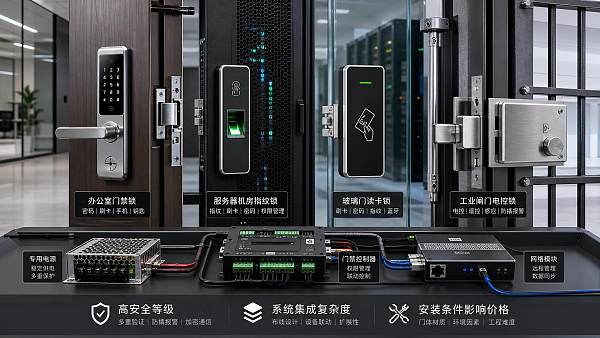
Door Type and Mechanical Conditions Quietly Drive the Budget
This is where many commercial estimates start to drift. The lock may be suitable in theory, but the actual door, frame, power transfer path, and usage pattern make the installation more complex. Retrofitting an electronic lock onto an existing timber office door is very different from securing a steel fire-rated door, a glass entry system, a high-cycle turnstile side gate, or a parcel locker compartment bank.
Check the physical conditions early:
- Door material, thickness, handing, and frame condition
- Fire-rating status and any restrictions on field modification
- Need for electric strikes, maglocks, mortise locks, cabinet locks, or multi-point mechanisms
- Concealed wiring versus surface cable route
- Power transfer hardware, door loop, hinge preparation, or wireless alternatives
- Cycle frequency and wear expectations
When a quote looks unusually low, this is one of the first places to investigate. Some suppliers price the electronics attractively, then leave site adaptation, door preparation, and third-party hardware outside the base scope.
Integration Is Often the Real Price Multiplier
In standalone deployments, electronic locking systems price may remain relatively straightforward. Once the project needs to connect with access control software, alarm monitoring, visitor management, elevator control, building management, or smart locker platforms, cost usually rises fast.
That increase is not just “integration cost” in the abstract. It shows up in controllers, gateways, protocol compatibility, software setup, API work, testing time, cybersecurity review, and fault diagnosis when something does not behave as expected. A lock that is inexpensive as hardware can become expensive inside a mixed-vendor system.
Ask very plain questions:
- Is the lock native to the planned access control platform, or does it need middleware?
- Who owns firmware coordination and version compatibility?
- What functions are actually supported after integration: lock/unlock only, or full events, schedules, remote override, battery status, and alarm linkage?
- Who is responsible for commissioning when several vendors are present on site?
A supplier saying “integration available” is not enough. In commercial procurement, partial integration can be more troublesome than no integration, because it creates expectations that operations later discover are missing.
Wireless vs Wired Is a Cost Decision, Not Just a Technical Preference
Wireless locks can reduce cabling labor, speed retrofit projects, and help on heritage or finished interiors where wiring is disruptive. But they shift cost into batteries, communication reliability planning, gateway placement, and maintenance routines. Wired locks usually carry more installation burden at the start but may deliver stronger power stability and simpler long-term monitoring in some environments.
There is no universal winner here. In a multi-floor office retrofit, wireless may be the sensible commercial choice. In a critical infrastructure room with strict uptime expectations, buyers often lean toward wired architecture because maintenance tolerance is lower. The important part is to price both the installation model and the support model, not just the lockset.
Compliance, Certification, and Market Access Requirements Matter
For international or regulated projects, compliance can change supplier eligibility and pricing quickly. Fire door compatibility, emergency egress requirements, electrical safety expectations, data handling obligations for biometric systems, and local building code review can all affect the final solution. Exact applicable standards depend on market and use case, so buyers should verify project-specific requirements before locking the specification.
This is also where some quotations become misleading. A vendor may offer a technically similar product at a lower price, but the documentation package, listing status, test evidence, or regional approval trail may be incomplete. If the project requires compliance review by consultants, insurers, or authorities having jurisdiction, incomplete paperwork becomes a real cost item, even before hardware issues appear.
Where information is unclear, mark it for procurement review as 【待核实】 rather than assuming equivalence.
Volume Helps, but Only When the Scope Is Clean
Commercial buyers often expect major unit-price improvement once project quantity rises. Sometimes that happens. Sometimes it does not, especially when the site mix includes different door types, different user groups, phased delivery, or custom firmware and credential rules.
A 200-door project with five standardized configurations is easier to price and support than a 60-door project with twenty exceptions. Standardization usually saves more money than headline volume. If you want better pricing, reduce unnecessary variation: lock function, finish, credential logic, and mounting format.
Do Not Ignore Maintenance, Because That Is Where Cheap Systems Get Expensive
A low purchase price can still produce a poor commercial decision if batteries are difficult to replace, firmware updates require on-site specialist visits, or spare parts are tied to a single channel with long lead times. Business evaluators should look beyond capex and ask what the lock fleet will cost to keep working without disruption.
Good questions here are simple and revealing. How is low-battery status reported? Can failed units be replaced without full re-enrollment? Are cylinders, readers, boards, or power modules field-serviceable? What is the practical warranty process for exported projects? If the answer to every service question is “contact factory,” the system may be cheap only on paper.
Watch the Scope Gaps in Tender Comparison
When buyers say electronic locking systems price varies wildly between vendors, the reason is often hidden scope. One quote includes readers, controllers, software seats, door position monitoring, request-to-exit devices, power supplies, and commissioning. Another includes only the lock hardware. Both are presented as a “system price.”
Force the comparison into a bill-of-scope view. Ask every bidder to identify included hardware, excluded hardware, software licenses, credential quantities, installation assumptions, testing responsibility, training, and after-sales support. That exercise usually narrows the apparent price gap very quickly.
A Practical Shortlist Before You Approve the Buy
- Match each opening to a real risk category instead of applying one lock type everywhere.
- Separate hardware cost from software, credential, installation, and service cost.
- Confirm what the system can actually do after integration, not what the brochure implies.
- Check whether the quoted solution fits the actual door and frame conditions on site.
- Review compliance documents early, especially for fire doors, emergency egress, and biometric handling.
- Reduce configuration variety before negotiating price.
- Ask how the system will be maintained over years, not just how it will be installed in month one.
That is usually where sound procurement decisions get made. Not by chasing the lowest lock price, but by understanding which cost drivers are structural, which are avoidable, and which are signs that the project scope is still immature. For commercial teams evaluating suppliers, that clarity is what turns electronic locking systems price from a confusing number into a decision you can defend later.
Have questions about this sector analysis, or seeking best practices specific to your niche? Drop us a line below and let the senior consultants at MHLS assist you.
We respect your privacy. Your information is strictly confidential.
Recommended News
 Physical Security System Engineering: From Risk Assessment to System DesignUnmanned Terminal FellowExplore physical security system engineering, from risk assessment to integrated design, procurement and testing. Build a safer, more resilient facility.
 Apple Home Collection Smart Lock and Other Accessories Open for Preorder November 13Biometric Auth ScientistApple Home Collection preorders open November 13, 2026. Explore the LG smart lock’s Matter and Aliro support and what buyers should verify before ordering.
 Choosing Servo-Driven Flap Barriers: Throughput, Safety and Access ControlAccess Control StrategistServo-driven flap barriers can balance throughput, safety and access control. Discover how to compare lanes, test performance and choose with confidence.
 Parcel Locker Network Pricing: Setup Costs, Fees and Contract TermsUnmanned Terminal FellowCompare parcel locker networks pricing, from setup costs and recurring fees to contract terms. Discover hidden charges and choose the right model.
 JR East Plans UWB Walk-Through Gates at 40 Stations in Spring 2028Access Control StrategistJR East plans UWB walk-through gates at 40 stations in spring 2028. Explore the rollout timeline and what suppliers should watch.
 Bank Vault Security Standards: UL and EN Ratings ExplainedVault Structural ArchitectExplore bank vault security standards and learn how UL 608 classes and EN 1143-1 grades differ, what they test, and how to verify certification before you buy.
 Mechanical Lock Hardware Prices: What Buyers Should Budget for Bulk OrdersMr. Gideon CrossMechanical lock hardware price is just the starting point. Discover what drives bulk-order costs and how to compare supplier quotes with confidence.
 IndexBox Forecasts Steady Global Security Keypad Market Growth Through 2035Dr. Valerius ThorneGlobal security keypad market growth is forecast at 3.3% annually through 2035. Explore the smart home and replacement trends shaping demand.
 Choosing an Infrared Safety Sensors Manufacturer: What Buyers Should CheckUnmanned Terminal FellowChoosing an infrared safety sensors manufacturer? Compare safety evidence, integration, environmental performance and lifecycle costs before you buy.
 Choosing a Security Material Testing Service: What to Check for Lock and Safe MaterialsProf. Elara SterlingChoose a security material testing service with confidence. Learn what to check for lock and safe materials, from attack methods and accreditation to reliable reports.
 How Precision Anti-Pick Lock Cylinders Resist ManipulationSecurity Metallurgy ExpertDiscover how precision anti-pick lock technology resists manipulation, and learn what to check when comparing security features, test evidence, and everyday reliability.
 Dermalog Joins NIST FastCAP Program for Contactless Fingerprint TestingProf. Elara SterlingDermalog joins the NIST FastCAP program for contactless fingerprint testing. Discover what this means for biometric identification and digital identity.











