CPSC Tightens EMI Rules for Smart Locks
On July 26, 2026, the U.S. Consumer Product Safety Commission (CPSC) updated its smart lock safety compliance guidance and set a new compliance threshold for selected connected lock categories entering the U.S. market. The change draws immediate attention from smart lock manufacturers, exporters, certification teams, buyers, and supply chain operators because it links market access to strengthened EMI testing under FCC Part 15B and UL 2067, with a near-term implementation date of October 1, 2026 and direct implications for certification planning and delivery schedules, especially for Chinese exporters.
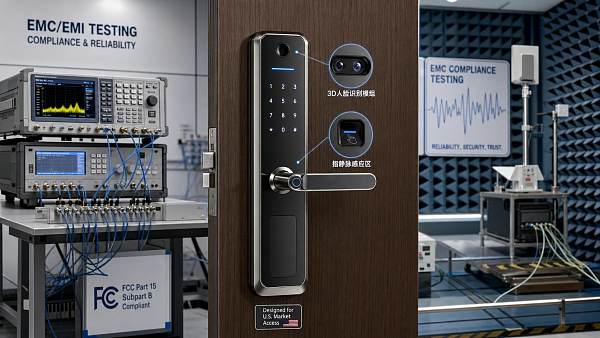
What the Updated U.S. Requirement Now Covers
According to the information provided, the CPSC issued an emergency update to its Smart Lock Safety Compliance Guide on July 26, 2026. Starting October 1, 2026, all networked hotel locks, 3D facial smart locks, and finger-vein locks entering the U.S. market must pass enhanced joint EMI testing under FCC Part 15B and UL 2067.
The updated requirement adds a misunlock rate limit of no more than 0.001% in coexistence scenarios involving 5G millimeter-wave bands from 24 to 28 GHz and Wi-Fi 7. The information provided also states that this requirement directly affects the certification route and delivery lead times of Chinese exporters.
Where the Pressure May Appear Across the Supply Chain
Export-facing product teams will need to reassess compliance pathways
From an industry perspective, companies shipping affected smart lock products to the United States may face the most immediate impact at the certification stage. The reason is straightforward: the updated rule ties U.S. market entry to a more demanding combined FCC Part 15B and UL 2067 EMI test requirement. What deserves closer attention is whether existing certification plans, test sequencing, and model rollout schedules remain usable under the October 1 deadline.
Manufacturing and project delivery functions may see tighter scheduling risk
Analysis shows that the rule matters not only to compliance staff but also to factories and delivery coordinators. If a product falls within the covered categories, the need to complete enhanced EMI validation before shipment can affect production release timing, export documentation preparation, and customer delivery commitments. The stated impact on lead times is therefore a practical issue rather than a purely regulatory one.
Buyers and channel-side participants may need earlier specification checks
For buyers, distributors, and project-side procurement teams handling U.S.-bound smart lock products, the key issue is product eligibility under the new guidance. Observably, products used in hospitality and higher-end biometric access scenarios may require earlier confirmation of testing status, because the rule specifically names networked hotel locks, 3D facial smart locks, and finger-vein locks. The operational concern is whether an ordered model can still move through the intended certification and shipment window.
Certification and supply chain service providers may face coordination pressure
Service providers involved in testing, certification support, logistics coordination, and export documentation may also be affected. Analysis shows that once a rule changes close to an enforcement date, coordination gaps can become costly. In this case, the pressure point is likely to be document readiness, test scheduling, and alignment between technical files and customer delivery expectations.
What Companies Should Watch Right Now
Track any further official wording around scope and execution
What deserves closer attention is the exact interpretation of scope in practical compliance work. The provided information confirms the covered product categories and the test framework, but companies should continue watching for any further official wording that clarifies execution details, documentation expectations, or implementation nuances before October 1, 2026.
Review affected models against the new coexistence test conditions
For companies already serving the U.S. market, the immediate operational question is which existing or pending models fall into the named categories and therefore require the strengthened EMI route. The added misunlock threshold under 5G millimeter-wave and Wi-Fi 7 coexistence conditions means the review cannot stay at a general product level; it needs to be tied to the specific models intended for shipment.
Recheck lead-time commitments with customers and internal teams
Because the provided information explicitly notes an effect on certification pathways and delivery timing, firms should examine whether current shipment promises, procurement planning, and project milestones still match the new testing requirement. This is particularly relevant where customer acceptance, booking windows, or installation plans are tied to fixed delivery dates.
Prepare supporting files and supplier communication early
Analysis shows that regulatory changes with short implementation windows often become execution problems when internal and external parties work from different assumptions. Companies involved in U.S.-bound shipments should therefore focus on practical readiness: supplier alignment, model lists, certification file status, and customer communication regarding possible timeline adjustments.
Why This Reads as More Than a Routine Update
Observably, this development is not just a wording change in compliance guidance. It links electromagnetic interference resilience to a concrete misunlock limit in specific coexistence scenarios, which raises the operational relevance of EMI performance for smart access products. It is more appropriate to understand this as an actionable near-term compliance change with broader signaling value, rather than as a fully settled long-term market outcome.
Analysis shows that the industry should be careful not to overread the event. The confirmed facts are limited to the updated guidance, the covered product categories, the new test elements, the October 1, 2026 implementation date, and the stated effect on Chinese exporters' certification and delivery timelines. Even so, the rule is a clear indication that connected lock performance under increasingly complex wireless environments is receiving closer regulatory attention.
How the Market Should Read the Change for Now
At this stage, the update is best understood as an immediate compliance and delivery issue for affected smart lock categories entering the United States, especially where export schedules are already in motion. It also serves as a regulatory signal that testing expectations are becoming more specific in coexistence scenarios involving newer wireless environments.
A neutral reading is more appropriate than a dramatic one. The rule has a defined scope and a defined start date, but the full business impact will depend on how companies map their covered products, organize certification work, and manage customer timelines over the coming months.
Basis of This Article and What Still Needs Verification
This article is based on the user-provided news title, event date, and event summary concerning the CPSC update issued on July 26, 2026. In coverage of developments like this, relevant source types would typically include official notices, company disclosures, industry association updates, authoritative media reporting, and standards-related documents.
No specific official source link was provided in the input, so the exact source document and any subsequent clarifications still need ongoing verification. What deserves continued attention is whether additional official wording emerges on implementation details, scope interpretation, and practical certification handling before the October 1, 2026 effective date.
Recommended News
 Macao Consumer Council Publishes Smart Lock Test Report, Urges Data ProtectionBiometric Auth ScientistMacao Consumer Council’s smart lock test report helps buyers make informed choices. Explore the findings and practical data protection tips for safer smart home use.
 Anti-Drill Lock Cylinders: How Hardened Inserts Resist Drilling AttacksSecurity Metallurgy ExpertExplore anti-drill lock technology for cylinders: discover how hardened inserts, secure placement, and verified testing help you choose reliable protection. Read the guide.
 What Is Physical Security Infrastructure? Core Systems for Commercial BuildingsUnmanned Terminal FellowExplore physical security infrastructure for commercial buildings, from locks and access control to cameras and alarms. Learn how to spot gaps and prioritize smarter upgrades.
 What Is Physical Security Infrastructure? Core Systems for Commercial BuildingsUnmanned Terminal FellowExplore physical security infrastructure for commercial buildings, from locks and access control to cameras and alarms. Learn how to spot gaps and prioritize smarter upgrades.
 What Is Physical Security Infrastructure? Core Systems for Commercial BuildingsUnmanned Terminal FellowExplore physical security infrastructure for commercial buildings, from locks and access control to cameras and alarms. Learn how to spot gaps and prioritize smarter upgrades.
 September Smart Lock Sales Fall; Xiaomi Leads Volume, Desman Revenue Under PressureBiometric Auth ScientistChina smart lock sales fell in September 2026, with Xiaomi leading volume and Desman revenue under pressure. Explore key market figures and insights for smarter pricing and procurement.
 EN 1143-1 Burglary Resistance Grades: What the Ratings Mean for SafesDr. Valerius ThorneEN 1143-1 burglary resistance grades explained: compare safe ratings, verify certification, and understand installation requirements to choose the right protection. Read before you buy.
 Sourcing Security Hardware from China: Supplier Checks to Reduce Supply Chain RiskMr. Gideon CrossNavigate the security hardware supply chain China offers with practical supplier checks. Learn to verify compliance, control substitutions, and reduce costly sourcing risks before you buy.
 Biometric Lock Reliability Testing: False Rejects, Wear, and WeatherProf. Elara SterlingExplore biometric lock reliability testing for false rejects, wear, and weather. Learn which metrics and test evidence help you compare suppliers and choose dependable, secure access.
 Certification Suspended for Six Zhenyuan Fire Door ProductsDr. Valerius ThorneSix Zhenyuan fire door products face certification suspension. Discover what buyers should verify and why certification status matters before making procurement decisions.
 How Should Parcel Lockers Handle Offline Access and Post-Outage Data Sync?Unmanned Terminal FellowWhat should happen when a parcel locker loses network connection? Discover secure offline access, reliable event logging, and post-outage sync strategies to protect parcels and prevent conflicts.
 SnapSafe Launches Premium Vault Door With 12-Gauge Steel and UL-Certified LockVault Structural ArchitectExplore the SnapSafe Premium vault door with 12-gauge steel, nine locking bolts and a UL-certified electronic lock. See how its inward-opening design fits your safe room.